
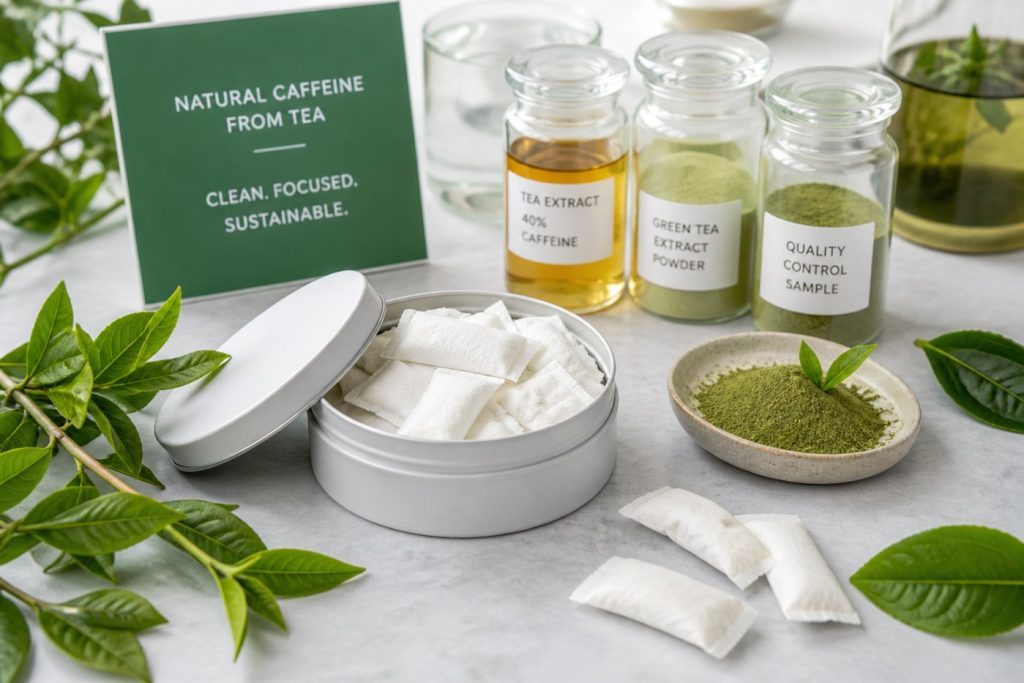
“Natural caffeine from tea” is a sourcing and formulation claim, not just a flavor idea. The manufacturer needs a documented caffeine source, controlled assay and a complete calculation of caffeine per pouch. Tea powder, tea extract and purified tea-derived caffeine behave differently in the blend.
Choose the Tea Ingredient for the Job
Tea powder brings botanical identity, color and bulk. Standardized extract can deliver a defined range while adding carrier and taste. More purified tea-derived caffeine may offer a cleaner dose but needs clear source documentation. Compare materials on active basis, not price per kilogram.
Build a Defensible Caffeine Calculation
Record caffeine assay for each contributing ingredient and calculate the result per pouch and daily serving. If multiple tea or guarana ingredients are used, include all sources. Set a finished-product tolerance and testing plan appropriate to the project.
Expect Botanical Taste and Color
Tea extracts can add bitterness, astringency and green or tan tones. Mint, lemon tea, peach tea and light berry profiles offer different masking routes. Evaluate the approved production grade because harvest, carrier and concentration can change sensory results.
Request the Right Documents
- Botanical name and plant part where relevant
- Manufacturing or extraction description
- Caffeine assay and method
- Carrier and full composition
- Heavy-metal, pesticide and microbiological data as appropriate
- Country of origin and traceability
- Change-notification commitment
Control the Blend and Fill
Caffeine-rich material may be present at a relatively low level. Particle size and density differences can encourage segregation. Use a documented pre-blend or staged addition, then sample at appropriate locations through filling.
Review “Natural” and Energy Claims
Definitions and expectations for natural claims vary by market. Do not imply that tea-derived caffeine is risk-free or fundamentally different in physiological identity. Caffeine amount, use directions and cautions should remain prominent.
Plan Supplier Continuity
Botanical supply may change by origin or season. Establish an approved grade and substitution process so a sourcing change triggers formula, sensory, label and stability review when needed.
Frequently Asked Questions
Is tea extract the same as tea-derived caffeine?
No. Tea extract can contain caffeine plus other tea solids; purified caffeine from tea has a different composition and use profile.
Can the pouch be called sugar free?
Potentially, if the complete formula and destination-market rules support the statement. Tea source alone does not determine sugar status.
Have a functional pouch or ODF project in development? Send the target market, active system, serving format, flavor direction and forecast through our contact page for a feasibility review.
Related manufacturing references
For a complete OEM review, connect this article with the main product and process pages. Buyers usually need category fit, stock-formula options, custom formulation support, process checks, and a direct project discussion before approving samples.
- Custom oral pouch manufacturing
- Stock formulation options
- Private label pouch project planning
- Formulation and R&D support
- Manufacturing process and quality checks
- Technical manufacturing blog
- Discuss a project
Content review note: technical articles are reviewed for functional oral pouch, ODF, packaging, and OEM procurement relevance.