
Primary target long-tail keyword: how to prevent oral pouch seam leakage with oil-based flavors
A seam can look closed at release and peel open after six weeks. Oil-based flavor is a frequent contributor. Liquid migrates through the blend, reaches the heat-seal layer and lowers bond strength. Fine powder trapped in the same seam makes the weak path worse.
Raising jaw temperature is not a complete fix. It can scorch the fabric, narrow the process window and hide a formulation problem until storage.
Identify the full liquid load
Count flavor solvent, oil, humectant and liquid botanical additions together. Buyers often focus on flavor percentage while a glycerin carrier or extract contributes more mobile liquid than the named flavor.
Ask the flavor supplier for carrier information and density. A product sold as powder may still contain encapsulated oil that releases under pressure or humidity. Test the commercial grade, not a laboratory substitute.
Choose a carrier that holds the liquid
The solid base needs enough absorption capacity to distribute flavor without wet pockets. Cellulose grades, gums and mineral carriers differ in uptake speed and release. Adding more carrier changes pouch size, mouthfeel and active concentration.
Screen small blends after ten minutes, one hour and the maximum production hold. A free-flowing fresh mix can become greasy at the hopper wall later. That delayed change is why quick bench filling misses the defect.
Control liquid addition and mixing order
Spray or add liquid gradually over a moving carrier bed where equipment allows. Dumping flavor into one point creates local wet agglomerates. These lumps smear across guides and enter the longitudinal or cross seal.
Write addition rate, mixer load and post-addition time into the batch record. Operators should not correct a wet batch with unrecorded carrier. That changes dose per pouch and makes the next batch impossible to reproduce.
Protect the seal zone from powder and oil
Inspect the forming shoulder, dosing tube and seal jaws during the run. Static dust, overfill and poor cut timing place material where the fabric must bond. An apparently minor film on the jaw can produce a repeating defect pattern.
Track leakage and seal appearance by machine lane and time. Random inspection of a few clean units favors the best moments of the run. Challenge samples around startup, speed changes and hopper refills.
Find a sealing window, not one setting
Evaluate temperature, pressure and dwell time across a justified range. The process must tolerate normal variation without open seams at the low end or brittle scorched edges at the high end.
Test longitudinal and end seals separately. Record peel behavior rather than relying only on visual closure. A fabric may seal well when clean but lose most of its margin with realistic flavor and powder contamination.
Age the seam before approval
Condition finished pouches in the final can. Check fresh, intermediate and end-of-shelf samples for peel strength, leakage, staining and flavor migration. Include elevated temperature when hot distribution is expected.
A common client mistake is approving the seal from same-day samples because packaging artwork is waiting. Oil migration is time dependent. The project needs an aged checkpoint before the full commercial order.
Separate package odor from pouch leakage
Strong aroma in the can does not automatically mean an open pouch. Flavor can diffuse through intact nonwoven and collect in the headspace or liner. Confirm loose powder, weight change and seam behavior before assigning cause.
Use controls with unflavored blend, flavored blend and empty packaging when the problem is unclear. This prevents repeated jaw adjustments for a flavor-scalping issue that belongs to the package system.
Use change control for fabric and flavor
A new flavor supplier, carrier or nonwoven grade can move the sealing window. Require technical review even when the declared flavor name and fabric basis weight remain the same.
Retain rolls, flavor samples and finished cans by lot. Without retained materials the factory cannot determine whether a later leak came from formulation, web quality, machine setup or component substitution.
Confirm that cleaning does not move the defect
Flavor oil left on guides and jaws can contaminate the next batch even after the wet formula is removed. Define cleaning agents, contact time, drying and visual inspection. A damp cleaning residue can also narrow the first seals of the following run.
Review rejects immediately after startup and after cleaning stops. Keep the sequence with the samples. If leakage clusters at those points, the corrective action may be sanitation and line-clearance control rather than a permanent increase in sealing temperature.
Include normal shipping vibration in the assessment. Repeated movement rubs pouches together and challenges a seam already weakened by oil migration. Inspect the bottom of the can for loose powder after conditioning; it can reveal small failures before an obviously open pouch is found.
Questions Buyers Usually Ask
Will higher sealing temperature stop oil-related leakage?
Not reliably. It may improve one condition while scorching fabric or reducing the process window; formulation and seal-zone contamination still need control.
When should seam strength be tested?
Fresh and after representative conditioning in the final formula and package, including elevated-temperature exposure where relevant.
For a seam review, provide the flavor carrier, total liquid load, fabric grade, pouch dimensions and current sealing range. LinkBioLabs can separate formula migration from machine contamination before scale-up.
Recommended Blog Images
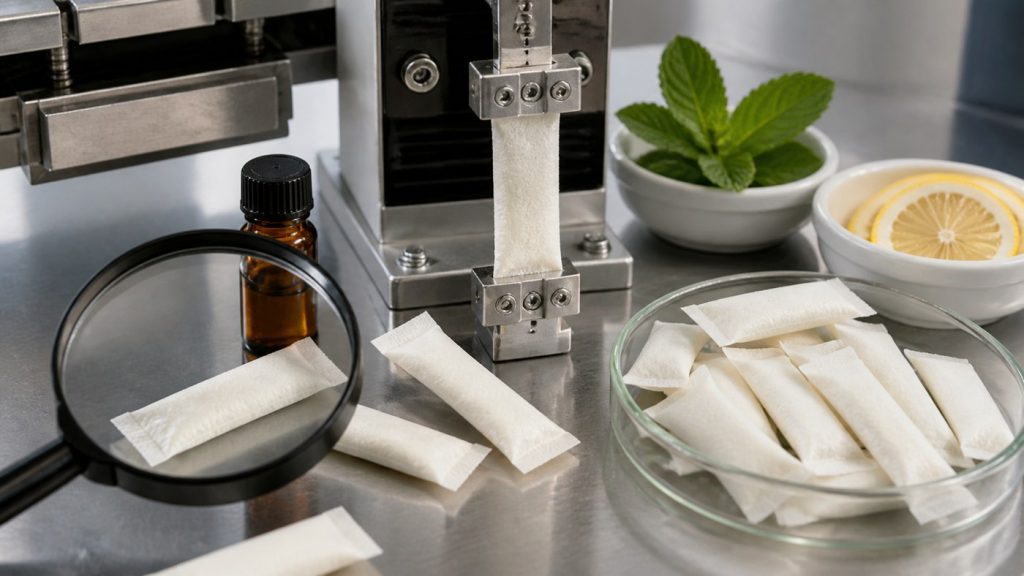
- Close factory image of heat-seal testing, oil flavor and realistic finished pouches.
- Failure-path diagram linking liquid load, wet pockets, seal contamination and aged leakage.
Related manufacturing references
For a complete OEM review, connect this article with the main product and process pages. Buyers usually need category fit, stock-formula options, custom formulation support, process checks, and a direct project discussion before approving samples.
- Custom oral pouch manufacturing
- Stock formulation options
- Private label pouch project planning
- Formulation and R&D support
- Manufacturing process and quality checks
- Technical manufacturing blog
- Discuss a project
Content review note: technical articles are reviewed for functional oral pouch, ODF, packaging, and OEM procurement relevance.