
Primary target long-tail keyword: semi-moist vs dry oral pouches shelf life test data
A dry pouch usually gives the factory a wider processing window. A semi-moist pouch can feel softer and release flavor faster. Neither format has a guaranteed shelf life.
Useful comparison data comes from the same active system, fabric and package tested at defined storage conditions. Comparing one fresh dry sample with an unrelated moist product tells the buyer very little.
Set measurable starting points
Record total moisture, water activity, pouch weight, blend appearance, sensory profile and seam condition at release. Water activity measures available water and is not interchangeable with moisture percentage.
Two formulas can contain similar water but have different water activity because polyols, salts and fibers bind it differently. Microbiological risk and texture must be assessed from the complete system.
Dry pouches usually flow better
A dry carrier blend feeds more consistently when particle distribution and electrostatics are controlled. It may produce dust, powder leakage and a chalky first impression. Very fine caffeine can segregate from coarse carrier during hopper vibration.
Track individual pouch weight and active uniformity through the run. Average batch assay does not identify beginning-to-end drift.
Semi-moist blends change during holding
After liquid addition, a blend may continue absorbing moisture. Flow at ten minutes can differ from flow after two hours. Clumps form, feeder surfaces become coated and fill weight varies.
Specify liquid-addition rate, mixing sequence, equilibration time and maximum hold. Record room humidity. Operators should not correct poor flow by adding carrier without a controlled formula revision.
Build a stability data table that matters
- Moisture and water activity at each interval
- Active assay and relevant degradants
- Pouch weight change
- Microbiological results
- Seam integrity and loose powder
- Texture, clumping and staining
- Flavor at fixed use times
- Can liner and closure condition
Use real-time and accelerated conditions. Add humidity cycling for tropical distribution. Test unopened cans at each interval rather than repeatedly opening one container.
Flavor data often separates the formats
Semi-moist pouches typically show a quicker initial flavor release. Volatile top notes can then migrate into the can or liner. Mint becomes harsh, citrus fades and botanical bitterness becomes more visible.
Dry pouches release more slowly. Short sensory panels may score them lower even though the flavor remains stable over a longer use period. Evaluate at one, five, ten and twenty minutes where appropriate.
Cheap sweetener blends can lose balance after three months. The active has not necessarily changed; the masking system has.
Texture failure may occur before assay failure
A semi-moist pouch can dry into a firm lump. A dry pouch can absorb humid air and become sticky. Botanical color may wick through the nonwoven. Pouches may adhere to each other even while caffeine assay remains within specification.
Set commercial acceptance limits for softness, free movement in the can, staining and removal. Laboratory compliance alone does not prevent consumer complaints.
Microbiology needs a risk-based approach
Lower available water generally reduces microbial growth potential, but dry products are not sterile. Raw materials, sanitation and handling still matter.
Semi-moist products need closer assessment of water activity and preservation where applicable. A preservative is not effective simply because it appears in the formula. pH, binding and distribution influence performance.
Packaging can reverse the expected result
A dry pouch in a poor closure may absorb humidity faster than a well-designed semi-moist pouch loses water. Test can, liner and lid as a unit. Repeated consumer opening also changes the headspace.
For hot shipping, include cases and pallets in route simulations. Condensation and temperature cycling are rarely represented by a single laboratory condition.
How to choose between the two
Use semi-moist when faster release and softer feel are central to the product. Accept the added controls for liquid addition, hold time, water activity and barrier packaging.
Use dry when process simplicity, lower available moisture and a slower sensory profile fit the brief. Do not over-dry merely to chase stability; excessive dust and poor mouthfeel create different failures.
Read accelerated results with restraint
Accelerated storage is useful for finding weak seals, rapid flavor loss and moisture movement. It is not a universal formula for converting eight hot weeks into a precise two-year shelf life. Reactions do not all speed up at the same rate, especially when botanical extracts, volatile flavors and nonwoven staining are involved.
Confirm the chosen format under real-time storage in the final sale package. If distribution includes ocean freight or an unconditioned regional warehouse, add a route-specific cycle instead of relying only on a constant chamber setting.
Check opened-can performance too
Unopened stability is only half the comparison. Add an in-use study that opens each can on a fixed schedule, removes one pouch and records weight change, aroma, clumping and closure condition. Dry pouches may gain moisture after repeated opening; semi-moist pouches may lose top notes and firm at the surface. The result is often more useful for pack sizing than another unopened chamber point.
Questions Buyers Usually Ask
Do semi-moist pouches always have shorter shelf life?
No. Formula and package design determine the result, although semi-moist products usually require tighter moisture control.
Which stability number is most important?
No single number is sufficient. Water activity, active assay, microbiology, texture, flavor and package integrity must be interpreted together.
When comparing formats, request matched prototypes and a written stability plan. LinkBioLabs can set dry and semi-moist targets against the same active, pouch size and market package so the decision is based on comparable data.
Recommended Blog Images
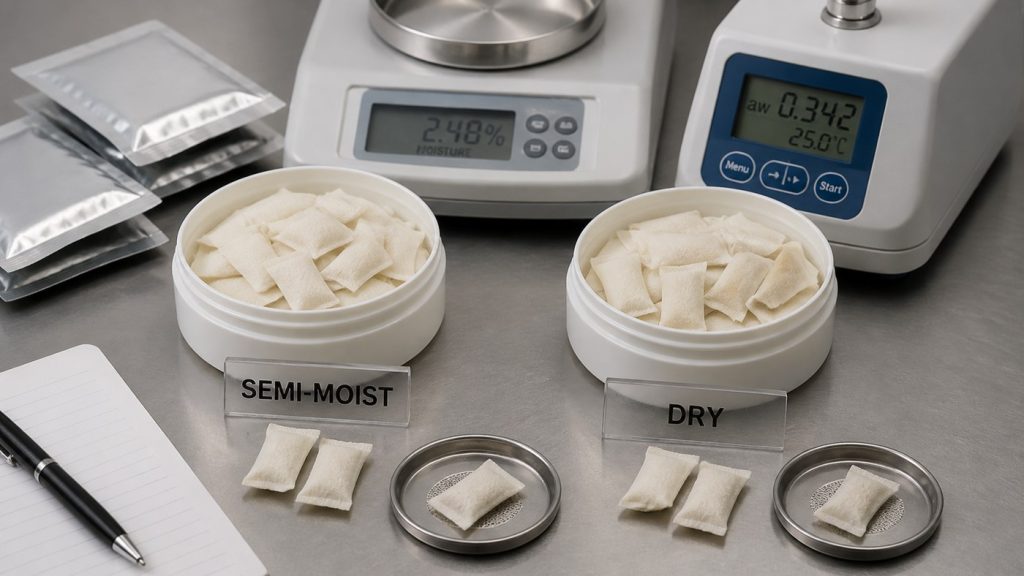
- Side-by-side laboratory photograph of semi-moist and dry pouches with moisture measurement equipment.
- Stability comparison chart for water activity, flavor release, clumping, staining, microbiology and packaging demand.
Related manufacturing references
For a complete OEM review, connect this article with the main product and process pages. Buyers usually need category fit, stock-formula options, custom formulation support, process checks, and a direct project discussion before approving samples.
- Custom oral pouch manufacturing
- Stock formulation options
- Private label pouch project planning
- Formulation and R&D support
- Manufacturing process and quality checks
- Technical manufacturing blog
- Discuss a project
Content review note: technical articles are reviewed for functional oral pouch, ODF, packaging, and OEM procurement relevance.