
Primary target long-tail keyword: oral pouch pilot batch acceptance criteria for private label brands
A pilot batch is not a large sample order. It tests whether the formula, material, equipment and package can produce repeatable saleable units. Approving it because the first can tastes good leaves the important questions unanswered.
Acceptance criteria should be written before production. Once branded cans, photography and launch dates exist, teams become much more willing to excuse high weight variation or weak flavor.
Define what the pilot must prove
List the decisions the batch will support: formula approval, line feasibility, analytical release, packaging fit and stability start. A small hand-filled run may support sensory work but cannot qualify high-speed fabric tracking or commercial seal consistency.
Record intended batch size, equipment, pouch dimensions, fill target and packaging configuration. If any are not representative, state the limitation and schedule the missing evidence.
Set dose and uniformity limits
Measure active assay and content uniformity using a sampling plan that covers production time. Low-dose caffeine, vitamins and botanicals may segregate after a blend passes the mixer sample. Beginning-to-end results reveal that drift.
Link content results with individual pouch and fill weight. A dose failure can come from nonuniform blend, feeder variation or both. Testing only a pooled composite hides unit-level risk.
Inspect fabric and seams under stress
Review pouch length, width, seam position, wrinkles, fiber lint, powder leakage and staining. Challenge units from startup and speed changes, not only the stable center of the run.
Condition seam samples with the real formula. Humectants and flavor oils may weaken the heat-seal layer over time. Fresh peel behavior is necessary but not sufficient.
Judge flavor on a timeline
Specify the intended use time and score opening, midpoint and finish. A strong mint opening can hide caffeine bitterness for two minutes and fail for the remaining fifteen. Herbal astringency often appears late.
Use coded samples and more than one trained evaluator. Record cooling, sweetness, bitterness, aroma, pouch softness and residue separately. Vague comments such as smooth or strong are difficult to formulate against.
Control moisture and water activity
Measure total moisture and water activity where relevant. They are not interchangeable: water activity reflects available water and helps inform microbiological and texture risk.
Record blend hold time and room humidity. Semi-moist material can continue absorbing liquid, clump and change fill behavior during the pilot. Dry material can create dust or static that produces a different failure.
Release packaging as part of the product
Confirm can count, closure, liner fit, tamper evidence, label application, lot coding and carton protection. Check whether pouches move freely and can be removed without tearing.
Use production-equivalent components for stability. A temporary laboratory jar cannot prove flavor retention, moisture barrier or liner compatibility for the final sale pack.
Account for rejects and material loss
Document machine setup loss, underweight or overweight units, seam rejects, loose powder and packaging waste. The pilot yield becomes an input to repeat-order cost and realistic MOQ.
Do not quote unit cost by dividing ingredient weight by theoretical pouch count. Threading fabric, feeder adjustment, testing and retained samples all consume material that never becomes revenue stock.
Write a disposition for every deviation
Classify deviations as acceptable with rationale, requiring corrective work or blocking scale-up. Assign an owner and evidence needed for closure. A verbal promise to watch it next time is not a corrective action.
Keep pilot retains from the beginning, middle and end. If stability or customers later expose a defect, those samples help distinguish batch-wide formulation failure from a localized production event.
Use a clear go, revise or stop gate
- Formula and timed sensory acceptance
- Dose and fill-weight performance
- Fabric and aged seam integrity
- Moisture and microbiological status
- Package compatibility
- Expected commercial yield
- Stability plan started
- Claims and label review complete
Proceed only when the remaining open items have controlled risk and a written closeout date. Revise the formula or process when one variable is blocking success. Stop when the concept depends on an oversized pouch, unsupported claim or uneconomic yield.
Confirm the data package the buyer will receive
Agree which documents follow the pilot: batch record summary, raw-material lots, test methods, certificate results, deviations, retain plan and stability schedule. A product manager cannot approve scale-up responsibly from photos and a tasting call.
Mark preliminary results clearly. Microbiology, third-party assays and stability checkpoints may arrive after filling. The project timeline should show what is released, what remains pending and which result can still block commercial production. This prevents artwork or freight bookings from becoming pressure to overlook unfinished evidence.
Approve a reference standard from the pilot and store it under controlled conditions. Production and quality teams can compare later lots against the same pouch dimensions, color, seam appearance and sensory profile instead of relying on memory or an old marketing photograph.
Questions Buyers Usually Ask
How many pouches are needed for a pilot?
The number depends on equipment setup, testing, retains and stability intervals; it should be based on evidence needs rather than a universal sample count.
Can hand-filled pouches replace a pilot batch?
They can support early sensory decisions but do not validate commercial feeding, fabric tracking, sealing, yield or beginning-to-end uniformity.
Send the formula stage, target batch size, planned tests and launch market when defining a pilot. LinkBioLabs can separate sensory samples from the evidence required for scale-up approval.
Recommended Blog Images
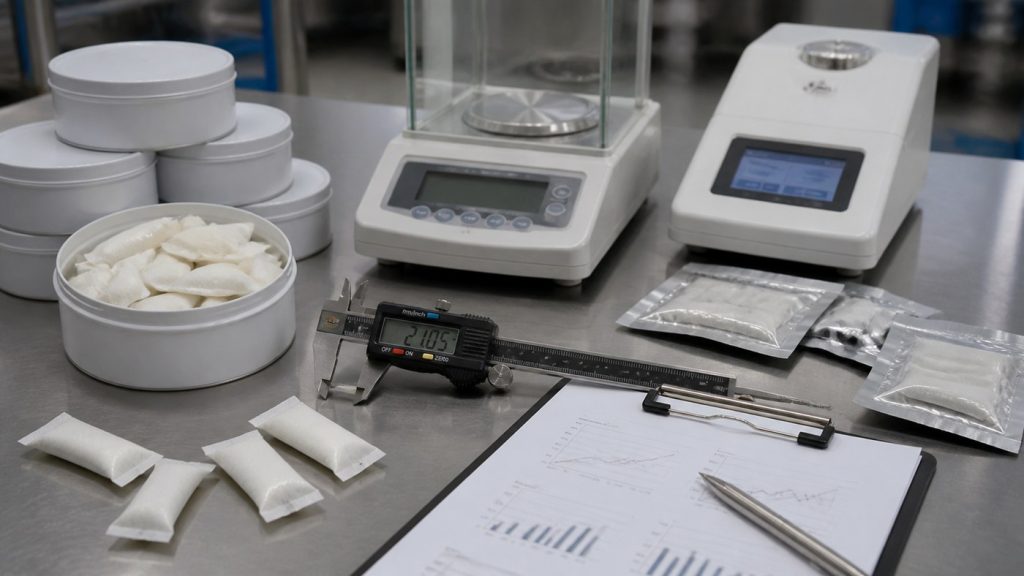
- Pilot acceptance bench with balance, caliper, water activity equipment, retains and realistic pouches.
- Go-revise-stop checklist for formula, process, package, stability and cost.
Related manufacturing references
For a complete OEM review, connect this article with the main product and process pages. Buyers usually need category fit, stock-formula options, custom formulation support, process checks, and a direct project discussion before approving samples.
- Custom oral pouch manufacturing
- Stock formulation options
- Private label pouch project planning
- Formulation and R&D support
- Manufacturing process and quality checks
- Technical manufacturing blog
- Discuss a project
Content review note: technical articles are reviewed for functional oral pouch, ODF, packaging, and OEM procurement relevance.