
Primary target long-tail keyword: how to prevent powder segregation in low-dose oral pouch production
Low-dose pouch failures rarely announce themselves in the mixer. The blend can pass one composite test, then separate during transfer, hopper vibration or a production stop. Units filled near the end of the run carry a different active level from those made at the beginning.
The practical question is not whether the powder was mixed. It is whether the blend remains uniform through every movement between dispensing and the sealed pouch.
Map every place the blend can separate
Draw the route from weighing to premix, main blend, intermediate container, lift, hopper and feeder. Each drop changes particle motion. Long transfer distances, steep chutes and repeated vibration allow dense fines to move differently from coarse carrier.
Production teams often focus on mixer time because it is easy to document. The larger risk may be the twenty-minute wait in a half-full hopper after a line adjustment. Include holds and restarts in the validation plan.
Match particle profiles before increasing time
Very fine caffeine, vitamins or botanical markers do not behave like a coarse fibrous carrier. Longer mixing cannot permanently correct a large difference in size, density or shape. It may even drive fines into equipment surfaces or create electrostatic charge.
Compare sieve distribution and bulk density for the active, premix and carrier. Consider a compatible granulated grade or controlled milling where appropriate. Do not change particle size without repeating dissolution, sensory and stability work.
Build the premix geometrically
A low-dose active should first be distributed into a manageable portion of carrier. Add approximately equal volumes in stages rather than dropping a small active quantity into the full mixer. Screen lumps before addition and control the order of liquids, flavors and powders.
Record actual addition sequence and mixing energy. Operators should not rely on visual whiteness; many active powders are indistinguishable from carrier. A signed batch record is more useful than a formula sheet that says only mix until uniform.
Control electrostatics and room humidity
Dry fine powders can cling to bags, scoops, mixer walls and hopper windows. The batch weight reconciles poorly and the material released later may create a local high concentration. Excess humidity creates the opposite problem: clumps that feed intermittently.
Set a workable temperature and humidity range, ground equipment where needed and use consistent contact materials. Inspect residue after discharge. A clean-looking stainless wall can still carry a visible film of the most potent ingredient.
Limit uncontrolled transfer and hold time
Use covered, identified containers and minimize unnecessary pouring. Define a maximum time between blending and filling. If the line stops, document duration and decide whether controlled remixing is allowed.
Do not let operators stir the hopper by hand to fix flow. That creates an undocumented local mix and may damage pouch-weight consistency. The response to bridging belongs in the approved process, not in shift-by-shift improvisation.
Sample across time, not from one location
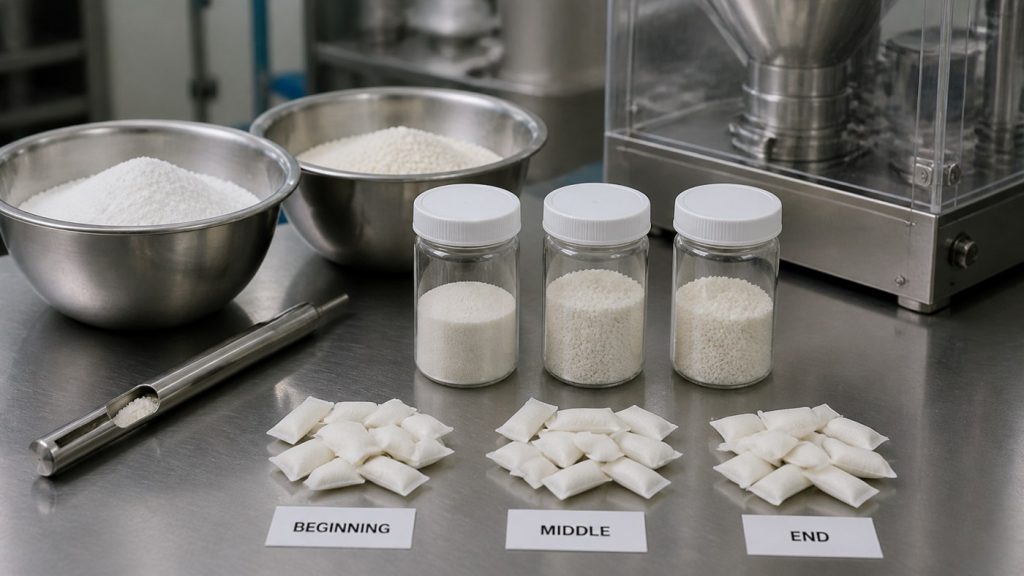
Take finished-pouch samples from the beginning, middle and end of the run and around planned stops. For longer batches, add intervals based on production time or container change. Test individual or justified composite samples according to the risk.
A passing average can hide high and low groups. Review results by sequence. A trend that remains within specification during the pilot may cross the limit when the commercial batch becomes three times longer.
Separate fill-weight variation from assay variation
A pouch can miss dose because the blend is nonuniform, the feeder delivered the wrong mass or both. Measure individual pouch weight alongside active content. Without both datasets the investigation cannot distinguish formulation from machine behavior.
Check powder leakage and material in the seal. Fine active lost as dust can reduce dose while contaminating the can. Reconciliation should include retained blend, equipment residue, rejected pouches and cleaning loss.
Scale by evidence, not mixer capacity
A larger mixer changes fill level, shear and discharge pattern. Keeping the same minutes does not prove the same mixing result. Validate commercial load size and include the slowest realistic production condition.
Most small OEMs do not have continuous blend monitoring. That makes a sound sampling map, retained samples and change control essential. New suppliers, particle grades or carriers should trigger a targeted requalification rather than silent substitution.
Use the first commercial batches as continued verification
Validation does not end with one successful pilot. Trend active results, individual weights, reject patterns and reconciliation for the first commercial lots. Watch for shifts after a new carrier lot, longer run or different room humidity. A stable average with a widening beginning-to-end range is an early warning.
Set an escalation rule before release. If the trend approaches the internal limit, investigate particle distribution, hold time and hopper behavior while retained blend is still available. Waiting for an out-of-specification result removes useful evidence and puts more inventory at risk.
Questions Buyers Usually Ask
Does longer mixing always improve content uniformity?
No. When particles differ substantially, longer mixing may not prevent later segregation and can increase electrostatic or attrition problems.
Where should finished pouches be sampled?
At minimum across the beginning, middle and end, with added samples around stops, refills or intermediate-container changes.
A useful review includes active dose, particle data, batch size, transfer route and current sampling plan. LinkBioLabs can use that information to define a realistic premix and filling study.
Recommended Blog Images
- Beginning-middle-end production samples beside blender, carrier and low-dose premix.
- Process map showing segregation risks from weighing through hopper and filling.
Related manufacturing references
For a complete OEM review, connect this article with the main product and process pages. Buyers usually need category fit, stock-formula options, custom formulation support, process checks, and a direct project discussion before approving samples.
- Custom oral pouch manufacturing
- Stock formulation options
- Private label pouch project planning
- Formulation and R&D support
- Manufacturing process and quality checks
- Technical manufacturing blog
- Discuss a project
Content review note: technical articles are reviewed for functional oral pouch, ODF, packaging, and OEM procurement relevance.