
Primary target long-tail keyword: oral pouch shipping case validation for international OEM orders
A can that passes factory inspection can arrive oval, scuffed or partly open after export. The formula is blamed first, yet the damage often begins with an oversized case, weak corrugated board, empty headspace or pallet overhang. Heat and humidity reduce carton strength while weeks of vibration let cans rub against each other.
Shipping validation should use the final can count, label, liner, carton and pallet pattern. A drop test on one carefully packed sample is not a distribution study.
Write the distribution route
Define parcel or pallet shipment, transfer points, stacking duration, container route and expected climate. Air courier, mixed e-commerce parcel and sea freight do not impose the same hazards.
Include warehouse time at origin and destination. Corrugated cases may spend longer under static load than they spend moving.
Specify board performance, not only flute name
Flute and paper grade influence behavior, but compression strength depends on construction, dimensions, moisture and manufacturing quality. Ask for measurable case specifications and supplier consistency.
A recycled board may perform well when dry and lose strength in humid storage. Condition test cases for the route rather than testing only fresh cartons from an air-conditioned room.
Control empty space
Cans that move inside a case rub labels, strike lids and concentrate impact. Oversized dividers can create the same problem while appearing protective.
Set case internal dimensions, can orientation and any pads or dividers. Pack samples using normal production tolerances, not hand-selected perfect cans.
Test compression with the pallet in mind
Bottom cases carry the full stack plus dynamic warehouse loads. Evaluate pallet pattern, stack height, storage duration and safety factor.
Avoid pallet overhang and misaligned columns. A strong case loses much of its value when corners are unsupported or straps crush the top layer.
Use vibration to expose rubbing and lid movement
Vibration can rotate screw closures, polish printed surfaces and loosen pouches inside cans. Inspect torque, liner position, powder leakage and label appearance after the test.
Run the filled commercial case. Empty cans and water-filled substitutes do not reproduce pouch movement or product dust.
Drop the package in defined orientations
Drops should cover faces, edges and corners appropriate to the shipping system. Record height, sequence and case condition. Randomly throwing a carton provides drama, not repeatable evidence.
Inspect hidden damage. A can may spring back after impact while the liner wrinkles or the lid thread becomes easier to open.
Add temperature and humidity conditioning
Warm cans soften, labels become more vulnerable and corrugated board weakens in humidity. Cold conditions can make plastic closures brittle. Condition packages before mechanical challenges when the route requires it.
Check the product too. Heat-driven pouch swelling or flavor migration can increase internal can pressure and worsen a marginal closure.
Define pass and fail before testing
Set limits for case collapse, can deformation, lid opening, seal damage, label scuff, leakage and saleable appearance. “No major damage” invites argument after the test.
Allow cosmetic criteria that match the channel. A distributor master case and a direct-to-consumer parcel may need different presentation thresholds.
Retest changes that affect the system
- Can resin or dimensions
- Closure or liner
- Label material
- Case supplier or grade
- Case count
- Divider design
- Pallet pattern
- Shipping mode
- Product fill or moisture
Packaging is a system. A lighter can or new label varnish can fail even when the outer case specification remains unchanged.
Questions Buyers Usually Ask
Which test standard applies to oral pouch shipping cases?
The route and shipment mode determine the appropriate protocol. ASTM D4169 and related compression, vibration and parcel methods are common references, but the project needs a tailored sequence.
Can a supplier certificate replace finished-case testing?
No. Board data does not test the complete combination of cans, closures, labels, dividers, carton and pallet pattern.
Provide can dimensions, units per case, pallet pattern and destination route for a packaging test brief before the first export order is packed.
Recommended Blog Images
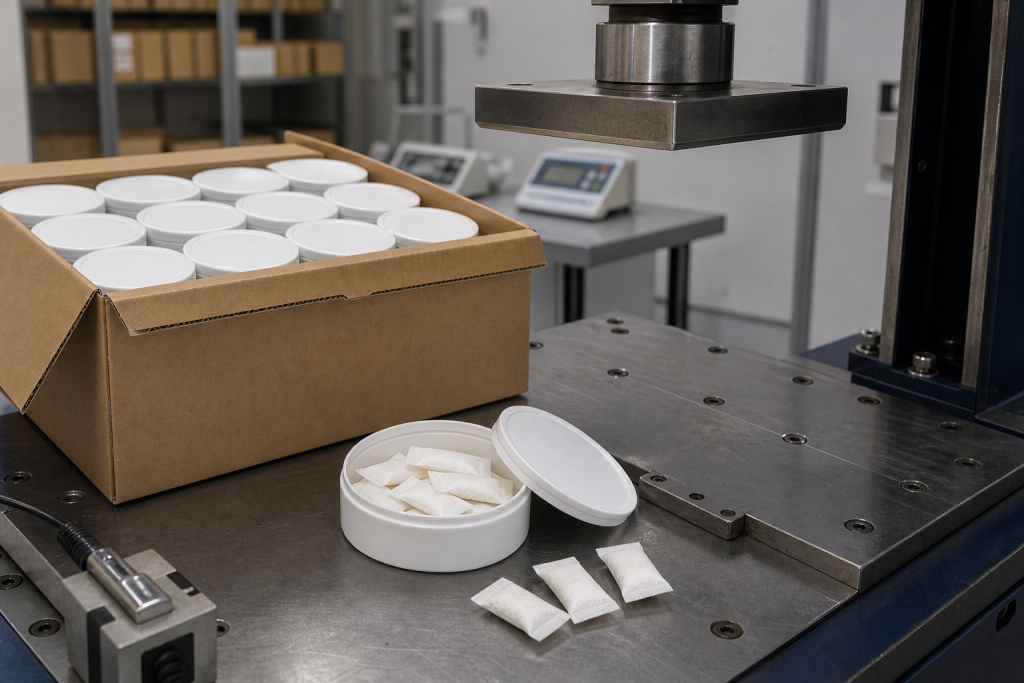
- Packaging laboratory with filled oral pouch cases, compression platen and open sample can.
- Distribution sequence graphic covering climate, compression, vibration, drops and final inspection.
Inspect the shipment at can and pouch level
After each test sequence, do more than count crushed cartons. Measure representative can dimensions and opening torque, inspect liners and labels, and open cans over a clean surface to find loose powder. Examine pouch seams, surface staining and shape. A carton may look saleable while repeated vibration has opened a small number of pouches inside every can.
Use production-packed cases
Laboratory staff often arrange every can neatly and add extra tape. That package does not represent routine output. Pull cases from the packing line, including normal board, tape and count tolerances. Record case and component lots. If special hand packing is required to pass, either update the actual work instruction or treat the test as nonrepresentative.
Close failures with a design change
When a case fails, identify the mechanism before adding more material. Corner collapse may need a stronger case or better pallet alignment; label rubbing may need dividers or coating; loose lids may point to closure control. Repeat the relevant conditioning and mechanical sequence after the change. One undamaged replacement sample is not enough to close the investigation.
Photograph the pallet and case arrangement before and after testing. Images preserve details such as overhang, strap position and crushed corners that summary measurements miss, and they make packaging corrections easier to communicate with distant suppliers.
Related manufacturing references
For a complete OEM review, connect this article with the main product and process pages. Buyers usually need category fit, stock-formula options, custom formulation support, process checks, and a direct project discussion before approving samples.
- Custom oral pouch manufacturing
- Stock formulation options
- Private label pouch project planning
- Formulation and R&D support
- Manufacturing process and quality checks
- Technical manufacturing blog
- Discuss a project
Content review note: technical articles are reviewed for functional oral pouch, ODF, packaging, and OEM procurement relevance.