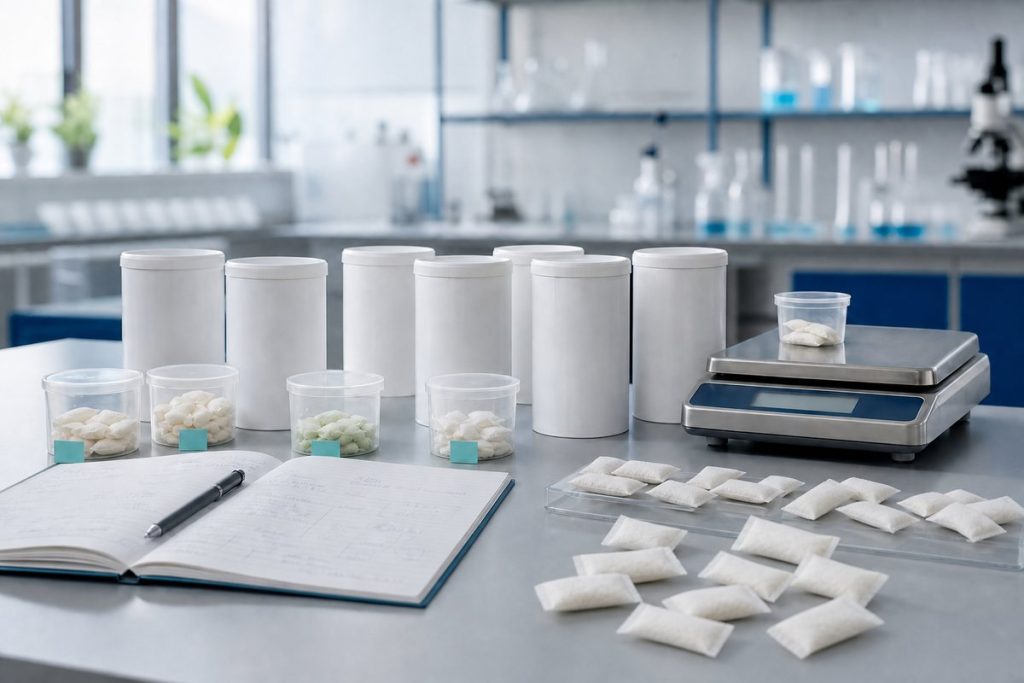
Most custom oral pouch projects do not fail because the first sample is imperfect. They fail because feedback is vague, revisions are not controlled and the final approval cannot be translated into production. Sample development works best when it is treated as a short engineering project rather than a flavor guessing exercise.
The goal of R&D is not to produce endless interesting samples. It is to reduce uncertainty until the brand and manufacturer can sign off one formula, one sensory target and one commercial specification.
Write the Brief Before Choosing Ingredients
Describe the target consumer, use occasion, destination market, functional direction and desired experience. State non-negotiable points separately from preferences. If caffeine amount is fixed but mint intensity is flexible, the formulator needs to know. Include products the sample should resemble and, just as importantly, what should be avoided.
- Product category and intended positioning
- Target and excluded ingredients
- Amount or strength direction per pouch
- Pouch weight, size, moisture and count per can
- Flavor references and sweetness preference
- Target market, warnings and proposed claims
- Packaging format, MOQ range and launch date
Use Each Sample Round to Answer One Set of Questions
Round one: feasibility
Confirm that the core ingredients fit, the base is manufacturable and the main flavor direction is plausible. Do not spend time choosing between minor label colors while the formula is still unstable.
Round two: balance
Adjust sweetness, cooling, bitterness, moisture and flavor timing. Keep the active system stable unless the first round exposed a genuine technical problem.
Round three: confirmation
Verify the preferred formula against written criteria and prepare the production specification. A final sample should not introduce several new ingredients simply because another revision is available.
Evaluate Samples Blind and on a Schedule
Use coded samples where possible and have evaluators follow the same timing. Record aroma on opening, first-minute sensation, midpoint balance, finish, pouch softness, irritation, dust and visible seal quality. Collect individual notes before a group discussion so the loudest opinion does not become the only data.
Store part of every sample and revisit it after a short interval. Freshly made pouches can behave differently after moisture equilibrates. Early observations do not replace formal stability work, but they can expose a direction that is unlikely to age well.
Control Revisions Like Artwork
Give each formula a code and revision date. The change log should say what changed and why. Feedback such as “version 3 is better” is risky if the factory and buyer are looking at different shipments. When approving a sample, identify the exact code, date and package.
Move From Preference to Specification
A retained sample is valuable, but production also needs numbers and written descriptions. Set ingredient identities and amounts, blending instructions, target pouch weight and tolerance, moisture range, seam and appearance requirements, sensory target, count per can, packaging components and release tests. Agree on which deviations require buyer approval.
Keep Commercial Limits Visible During R&D
An ingredient may work technically but require a supplier MOQ far above the first order. A special pouch paper or can can add months. Ask for cost and lead-time consequences before approving changes. The best prototype is one the brand can afford to reorder, not only one that performs well in a tasting session.
What a Good R&D Handoff Looks Like
- Signed formula and product specification
- Named ingredient grades and approved suppliers
- Retained approval samples held by both parties
- Agreed in-process and finished-product checks
- Final claims and artwork based on the locked formula
- Scale-up or pre-production review where required
- Change-control contact and approval process
LinkBioLabs provides oral pouch formulation and R&D services for caffeine, guarana, nootropic, oral care, nutritional and stress-relief projects. Brands can send a structured brief through our contact page; our team will review feasibility, sampling scope, packaging and expected production volume together.
Related manufacturing references
For a complete OEM review, connect this article with the main product and process pages. Buyers usually need category fit, stock-formula options, custom formulation support, process checks, and a direct project discussion before approving samples.
- Custom oral pouch manufacturing
- Stock formulation options
- Private label pouch project planning
- Formulation and R&D support
- Manufacturing process and quality checks
- Technical manufacturing blog
- Discuss a project
Content review note: technical articles are reviewed for functional oral pouch, ODF, packaging, and OEM procurement relevance.