
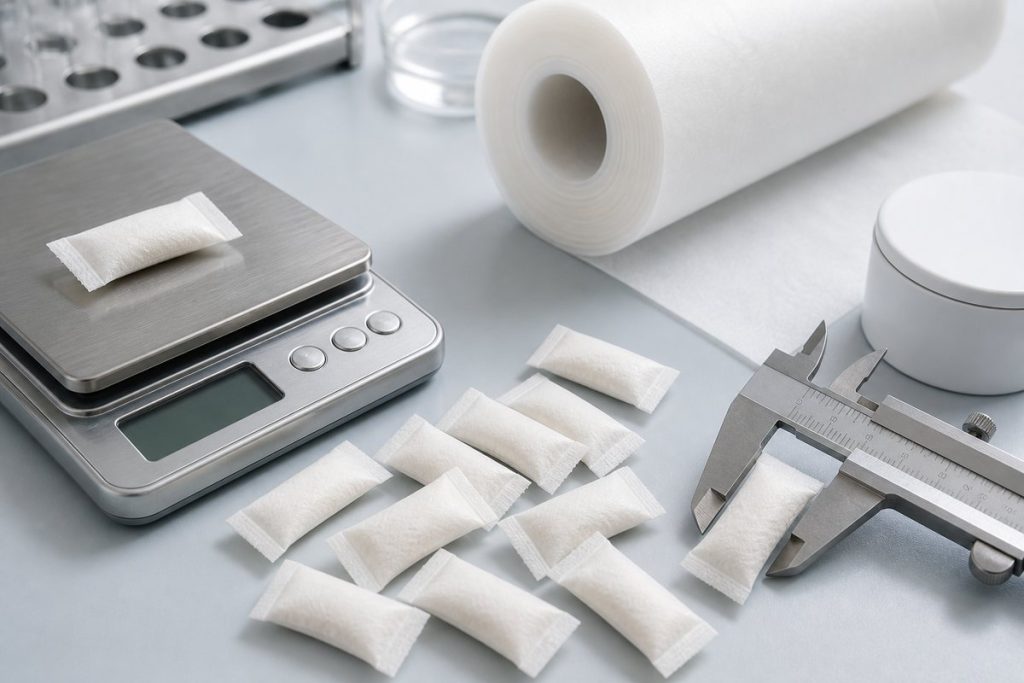
Buyers often spend weeks adjusting flavor and then approve the pouch itself with a sentence such as “use the standard small size.” That shortcut can create a product that feels bulky, leaks powder, folds badly in the can or changes when production moves from a sample machine to a commercial line.
Pouch material, dimensions and fill weight should be treated as part of the formula. They determine how the product sits under the lip, how quickly moisture and flavor move through the fabric, how reliable the seal is and how many pouches fit in the chosen can. An OEM quotation is easier to compare when these details are written down.
Pouch Material Is More Than a Color
Functional oral pouches commonly use food-contact nonwoven material selected for softness, strength, sealing performance and permeability. Two white rolls can behave differently because of fiber structure, basis weight, thickness or heat-seal layer. Ask the factory to identify the approved material by specification or internal code, not merely as “pouch paper.”
The material must tolerate the actual filling. Fine powders can find weak seams or open structures; moist blends can stain or soften some fabrics; botanical particles can create hard points. A material that works for a dry caffeine pouch may not be the best choice for a soft, higher-moisture nutritional concept.
Define the Size as a Finished Pouch
Length and width should refer to the sealed finished pouch, with the measurement method agreed. The usable filled area is smaller because the seal occupies space. Corner shape, seam width and fold behavior influence comfort even when two pouches share the same outside dimensions.
- Finished length and width with tolerances
- Target seam width and acceptable seal appearance
- Pouch material code, basis weight or other agreed identifier
- Dry, semi-moist or moist product direction
- Target count per can and expected pack arrangement
- Limits for open seams, wrinkles, staining and loose powder
Choose Fill Weight From the Formula, Not From Habit
Fill weight has to accommodate the active ingredients, carriers, flavor system and moisture while leaving enough room for a stable seal. Increasing weight can improve ingredient capacity, but it can also make the pouch thick and reduce the count that fits neatly in the can. Reducing it too far can make dosing and blend uniformity harder, especially when several low-level ingredients are present.
LinkBioLabs manufacturing projects can be developed across fill-weight ranges suited to the selected format, including approximately 0.20 g to 0.60 g where technically appropriate. The final value is not a catalog preference: it is confirmed against ingredient load, sensory target, pouch dimensions and equipment performance.
Write a Target and a Tolerance
A target without a tolerance is incomplete, while an unrealistic tolerance can add cost without improving the consumer experience. The factory should explain how fill weight is checked during the run, how often samples are taken and what action occurs when results begin to trend away from target.
Average weight alone can hide individual light or heavy pouches. A useful control plan considers individual results, batch averages and the sampling frequency. It should also address count per can, because a correct pouch weight does not compensate for a missing unit.
Moisture Changes Both Feel and Processing
Dry pouches may offer easier handling and a different storage profile, while higher-moisture pouches can feel softer and release flavor differently. Neither direction is automatically premium. Moisture affects powder flow, sealing, microbial risk, staining and packaging requirements, so the approved range must match the chosen formula and can system.
When comparing prototypes, let samples equilibrate for an agreed period and evaluate them from the intended package. A pouch tested immediately after hand filling may not represent the same product after moisture has redistributed through the filling and fabric.
Seal Quality Needs Objective Checks
A neat-looking edge is only the beginning. Seals need enough strength for filling, counting, packing, transport and normal use without becoming hard or sharp. Manufacturers may use visual inspection, controlled handling tests, dimensional checks and tensile or burst-related methods appropriate to their equipment and specification.
Modern pouch quality systems commonly assess several physical parameters together. Industry measurement guidance emphasizes moisture, dimensional accuracy, weight and pouch strength as connected production variables. Buyers should ask for the actual factory method and acceptance criteria rather than requesting a test name copied from another product.
Approve Production-Representative Samples
Laboratory samples are useful for flavor direction, but the final sign-off should account for the intended material and commercial filling process. If a different roll stock, seam geometry or pouch size is introduced during scale-up, document the change and repeat the checks affected by it. The brand should retain a signed sample and specification version.
What to Request Before Purchase Order Approval
- A coded drawing or specification for the finished pouch
- Material identity and food-contact documentation appropriate to the market
- Target fill weight, tolerance and in-process sampling plan
- Moisture or water-activity controls appropriate to the formula
- Seal, appearance, dust and defect acceptance criteria
- Pouch count and can compatibility confirmation
- Change-control approval for material or dimension substitutions
Turn the Sample Into a Repeatable Product
The purpose of a physical specification is not to make procurement complicated. It gives the buyer and manufacturer the same definition of an acceptable pouch. When the formula, fabric, size, fill weight, moisture, seams and packaging are approved together, production discussions become faster and repeat orders are easier to compare.
LinkBioLabs supports oral pouch formulation and R&D, material selection, pilot samples, manufacturing and packaging for private label and custom projects. Share the intended ingredients, target pouch experience, can count, market and order forecast through our contact page to build a production-ready brief.
Related manufacturing references
For a complete OEM review, connect this article with the main product and process pages. Buyers usually need category fit, stock-formula options, custom formulation support, process checks, and a direct project discussion before approving samples.
- Custom oral pouch manufacturing
- Stock formulation options
- Private label pouch project planning
- Formulation and R&D support
- Manufacturing process and quality checks
- Technical manufacturing blog
- Discuss a project
Content review note: technical articles are reviewed for functional oral pouch, ODF, packaging, and OEM procurement relevance.