Primary target long-tail keyword: oral pouch flavor carryover cleaning validation requirements
Mint from the previous batch can appear in a berry pouch at a level too low for routine chemical testing yet obvious to a trained panel. Flavor carryover is not only a sanitation issue. It changes the product promise and can turn mild oral-care or herbal formulas into rejects.
Cleaning validation should show that the approved procedure repeatedly removes relevant residues from shared equipment. A shiny hopper is not proof. The worst locations are usually seams, gaskets, dosing screws and parts operators cannot see from the floor.
Map every product-contact surface
Follow the blend through mixer, transfer container, hopper, feeder, forming parts, seal area and collection trays. Include scoops, screens, vacuum tools and temporary bins. Small utensils are frequently moved between rooms and escape the equipment checklist.
Mark hard-to-clean joints, flexible hoses, dead legs and scratched polymer parts. A broad stainless wall is rarely the worst sampling site.
Choose the worst flavor rationally
Strong mint, cooling agents, berry esters, coffee notes and concentrated botanicals persist differently. Select a challenge product based on intensity, solubility, stickiness and historical experience rather than choosing the batch already scheduled.
Oil-rich flavors may coat surfaces while fine powders travel into seals and filters. One worst case may not cover both mechanisms, so a grouped strategy can be more defensible.
Write the cleaning process in detail
Specify disassembly, dry removal, cleaning agent, concentration, water quality where used, contact time, mechanical action, rinse, drying and inspection. “Clean thoroughly” cannot be validated or repeated across shifts.
Control the time from production end to cleaning. Flavor residue that sits overnight may penetrate gaskets or harden with carrier. A procedure proven after immediate cleaning may fail after a weekend hold.
Use visual, swab and rinse evidence
Visual inspection finds powder and damage but may miss invisible aroma. Swabs target defined surfaces; rinse samples reach enclosed systems but dilute local residue. Use the method that matches equipment design and failure risk.
Recovery studies matter. A swab result is not meaningful if the sampling material cannot recover oily mint from the chosen gasket or stainless finish.
Add sensory checks where chemistry is weak
Flavor mixtures may not have one practical marker. A controlled blank run or first-off pouch evaluated by trained staff can reveal carryover below an analytical screening limit. Sensory work should be coded and documented, not an operator sniff test.
Keep sensory approval separate from claims about microbiological cleanliness. The tests answer different questions.
Define acceptable limits before validation
Limits can use toxicological, allergen, dose and sensory considerations depending on the residue. For flavor identity, the practical limit may be no detectable carryover under a defined panel method.
Do not set the limit after seeing the results. That turns validation into justification of the existing process rather than a test of whether it works.
Run consecutive successful cleanings
One passing event shows that cleaning can work once. Validation should cover repeat performance, typical operators and the defined worst condition. Record deviations such as delayed cleaning, damaged seals or incomplete drying.
The first batch after cleaning deserves extra observation. Retain beginning samples because residues often appear at startup and disappear later, hiding inside a composite.
Prevent recontamination after cleaning
Protect cleaned parts during drying and storage. Identify status and re-clean time limits. An open hopper beside flavor weighing can collect airborne mint even when the previous cleaning was adequate.
Separate brushes, wipes and vacuum tools where practical. A cleaning tool used across strong flavors can become the transfer source.
Keep the program alive after changes
- New flavor chemistry
- New cleaning agent
- Equipment modification
- Longer dirty hold
- Changed gasket material
- Repeated sensory complaint
- New allergen or botanical risk
These changes should trigger review or revalidation. Trend first-off sensory complaints and swab results. A slow increase often signals worn surfaces or shortening cleaning time before a clear failure occurs.
Control the production sequence as an added safeguard
Campaign planning can reduce carryover risk but does not replace cleaning. Run mild flavors before strong mint or coffee where formulas and schedules permit. Keep allergen, botanical and high-intensity cooling risks separate from simple flavor similarity.
Document why the sequence is acceptable. A berry-to-mint order may protect the mint product but still leave berry notes in equipment before a mild oral-care run the next morning. Scheduling must consider the full campaign, not only adjacent batches.
When a complaint appears, review the previous product, dirty hold, cleaning operator, swab locations and first-off retains together. This often identifies a local gasket or utensil issue faster than repeating the full cleaning cycle without a hypothesis.
Include maintenance work in line clearance. Lubricants, replacement seals and tools introduced during repair can retain or spread aroma. After maintenance, repeat the defined inspection and first-off check rather than assuming the previous validated cleaning remains effective.
Questions Buyers Usually Ask
Is visual cleanliness enough for flavor changeover?
No. Volatile or oily flavor residues can remain sensorially detectable after surfaces look clean.
Should every flavor require a separate validation?
Not always. Products may be grouped using a justified worst-case approach based on intensity, solubility and cleanability.
A useful cleaning review includes equipment flow, flavor families, cleaning steps and current complaints. LinkBioLabs can identify the worst locations and evidence needed before a shared line is approved.
Recommended Blog Images
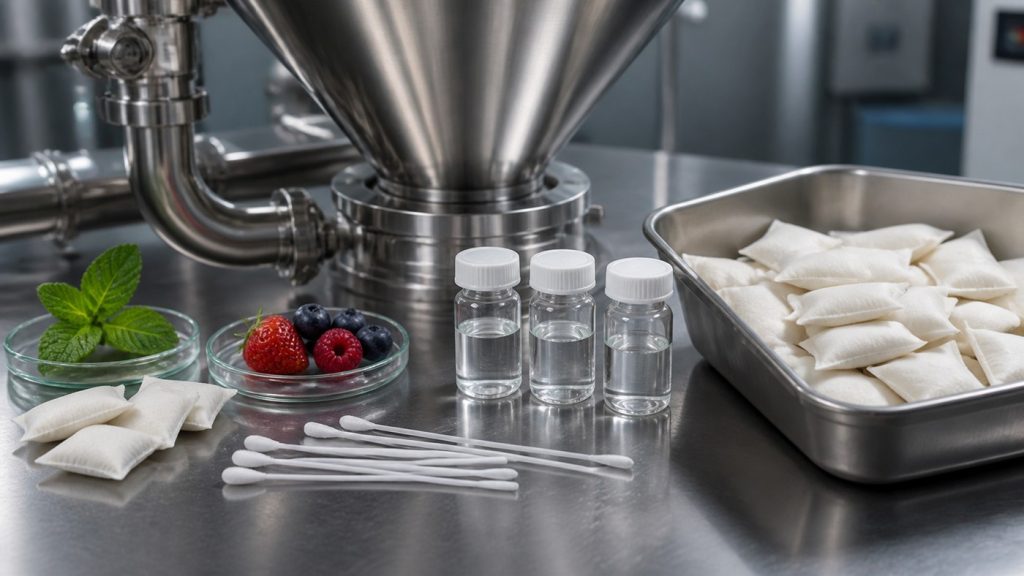
- Factory cleaning validation scene with hopper, swabs, rinse vials and separated flavor references.
- Equipment map highlighting product-contact points and worst-case swab locations.
Related manufacturing references
For a complete OEM review, connect this article with the main product and process pages. Buyers usually need category fit, stock-formula options, custom formulation support, process checks, and a direct project discussion before approving samples.
- Custom oral pouch manufacturing
- Stock formulation options
- Private label pouch project planning
- Formulation and R&D support
- Manufacturing process and quality checks
- Technical manufacturing blog
- Discuss a project
Content review note: technical articles are reviewed for functional oral pouch, ODF, packaging, and OEM procurement relevance.