
Primary target long-tail keyword: do oral pouch cans need nitrogen flushing for stability
Nitrogen flushing sounds like an easy shelf-life upgrade. Replace the air in the can, close the lid and oxidation disappears. Production rarely behaves that neatly. A fast filler leaves oxygen between individual pouches, a poorly timed gas nozzle only sweeps the top of the can, and a weak liner allows fresh air to return after packing.
The right question is not whether nitrogen is good or bad. It is whether oxidation limits the actual formula, whether the package can hold the modified headspace, and whether the line can measure a repeatable result. For some vitamin, botanical and flavor systems, flushing earns its cost. For a stable dry mint formula, it may add equipment and gas checks without improving the expiry result.
Start with the oxidation risk in the formula
List ingredients that can lose potency, color or aroma through oxygen exposure. Vitamin C, some botanical extracts, unsaturated oils and delicate citrus notes deserve attention. Caffeine itself is not a reason to add nitrogen automatically. The whole formula and its expected failure mode matter.
Run a small comparison with normal air and reduced-oxygen headspace in the intended can. Measure relevant assay, color, odor and flavor at planned intervals. If both sets age the same way, moisture, heat or ingredient interaction may be the real constraint.
Headspace is not only the empty space above the pouches
Air remains between the pouches and inside the porous nonwoven. A nozzle that gives a low reading at the can opening may not remove oxygen deeper in the pack. Can count, pouch orientation and fill level change the gas path.
Test the complete commercial configuration. An empty can trial or a can containing smooth plastic blocks gives an unrealistically easy purge. The production study needs the final pouch count, pouch moisture and line speed.
Specify residual oxygen, not “nitrogen flushed”
A purchase specification should state where and when residual oxygen is measured. One reading directly under the nozzle proves little. Define the sampling location, test method, delay after closure, number of cans and acceptance rule.
Record actual numbers across startup, stable running, gas-cylinder change and restart. Most failures appear during transitions. A batch average can hide the few minutes when pressure dropped or the nozzle moved out of position.
Do not ignore package re-entry
A low value at packing can rise if the lid fit, liner compression or plastic barrier is inadequate. The can body, closure and liner work as one system. A desiccant controls moisture; it does not remove oxygen unless it is specifically designed as an oxygen scavenger.
Repeat headspace testing after storage. If oxygen quickly returns while unopened controls remain low, investigate closure torque, liner flatness, can ovality and material transmission rather than increasing the nitrogen flow.
Control the gas and delivery system
Use a suitable food-contact gas specification and keep supplier documentation with the packaging record. Regulators and auditors will expect more than a cylinder label. Filters, hoses and nozzles also need identification, cleaning and maintenance.
Position the nozzle so gas displaces air without blowing fine powder into the seal or out of the can. High flow is not always better. It can disturb lightweight pouches, cool the closure area or spread flavor dust onto equipment.
Measure at realistic production speed
Bench flushing often uses a long purge that cannot be repeated on an automatic line. Validate the shortest dependable dwell time at the intended cans per minute. Then challenge the low and high ends of the operating window.
Include line stops. A can paused between flush and closure can refill with room air. The restart instruction should say whether that can is reworked, reflushed or rejected instead of leaving the decision to an operator.
Link residual oxygen to stability data
Residual oxygen is a process metric, not the final proof of shelf life. Store flushed and non-flushed controls in the commercial pack and test the properties the brand promises. Look for potency, discoloration, aroma loss, off-notes and can odor.
Accelerated work is useful for screening, but it can exaggerate flavor loss or create reactions that do not dominate at normal storage. Keep real-time samples running before assigning a long expiry.
Calculate the commercial tradeoff
Nitrogen adds gas, controls, verification, maintenance and sometimes slower throughput. It may also reduce costly active overage or protect a fragile flavor. Compare those costs using measured stability improvement, not a generic premium-packaging claim.
For low-MOQ projects, confirm whether the manufacturer can flush on the same line used for the commercial run. A hand-flushed sample can create a shelf-life expectation that the quoted production route cannot deliver.
Write a release-ready control plan
- Gas grade and supplier documents
- Nozzle position and pressure range
- Minimum purge time
- Residual oxygen method
- Sampling frequency
- Closure timing
- Restart handling
- Stored verification samples
- Deviation limit
Keep the readings with the batch record. If a later complaint involves faded citrus aroma or vitamin loss, the team can separate formula degradation from a gas-control or closure problem.
Questions Buyers Usually Ask
Does nitrogen flushing guarantee a longer oral pouch shelf life?
No. It only addresses oxygen exposure. Moisture, temperature, light, ingredient compatibility and package leakage may still control shelf life.
What residual oxygen limit should an OEM use?
There is no universal figure for every formula and can. The limit should be tied to validated process capability and stability results for the specific product.
If an oxygen-sensitive vitamin, botanical or flavor is driving your shelf-life concern, share the formula direction, can format and target expiry. LinkBioLabs can compare package and flushing trials before the production specification is fixed.
Recommended Blog Images
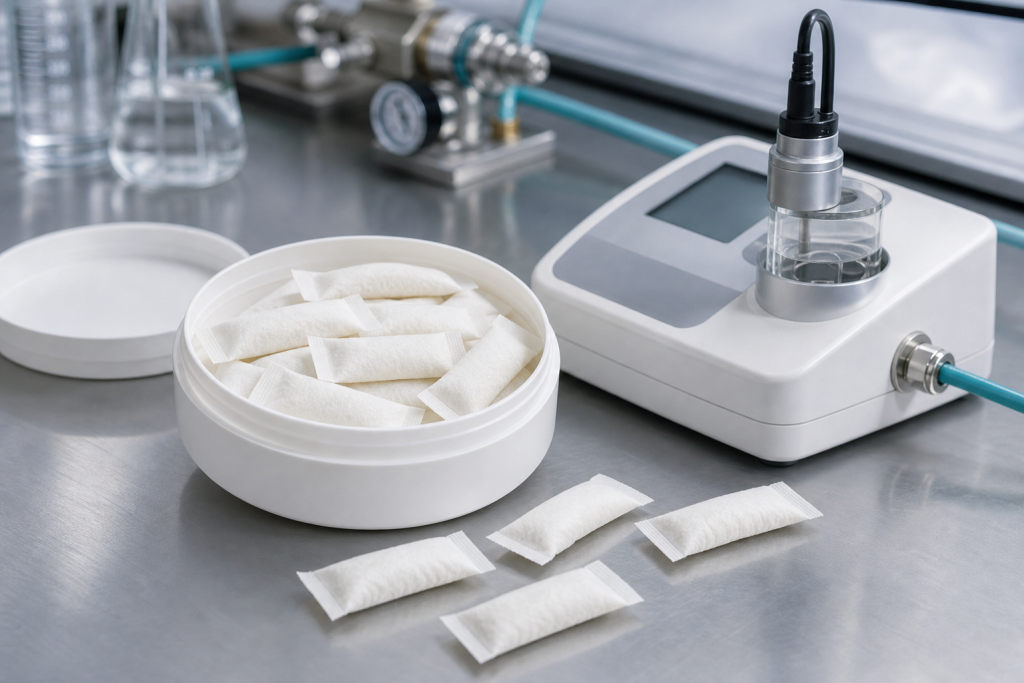
- Factory packaging-lab photograph of slim oral pouches, nitrogen line and headspace oxygen analyzer.
- Comparison graphic showing oxygen at packing, after closure and during stability storage.
Related manufacturing references
For a complete OEM review, connect this article with the main product and process pages. Buyers usually need category fit, stock-formula options, custom formulation support, process checks, and a direct project discussion before approving samples.
- Custom oral pouch manufacturing
- Stock formulation options
- Private label pouch project planning
- Formulation and R&D support
- Manufacturing process and quality checks
- Technical manufacturing blog
- Discuss a project
Content review note: technical articles are reviewed for functional oral pouch, ODF, packaging, and OEM procurement relevance.