
Primary target long-tail keyword: oral pouch can liner compatibility testing for flavor stability
A can can pass a basic leak check and still damage the pouch inside it. Mint oil moves into some liner materials. Citrus top notes disappear into the headspace. Plastic odor transfers to a mild oral-care formula. Moisture leaves a semi-moist pouch even though the lid appears tight.
Compatibility testing treats the formula, nonwoven, can, liner and closure as one system. Buying the cheapest stock can after formulation approval reverses that logic and often forces a late stability restart.
Define what the liner is expected to do
The liner may provide sealing pressure, tamper evidence, moisture control or only a clean contact surface. Ask the packaging supplier for material construction, adhesive information where relevant, food-contact documentation and recommended storage conditions.
Do not accept silver appearance as proof of barrier. Two visually similar liners can use different polymers, foams or foil thicknesses. The exact commercial structure must be used in testing.
Flavor scalping is easy to miss
Scalping occurs when packaging absorbs flavor molecules. The pouch has not leaked, yet mint becomes weaker and the liner smells stronger each month. Citrus, berry and coffee top notes can shift at different rates, leaving an unbalanced base flavor.
Compare retained formula in glass or another suitable control with the candidate can systems. Smell the liner separately, then run a timed pouch panel. Instrumental data helps when available, but a disciplined sensory record often identifies the first commercial change.
Watch for odor moving in the other direction
Fresh plastic, inks, adhesives and recycled-content packaging may contribute odor. A strong mint product can hide it during development. A mild xylitol or tea formula exposes it immediately after storage.
Condition empty packaging as well as filled cans. Record odor before filling and after heat exposure. Printed labels and shrink bands should be included because volatile components do not respect the project teams dividing packaging and formulation.
Measure moisture as a system
Weigh sealed cans and individual pouches over time. Check moisture or water activity where relevant, pouch texture, clumping and free movement. A semi-moist pouch may firm while the can weight change looks small because moisture redistributed into the liner.
Dry pouches can gain moisture during repeated opening. Add an in-use study that opens the can on a fixed schedule and removes units. Unopened stability alone can overstate consumer performance.
Closure consistency matters more than one good sample
Measure application conditions and inspect multiple cans across a packaging run. Warped rims, liner placement and cap torque variation create isolated failures. Those random cans generate customer complaints that a small laboratory set may not predict.
Keep units from the beginning, middle and end of packaging. If only one carton shows weight drift, investigate closure application and component lots before reformulating the pouch.
Challenge hot transport and cycling
Constant room temperature does not represent a container route. Heat expands headspace and accelerates flavor migration. Cooling can create condensation or pressure changes. Humidity attacks labels and secondary seals while the can is repeatedly handled.
Use accelerated screening, real-time storage and route-specific cycles. Do not convert a few hot weeks into an exact two-year shelf life without supporting real-time data. Different flavor and packaging reactions accelerate at different rates.
Lock the commercial component codes
Approve the can, lid, liner and supplier by exact code. A packaging converter may offer an equivalent liner later. Equivalent dimensions do not prove equivalent absorption, seal behavior or odor.
Require change notification for polymer, adhesive, thickness, colorant and manufacturing site where applicable. Retain packaging samples from every lot so later investigations have a physical comparison.
Set acceptance criteria before artwork
- Can and pouch weight change
- Liner and headspace odor
- Timed flavor profile
- Pouch texture and staining
- Closure integrity
- Component deformation
- Label and print condition
- Microbiological quality where relevant
Agree commercial limits before branded packaging is purchased. If the product only passes in a different liner, changing artwork is cheaper than defending a stale flavor for the full shelf life.
Compare pack size with the in-use period
A larger can stays open in the consumer environment for more days. That gives dry pouches more opportunities to absorb humidity and semi-moist pouches more time to lose aroma. The same closure can perform well for a fifteen-count trial and poorly for a sixty-count commercial pack.
Run the opening schedule against the proposed count and serving direction. Include partially empty headspace near the end of use. If the formula changes noticeably, reduce the count, improve the closure or give clearer storage instructions rather than relying on unopened shelf-life data.
Photograph liner placement and closure surfaces at every interval. Images give packaging and formulation teams a common record when odor, weight drift or deformation appears. Written notes alone often miss whether a defect began at the rim, liner edge or pouch contact surface.
Questions Buyers Usually Ask
Can a high-barrier liner guarantee flavor stability?
No. It can reduce transfer, but formula ingredients may still react with each other or migrate into other packaging components.
Should empty cans be tested?
Yes. Empty-packaging controls help identify odor or volatile transfer originating from the can, liner, label or adhesive.
Send the proposed can construction, liner code, moisture style and flavor family when requesting compatibility work. LinkBioLabs can build the package screen before printed components are ordered.
Recommended Blog Images
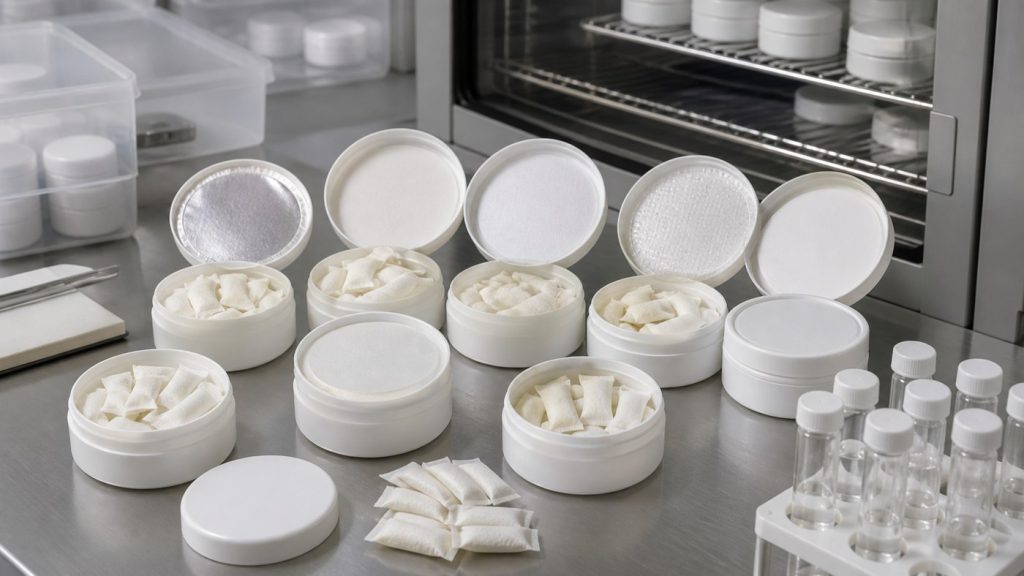
- Multiple can and liner structures undergoing stability conditioning with finished pouches.
- Compatibility matrix covering flavor, odor, moisture, closure and hot-route performance.
Related manufacturing references
For a complete OEM review, connect this article with the main product and process pages. Buyers usually need category fit, stock-formula options, custom formulation support, process checks, and a direct project discussion before approving samples.
- Custom oral pouch manufacturing
- Stock formulation options
- Private label pouch project planning
- Formulation and R&D support
- Manufacturing process and quality checks
- Technical manufacturing blog
- Discuss a project
Content review note: technical articles are reviewed for functional oral pouch, ODF, packaging, and OEM procurement relevance.