
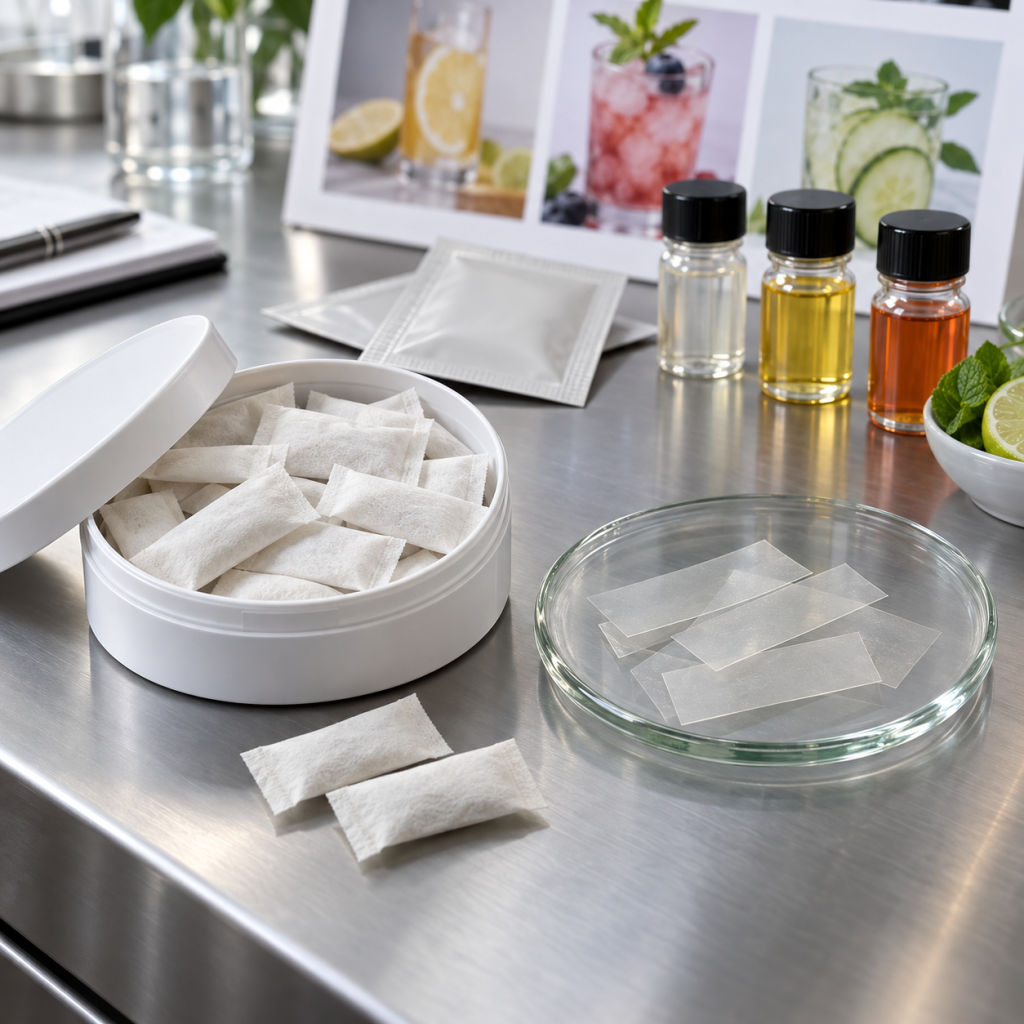
Same concept does not mean same formula
A beverage or wellness brand may want one idea in two oral formats: a pouch and an ODF strip. The brand language can be shared. The formula cannot simply be copied. An oral pouch depends on powder flow, carrier structure, pouch fabric, moisture and flavor release through saliva. An orodispersible film depends on polymer system, plasticizer, solids load, drying behavior, film strength, cutting and sachet barrier.
This difference matters most when the concept contains caffeine, L-theanine, vitamins, minerals or botanical extracts. A bitter botanical may be manageable in a pouch with strong mint and slower release, but it may become too sharp in a fast-dissolving film. A vitamin blend may work in a film but make a pouch gritty. The shared brand idea is useful; the technical path still splits.
Choose the launch sequence by use occasion
ODF strips and pouches can serve different moments. Films are thin, portable and quick to use. Pouches are slower, more sensory and often feel more like a routine. For a beverage brand, ODF may work as a pocket-format extension of a flavor system, while pouches may support longer work, travel or focus occasions. Trying to launch both formats at once can stretch sampling, artwork and testing resources.
- Launch ODF first when: the formula load is modest, quick dissolve matters, and the brand wants a very thin pack.
- Launch pouches first when: mouthfeel, gradual flavor release and can-based branding are central to the product idea.
- Launch both only when: the buyer has budget for separate samples, packaging, stability checks and label review.
A small brand often does better with one commercial format and one development-format sample. That keeps learning active without doubling all costs immediately.
Technical limits that split the formats
ODF films dislike some loads. Too much crystalline material can weaken the film, slow dissolution, or create visible specks. Some botanical extracts interact poorly with polymers or change during drying. Pouches have different problems: powder segregation, fabric staining, flavor oil leakage, water activity drift, and pouch hardening. A formula that is stable in one format may fail quietly in the other.
Flavor also behaves differently. In a film, the user gets a quick burst as the strip hydrates and disappears. In a pouch, flavor is judged over minutes. A citrus flavor that works in ODF may fade too fast in a pouch. A strong mint that works in a pouch may overpower a film. The sensory panel should score each format separately instead of using one approval note.
Packaging and sampling are separate projects
ODF strips usually need sachets or blister-style protection with strong moisture barrier. Oral pouches need cans, liners, labels, desiccant decisions, count control and carton handling. Artwork may share brand colors, but dielines and required panels differ. The project manager should treat packaging as two workstreams.
Sampling should also be staged. First, prove the functional concept in each format. Second, refine flavor and mouthfeel. Third, run packaging compatibility and stability checks. Skipping straight to printed packaging creates risk. The product line may look unified on a mockup but behave unevenly in storage.
How to build a practical first line
A practical first line usually starts with one core function and two flavor directions. For example, caffeine plus citrus-mint can be tested in an ODF strip and a pouch, but the target active load and flavor system should be adjusted for each format. The buyer then compares user occasion, cost, sample feedback and packaging path before choosing the first SKU.
LinkBioLabs can support both oral pouch and ODF development, but the cleanest projects keep the decision map visible. Do not ask the factory for “the same formula in both.” Ask which ingredients, flavors and package choices can carry the same brand promise without forcing either format beyond its manufacturing limits.
Shared branding still needs separate acceptance tests
A combined line should share brand logic, not acceptance limits. ODF strips need checks for film thickness, tack, dissolution, cutting quality, sachet seal and brittleness after storage. Oral pouches need checks for fill weight, seam integrity, pouch softness, water activity, flavor hold and can closure. Buyers should write one product-line brief and two technical acceptance sheets. That small separation prevents the team from approving one format because the other format performed well.
Frequently asked questions
Can the same active blend be used in ODF strips and oral pouches?
Sometimes, but the formula usually needs separate adjustment because film formation and pouch filling have different constraints.
Which should a beverage brand launch first, ODF or oral pouches?
Choose based on use occasion, budget, packaging path and formula feasibility. Many brands sample both but commercialize one first.
Do ODF strips and pouches need separate stability checks?
Yes. Moisture barrier, flavor behavior and ingredient compatibility differ, so each format needs its own review.
{“@context”:”https://schema.org”,”@type”:”FAQPage”,”mainEntity”:[{“@type”:”Question”,”name”:”Can the same active blend be used in ODF strips and oral pouches?”,”acceptedAnswer”:{“@type”:”Answer”,”text”:”Sometimes, but the formula usually needs separate adjustment because film formation and pouch filling have different constraints.”}},{“@type”:”Question”,”name”:”Which should a beverage brand launch first, ODF or oral pouches?”,”acceptedAnswer”:{“@type”:”Answer”,”text”:”Choose based on use occasion, budget, packaging path and formula feasibility. Many brands sample both but commercialize one first.”}},{“@type”:”Question”,”name”:”Do ODF strips and pouches need separate stability checks?”,”acceptedAnswer”:{“@type”:”Answer”,”text”:”Yes. Moisture barrier, flavor behavior and ingredient compatibility differ, so each format needs its own review.”}}]}
Reference notes for buyers
This article is written for B2B product development and procurement planning. It is not legal, medical, or regulatory advice.
Related manufacturing references
For a complete OEM review, connect this article with the main product and process pages. Buyers usually need category fit, stock-formula options, custom formulation support, process checks, and a direct project discussion before approving samples.
- Custom oral pouch manufacturing
- Stock formulation options
- Private label pouch project planning
- Formulation and R&D support
- Manufacturing process and quality checks
- Technical manufacturing blog
- Discuss a project
Content review note: technical articles are reviewed for functional oral pouch, ODF, packaging, and OEM procurement relevance.