
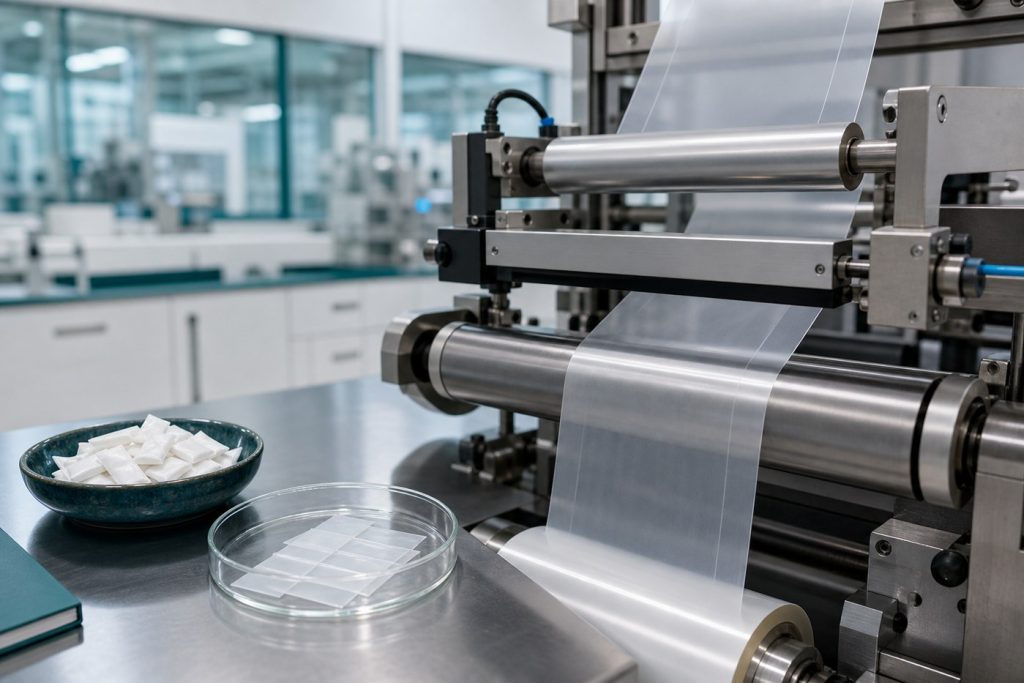
Film thickness is both a product attribute and a process signal. If solids are well dispersed, coat-weight variation can translate into dose variation. It can also change drying, disintegration, stiffness and the way individual strips feed into sachets.
Control the Coating Solution First
Verify solids, viscosity, homogeneity, temperature and air removal before casting. A stable coating gap cannot compensate for settling, foam or viscosity drift in the feed.
Measure More Than One Location
Build an across-web and along-web sampling map. Edge and center positions can behave differently. Record roll position so a thickness or assay result can be traced to its process conditions.
Use Suitable Measurement Methods
A contact micrometer is simple but can compress soft films. Non-contact or mass-per-area methods may add useful information. Define conditioning, number of readings and instrument resolution.
Connect Thickness to Critical Attributes
- Active content or dosage-unit uniformity
- Disintegration time
- Tensile and folding behavior
- Residual moisture
- Cut dimensions and edge quality
- Sachet feeding and seal-zone clearance
Manage Start-Up and Transitions
Coating start, stops, speed changes and solution replenishment can create non-representative film. Define discard or segregation zones and reconcile accepted yield.
Set Specifications From Capability
A copied micrometer range has little value if the method and process cannot reliably distinguish it. Develop limits using pilot data, analytical variation and the product’s dose and performance requirements.
Frequently Asked Questions
Does uniform thickness guarantee uniform dose?
No. Active distribution and assay still matter, especially if the solution settles or phase-separates.
When should thickness be checked?
During development, coating start-up, at defined intervals across the web, and after relevant process changes.
Planning a functional pouch or ODF project? Share the target market, formula direction, pack format and forecast through our contact page. LinkBioLabs can review stock, modified and fully custom manufacturing routes.
Related manufacturing references
For a complete OEM review, connect this article with the main product and process pages. Buyers usually need category fit, stock-formula options, custom formulation support, process checks, and a direct project discussion before approving samples.
- Custom oral pouch manufacturing
- Stock formulation options
- Private label pouch project planning
- Formulation and R&D support
- Manufacturing process and quality checks
- Technical manufacturing blog
- Discuss a project
Content review note: technical articles are reviewed for functional oral pouch, ODF, packaging, and OEM procurement relevance.