
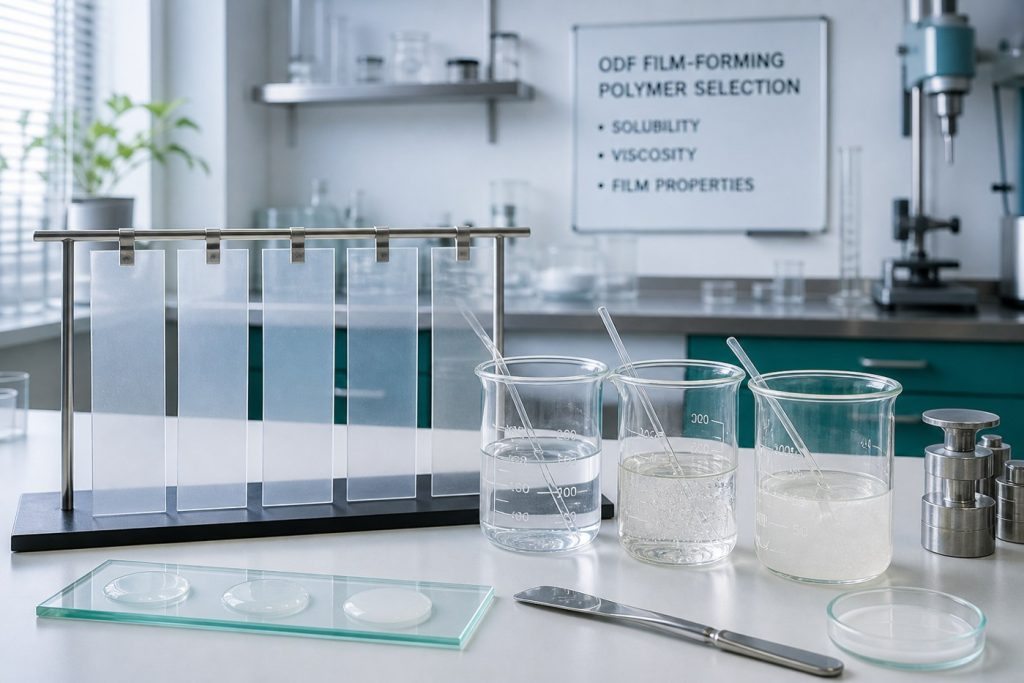
The polymer is the structural backbone of an orodispersible film, but selecting one from a supplier list is not enough. Grade, molecular weight, solution viscosity, interaction with the active and the drying process all influence whether the film can be coated, handled, packaged and dispersed as intended.
Translate the Product Brief Into Polymer Requirements
Define film size, active load, desired dispersion behavior, taste system, moisture target and packaging. A fast-wetting wellness film and a high-load suspended-active film may need very different polymer strategies.
Screen Solubility and Solution Behavior
The polymer must hydrate predictably at a practical solids level. Measure viscosity over the expected temperature and hold time. Lumps, trapped air, gel particles or continued viscosity growth can create coating lines and thickness variation.
Evaluate Compatibility With the Complete Formula
Acids, salts, botanical extracts, sweeteners, flavors and surfactants may change polymer hydration or cause precipitation. Test the commercial active grade and every carrier it brings; a clear placebo solution is only a starting point.
Balance Critical Film Properties
- Release from the casting liner
- Thickness and mass-per-area consistency
- Tensile strength, flexibility and folding behavior
- Surface tack and blocking
- Wetting and disintegration
- Taste, mouthfeel and residue
- Residual moisture and storage stability
Do Not Optimize Disintegration Alone
Reducing polymer or adding highly water-soluble ingredients may speed breakup but weaken the web. Increasing plasticizer can improve flexibility while increasing tack or moisture sensitivity. Useful development searches for a workable window across all attributes.
Plan for Drying and Scale
A polymer system that performs in a small tray may behave differently under continuous airflow and web tension. Drying rate affects residual moisture, crystallization, curl and mechanical strength. Pilot trials should use representative coat weight and residence time.
Document the Commercial Grade
Lock supplier, grade, viscosity range, microbiological limits, storage and change notification. A material with the same generic name may not be equivalent in production.
Frequently Asked Questions
Can two film-forming polymers be blended?
Yes. Blends can balance strength, disintegration and processing, but compatibility and batch reproducibility must be demonstrated.
Is a natural polymer always preferable?
Not automatically. Source, variability, microbiology, processing and performance matter alongside label preference.
Have a functional pouch or ODF project in development? Send the target market, active system, serving format, flavor direction and forecast through our contact page for a feasibility review.
Related manufacturing references
For a complete OEM review, connect this article with the main product and process pages. Buyers usually need category fit, stock-formula options, custom formulation support, process checks, and a direct project discussion before approving samples.
- Custom oral pouch manufacturing
- Stock formulation options
- Private label pouch project planning
- Formulation and R&D support
- Manufacturing process and quality checks
- Technical manufacturing blog
- Discuss a project
Content review note: technical articles are reviewed for functional oral pouch, ODF, packaging, and OEM procurement relevance.