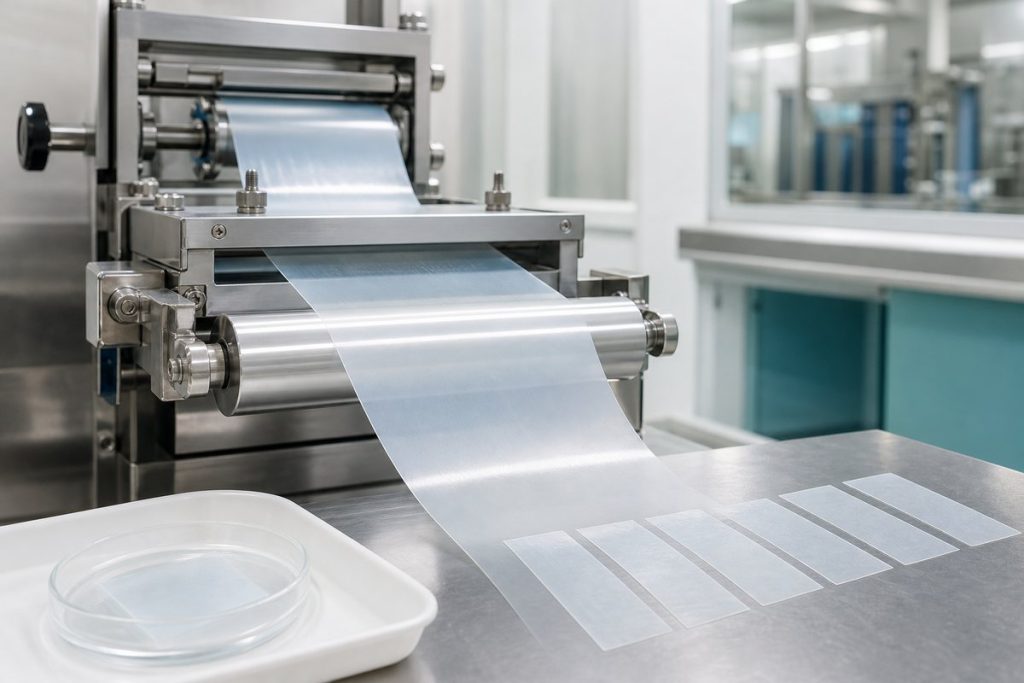
A laboratory ODF can look excellent in a small tray and still struggle on a continuous line. Commercial scale-up changes the mixing volume, coating width, drying path, web tension and time between operations. The objective is not to make a larger copy of the bench sample; it is to preserve the approved film characteristics through a different production environment.
Brands sourcing an ODF contract manufacturer should ask how the formulation and process are transferred together. A formula without mixing, casting and drying controls is incomplete, while a machine setting without a defined film target cannot protect quality.
Define the Target Film Before the Pilot Run
The product specification should describe the film dimensions, thickness or mass per area, appearance, mechanical handling, disintegration target, ingredient content and packaging. Sensory points such as flavor, tackiness and mouthfeel also need an approved reference. These targets guide which process adjustments are acceptable during scale-up.
Mixing Changes With Batch Size
Polymer hydration, active dispersion, viscosity and entrained air influence the cast web. A larger vessel can create different shear and temperature histories from a laboratory mixer. Record addition order, mixing time, temperature, hold time and deaeration. The solution should remain suitable throughout the planned coating window, not only when first prepared.
Casting and Drying Work as One Process
Coating gap, line speed and solution viscosity influence wet-film thickness. Drying temperature, airflow and residence time then affect residual moisture, film structure and handling. Running hotter is not always faster if it creates bubbles, curling, surface skinning or ingredient stress.
A published study on ODF transfer from laboratory to continuous manufacturing highlights the importance of defined viscosity ranges and drying conditions. Broader reviews likewise identify bubbles, nonuniformity, shrinkage and rippling as recurring solvent-casting risks.
Plan Where Uniformity Is Measured
One sample from the center of a roll cannot represent the full web. The pilot plan should consider positions across the width and along the run, especially during startup and after adjustments. The manufacturer should define how coated film is identified and segregated before slitting and cutting.
- Casting-solution solids, viscosity and hold time
- Wet and dry film thickness or mass per area
- Moisture or residual solvent where relevant
- Active or marker content and content uniformity
- Tensile, folding or handling properties as appropriate
- Disintegration and sensory characteristics
- Cut dimensions, unit weight and visual defects
Do Not Leave Cutting and Packaging Until the End
A film must survive slitting, cutting, transfer and sachet sealing. A formulation that performs only when lifted carefully by hand is not commercially ready. Pilot material should run through representative downstream equipment so static, sticking, edge damage and registration issues appear before launch inventory is made.
Use a Controlled Scale-Up Record
Record which parameters changed from the lab method, the reason for each change and the result. Keep samples from defined roll positions. If the pilot leads to a formulation change, update the specification and stability plan rather than treating it as a harmless machine adjustment.
Questions for an ODF Contract Manufacturer
- Which equipment is used for laboratory, pilot and commercial casting?
- How is casting-solution viscosity controlled over the run?
- Which drying parameters are recorded?
- How is cross-web and along-web uniformity sampled?
- Can pilot films be cut and sachet-packed on representative equipment?
- Which scale-up changes require brand approval?
- What batch documents and retained samples are provided?
LinkBioLabs supports orodispersible film development from formulation planning and prototype casting through cutting, unit-dose packaging and scale-up. Share the active system, target film size, market, packaging direction and projected volume through our contact page for a manufacturing feasibility review.
Related manufacturing references
For a complete OEM review, connect this article with the main product and process pages. Buyers usually need category fit, stock-formula options, custom formulation support, process checks, and a direct project discussion before approving samples.
- Custom oral pouch manufacturing
- Stock formulation options
- Private label pouch project planning
- Formulation and R&D support
- Manufacturing process and quality checks
- Technical manufacturing blog
- Discuss a project
Content review note: technical articles are reviewed for functional oral pouch, ODF, packaging, and OEM procurement relevance.