
Primary target long-tail keyword: nonwoven fabric grades for oral pouch mass production
Nonwoven fabric is often approved from softness and appearance. That is not enough for commercial caffeine pouch production. The fabric must track through the machine, contain fine powder, seal within a workable temperature range and remain comfortable after weeks in contact with the formula.
There is no universal best grade. A useful comparison looks at construction, basis weight, pore behavior, lint, tensile strength and sealing performance on the intended line.
Compare construction before price
Heat-sealable pouch webs may use different fiber blends and bonding patterns. Two white materials with the same basis weight can behave very differently under tension. One stretches near the forming shoulder. Another remains stable but feels stiff in the mouth.
Request the complete grade code, manufacturer, construction and supported food-contact documentation. Generic descriptions such as “premium soft nonwoven” are not purchasing specifications.
Basis weight changes more than thickness
A lighter web can feel discreet and permit quick liquid transfer. It may wrinkle, puncture or wander during high-speed filling. A heavier grade is normally easier to handle but may slow flavor release and feel bulky.
Test several grades at the final pouch dimensions. The narrowest pouch is often the most demanding because small web movement creates visibly uneven seals. Record thickness and basis-weight tolerances, not only nominal values.
Permeability must match the powder
Caffeine formulas contain fine active, flavors, sweeteners and larger carriers. If the fabric pore structure is too open for the fine fraction, dust appears outside the pouch and inside the can. This is both a quality and dose-control concern.
Run powder-retention work with the finished blend. Purified caffeine, tea powder and guarana extract do not behave alike. A fabric that holds a coarse placebo may leak the production formula.
Air permeability also influences saliva entry and flavor release. Lower permeability is not automatically better. It can produce a slow, weak consumer experience.
Lint is a production contaminant
Some soft webs shed at slit edges and machine guides. Fiber lint accumulates on sensors, enters the seal and increases cleaning stops. It can also appear as visible strands on finished pouches.
Inspect cut edges under magnification and wipe guides after a defined trial quantity. Supplier lint data is useful, but machine confirmation matters. Most small buyers never ask for this test until a line begins stopping every hour.
The sealing window should be forgiving
Commercial lines vary slightly in jaw temperature, pressure and contact time. A fabric with a narrow sealing window produces incomplete seams when speed rises and scorched edges when temperature is increased to compensate.
Challenge low, center and high settings within the proposed window. Examine longitudinal and cross seals separately. Include powder contamination in the evaluation because real filling material can enter the seal zone.
Test fresh seals and conditioned pouches. Humectants and flavor oils in semi-moist formulas may migrate into the sealing layer and reduce strength over time.
Tensile direction matters on the machine
Nonwoven webs can have different strength in machine and cross directions. Web tension acts mainly along the running direction, while forming and sealing stress both axes.
Request tensile and elongation data in both directions. During the trial, record tension, tracking, wrinkle formation and registration. A fabric can have high ultimate strength yet stretch enough to move the seal position.
Use a representative line trial
Hand-filled pouches are suitable for early sensory work, not final fabric approval. Run the intended size, fill weight, formula and speed. Review hundreds of consecutive units rather than choosing ten good samples.
- Reject rate and line stops
- Fill contamination around seals
- Seam width and peel behavior
- Fabric staining
- Powder leakage
- Pouch softness after conditioning
- Performance in the final can
Keep samples from the start, middle and end of the roll. Material variation across a roll can be missed if the trial is too short.
Lock the supplier grade after approval
A converter may offer a cheaper “equivalent” later. Require technical review before replacement. Recheck machine behavior, powder retention, sensory release and stability. Identical color and basis weight do not prove equivalence.
The commercial specification should include grade, width, roll dimensions, splice rules, tolerances, sealing guidance and change notification.
Do not skip incoming-roll verification
A certificate of analysis does not show whether a roll was telescoped in transit, slit with a damaged blade or stored in a humid warehouse. Check roll width, edge quality, winding, splice location and a small basis-weight map before releasing the material to production.
Keep a retained swatch from every lot. When lint or seam failures appear weeks later, the retained sample lets the factory separate a fabric change from machine setup or formula contamination. Without it, the investigation becomes guesswork and the next order repeats the same argument.
Questions Buyers Usually Ask
Is the softest fabric best for caffeine pouches?
No. It must also resist lint, retain fine powder, seal reliably and track at production speed.
Can one fabric be used for dry and semi-moist pouches?
Sometimes, but semi-moist formulas require added testing for liquid migration, staining and aged seal strength.
Provide the pouch dimensions, target fill weight, moisture style and powder particle profile when asking for a fabric recommendation. LinkBioLabs can screen candidate webs on representative equipment before the material is committed to a full commercial roll.
Recommended Blog Images
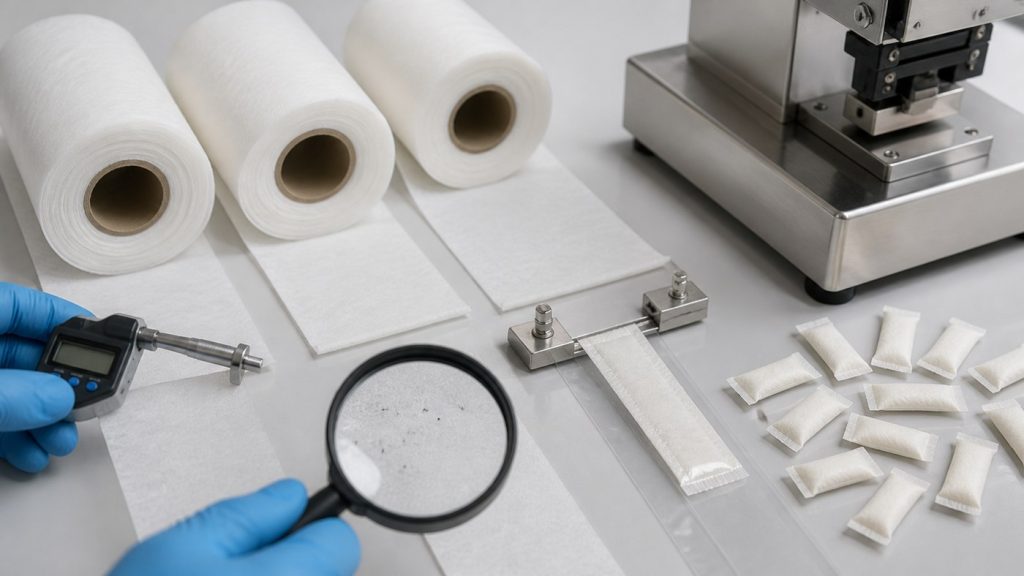
- Close factory photograph of three nonwoven rolls, cut swatches, finished pouches and heat-sealing equipment.
- Comparison graphic covering basis weight, permeability, lint, tensile behavior, softness and sealing window.
Related manufacturing references
For a complete OEM review, connect this article with the main product and process pages. Buyers usually need category fit, stock-formula options, custom formulation support, process checks, and a direct project discussion before approving samples.
- Custom oral pouch manufacturing
- Stock formulation options
- Private label pouch project planning
- Formulation and R&D support
- Manufacturing process and quality checks
- Technical manufacturing blog
- Discuss a project
Content review note: technical articles are reviewed for functional oral pouch, ODF, packaging, and OEM procurement relevance.