
Primary target long-tail keyword: microencapsulated vs liquid flavor for oral pouch manufacturing
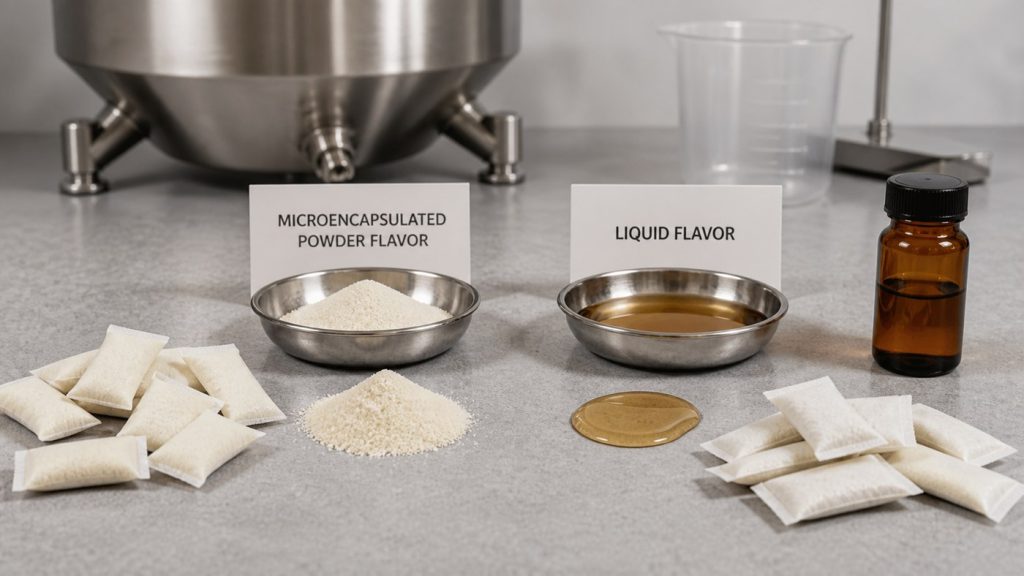
Liquid flavor is easy to dose in a bench sample and can give a strong opening. In production it may create wet pockets, coat the feeder and migrate into the pouch seam or can liner. Microencapsulated powder normally flows better, but the carrier takes space and release may feel delayed or dusty.
Neither format is automatically superior. The choice depends on flavor chemistry, pouch moisture, target use time, available fill mass and the way the commercial line handles liquids and fine powders.
Compare the complete flavor composition
Ask for the flavor carrier, solvent, oil content, encapsulating wall material and recommended storage. A product described as powder may still contain a high oil load. Two liquid mints can behave differently because one uses a solvent that distributes more evenly through cellulose.
Approve the exact supplier grade. Changing carrier while keeping the same flavor name can alter flow, seam strength and headspace aroma.
Liquid flavor changes the blend during holding
Freshly mixed material may look uniform, then continue absorbing liquid for an hour. Clumps form, bulk density shifts and the hopper wall becomes coated. Operators often respond by adding carrier, unintentionally changing dose and flavor concentration.
Screen the blend immediately, after expected equilibration and at the maximum production hold. Write the permitted hold and remix instructions into the batch record.
Encapsulation trades oil control for carrier mass
A microcapsule keeps volatile material inside a dry particle until moisture, pressure or time releases it. This can protect top notes and reduce direct oil contact with seals. The wall and carrier also increase the grams needed to deliver the same aromatic strength.
That extra mass competes with actives and sweetener inside a slim pouch. A high flavor inclusion may make the unit bulky or slow saliva entry.
Particle behavior decides whether powder stays uniform
Fine microencapsulated flavor can segregate from a coarse fibrous base or cling to equipment through static. Agglomerated grades flow better but may create visible specks or uneven bursts if they do not distribute.
Compare sieve distribution and bulk density, use a controlled premix and sample beginning-to-end production. A single composite assay or sensory sample can hide a drifting flavor fraction.
Opening intensity is only one part of flavor quality
Liquid systems often release aroma quickly. That can feel fresh, or it can expose sharp cooling and sweetness before the formula has fully wetted. Encapsulated powder may create a gentler start and longer middle, depending on wall material and moisture.
Use timed sensory scoring for opening, peak, midpoint and finish. Include bitterness and astringency because delayed flavor can uncover the active during early use.
Seal contamination separates laboratory from factory
Liquid flavor and wet agglomerates can enter the longitudinal or end seal. Fresh seams appear closed, then weaken as oil migrates into the heat-seal layer. Increasing jaw temperature may scorch the fabric without correcting the formula.
Run aged peel or leakage checks in the real pouch and can. Inspect samples around startup, speed changes and hopper refills, not only the clean center of the run.
Packaging can absorb what the pouch releases
Mint, citrus and coffee volatiles move into liners, closures and headspace. A liquid flavor may scalp quickly; an encapsulated system can delay migration but still release during warm storage. Shiny packaging is not proof of aroma barrier.
Compare candidate flavors in the final can with empty-packaging and suitable formula controls. Smell the liner separately and score the pouch at fixed times.
Cost the usable flavor, not the quoted kilogram
Microencapsulated flavor may cost more per kilogram and require a higher inclusion because of carrier. Liquid flavor may need more absorbent carrier, slower filling, cleaning time and higher rejection allowance.
Calculate cost per released can using expected yield. A cheaper liquid that cuts line speed or weakens seams can be the more expensive commercial choice.
A hybrid system can solve a real timing problem
A small liquid top note combined with an encapsulated body can provide a recognizable opening and sustained middle. It also combines both process risks, so addition sequence and total liquid load must be controlled.
Do not add formats until the sensory timeline identifies the gap. Complexity without a defined purpose makes supplier changes and stability investigations harder.
Lock the production controls after approval
- Flavor grade and carrier
- Liquid addition rate
- Premix sequence
- Equilibration and hold time
- Particle expectations
- Seal window
- Timed sensory profile
- Can and liner code
- Stability checkpoints
Retain flavor, blend and finished cans by lot. A later complaint about weak aroma cannot be traced reliably if the factory has only the finished specification and no supplier sample.
Questions Buyers Usually Ask
Is microencapsulated flavor always more stable?
No. Stability depends on the wall material, formula moisture, package and storage; it must be tested in the finished pouch.
Can liquid and encapsulated flavors be combined?
Yes, when the combination solves a defined release or sensory problem and the total liquid, carrier and sealing effects are validated.
Provide the flavor family, desired use-time profile, pouch moisture and fill limit when comparing formats. LinkBioLabs can test both routes on representative equipment before a flavor grade is locked.
Recommended Blog Images
- Side-by-side factory photograph of microencapsulated powder and liquid flavor with realistic pouches.
- Comparison graphic covering flow, release, carrier mass, seals, packaging migration, stability and cost.
Related manufacturing references
For a complete OEM review, connect this article with the main product and process pages. Buyers usually need category fit, stock-formula options, custom formulation support, process checks, and a direct project discussion before approving samples.
- Custom oral pouch manufacturing
- Stock formulation options
- Private label pouch project planning
- Formulation and R&D support
- Manufacturing process and quality checks
- Technical manufacturing blog
- Discuss a project
Content review note: technical articles are reviewed for functional oral pouch, ODF, packaging, and OEM procurement relevance.