
Primary target long-tail keyword: how to mask bitter herbal extracts in oral pouches
A bitter herbal pouch rarely improves by adding more mint. Strong flavor can cover the first seconds, then the extract appears in the middle of use and stays after the pouch is removed. More sweetener often produces the same problem: a sweet opening followed by a harsher bitter finish.
Taste masking works when the manufacturer identifies where bitterness and astringency come from, then controls release through extract grade, particle design, carrier, moisture and a layered flavor system. The complete commercial formula must be tested. A flavored blank proves very little.
Profile the actual production extract
Botanical name alone does not predict taste. Plant part, extraction solvent, concentration, standardization and carrier can change bitterness substantially. A 10:1 dry extract does not necessarily taste like another supplier’s 10:1 grade.
Record marker assay, carrier percentage, particle size, color, odor, solubility and residual taste. Compare samples at an equivalent active-marker amount, not equal extract weight. A cheap low-assay material may require more powder and create a larger sensory problem.
Do not assume a water-soluble extract is easier. Dissolved bitter compounds may become available quickly in saliva. A fine suspension can delay exposure, but it creates settling and mouthfeel risks.
Prevent separation before solving flavor
Herbal extract particles often differ in density from cellulose carriers and sweeteners. A laboratory cup looks uniform because it is used immediately. On the production line, the blend sits in a hopper and vibrates. Dense particles move downward while fine light material rises.
Use a qualified pre-blend or geometric dilution sequence. Match particle distributions where practical. Limit hopper hold time and sample pouches across the run. If active distribution changes, sensory intensity changes too; flavor work cannot correct unit-to-unit variation.
Semi-moist formulas add another failure mode. Liquid is sprayed unevenly, causing local clumps rich in flavor and extract. Control spray rate, mixing sequence and post-addition mixing time.
Build masking in several modest layers
The first layer is the base. Carriers and moisture determine how quickly the extract reaches saliva. The second is sweetness, chosen for onset and duration. The third is flavor character. Acidity, cooling and mouthfeel provide additional controls but should not dominate.
Tea-like extracts often fit citrus, peach or clean mint. Earthy herbs may work with ginger, darker fruit or restrained spice. A candy profile can make a serious wellness product taste artificial while leaving the herbal aftertaste untouched.
Evaluate at fixed intervals: opening aroma, first minute, five minutes, midpoint and finish. Ask panelists to score bitterness, astringency, sweetness, cooling and residue separately. One overall liking score gives the formulator little useful direction.
Sweetener quality shows up during storage
High-intensity sweeteners have different onset and persistence. Polyols add bulk, cooling and moisture effects. Blends often work better than one sweetener at a high level, but every extra material affects flow and stability.
Cheap sweetener premixes may carry unknown maltodextrin levels or develop a flat, metallic finish after storage. Xylitol and erythritol grades also differ in particle size and water content. Approve the exact production grade and do not allow silent replacement.
Run aged sensory testing. A formula that tastes balanced at week one may lose citrus top notes at month three, exposing the unchanged botanical bitterness.
Use cooling and acids with restraint
Cooling can distract from bitterness and support mint positioning. Too much creates throat sensation or a long medicinal finish. Acids brighten fruit flavors but can sharpen certain botanical extracts and alter moisture behavior.
Test low, medium and high levels in the full formula. Do not select the strongest sample after a short tasting. Oral pouches are held longer than a beverage sip, and sensory intensity accumulates.
Physical masking is possible, but not free
Encapsulation, adsorption or complexation may reduce immediate taste exposure. These approaches increase raw-material mass and can change release. Coated particles may feel gritty or break during mixing. They may also make active assay extraction more difficult.
Confirm coating integrity after blending and filling. Check active recovery, particle distribution, pouch texture and shelf stability. A technique borrowed from tablets may not survive the shear, moisture or prolonged oral contact of a pouch.
Watch the fabric and package
Flavor oils and botanical colors can migrate into nonwoven fabric. A dark line around the seam makes an otherwise acceptable pouch look contaminated. Fine extract powder may also pass through a fabric with high permeability.
Test fabric grade, seal condition and staining with the final formula. Then age units in the intended can. Volatile flavor can move into the liner and lid, particularly in semi-moist formats.
Retained samples should be evaluated from unopened cans at each interval. Repeatedly opening the same stability can changes the headspace and gives misleading results.
Write a useful flavor approval standard
The approved sample should identify extract supplier and lot, formula version, pouch weight, moisture target, flavor grade and packaging. Keep retained units. “Mint herbal pouch” is not enough information to reproduce the result six months later.
Set acceptable sensory ranges rather than demanding an exact match to one fresh laboratory sample. Natural extract lots vary, but the consumer experience still needs controlled limits.
Questions Buyers Usually Ask
Can bitterness be removed completely?
Not always. The realistic goal is a balanced profile that remains acceptable for the intended use time without an excessive sweet or cooling load.
Should the flavor be selected before the extract supplier?
No. Flavor work should use the qualified commercial extract because supplier grade, carrier and standardization materially change taste.
For a private label herbal pouch review, send the exact extract specification, amount per pouch and desired use time. A small grade-comparison and sensory screen usually costs less than repeated flavor revisions after the active has already been purchased.
Recommended Blog Images
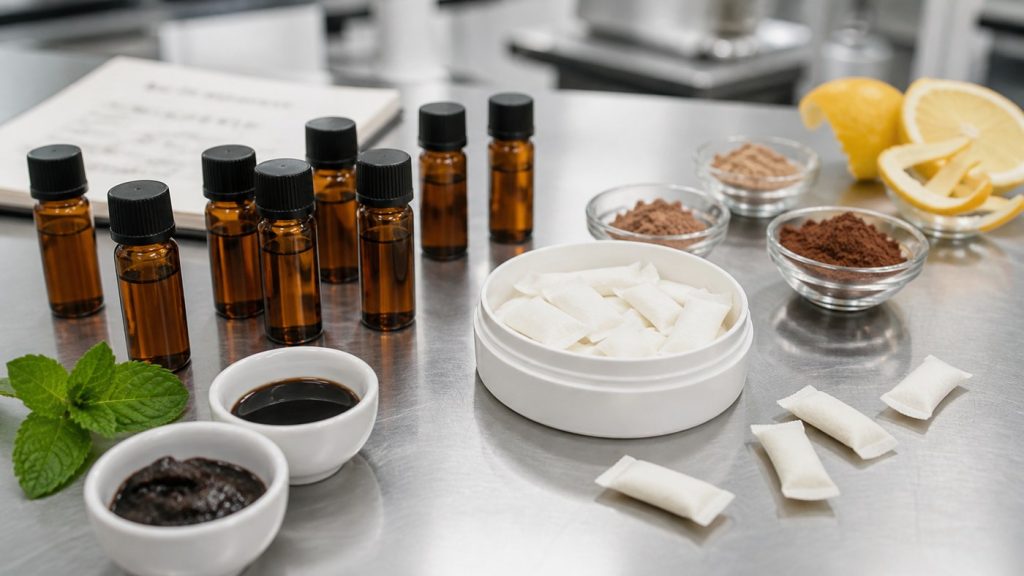
- Formulation bench photograph with white pouches, herbal extracts, mint, citrus and coded flavor samples.
- Sensory timeline graphic showing opening flavor, peak bitterness, astringency and aftertaste during pouch use.
Related manufacturing references
For a complete OEM review, connect this article with the main product and process pages. Buyers usually need category fit, stock-formula options, custom formulation support, process checks, and a direct project discussion before approving samples.
- Custom oral pouch manufacturing
- Stock formulation options
- Private label pouch project planning
- Formulation and R&D support
- Manufacturing process and quality checks
- Technical manufacturing blog
- Discuss a project
Content review note: technical articles are reviewed for functional oral pouch, ODF, packaging, and OEM procurement relevance.