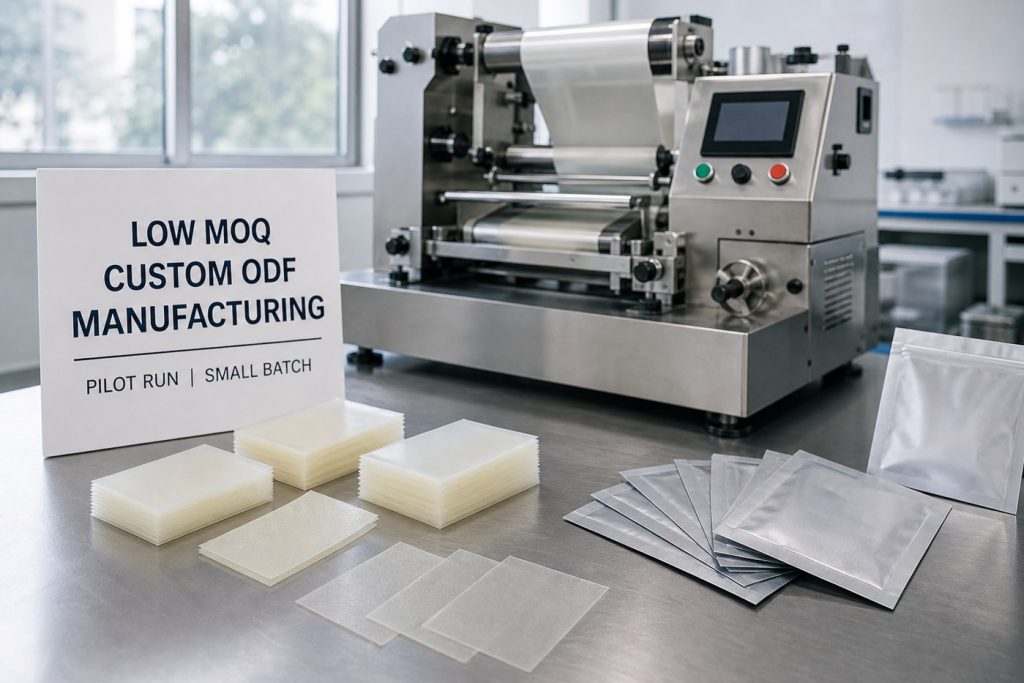
“Low MOQ” can mean a small development batch, a modest first commercial order or simply less inventory than a conventional launch. Those are different commitments. In ODF manufacturing, the practical minimum is often set by coating, cutting and sachet materials—not just the quantity of active ingredient.
Separate Development Quantity From Commercial MOQ
Laboratory sheets prove basic feasibility. A pilot roll tests continuous coating, drying and cutting. A saleable batch adds production controls, finished-product testing and printed packaging. Ask the manufacturer to quote these stages separately.
Begin With a Feasibility Screen
Provide the exact active grade, amount per strip, market, flavor direction and daily serving. The manufacturer should review solubility or suspension behavior, dose capacity, taste, heat and moisture sensitivity, and likely regulatory category before detailed development begins.
Understand What Creates the Minimum
- Minimum solution volume for stable mixing and coating
- Web length needed for start-up and process settings
- Cutting and sachet-machine setup loss
- Minimum order for barrier laminate and printing
- Laboratory sample and stability requirements
- Retained samples and production reconciliation
Use Stock Components Where They Do Not Weaken the Product
A standard film size, existing sachet structure or digital label can reduce first-run commitment. That does not mean accepting an unsuitable polymer or generic flavor. Standardize the invisible parts first and reserve customization for dose, sensory profile and brand identity.
Approve a Pilot With Measurable Criteria
Record thickness, mass per area, active uniformity, disintegration, mechanical handling, taste and sachet seal. Pilot material should be made with representative ingredients and packaging; a hand-cast laboratory strip is not a commercial reference standard.
Budget Beyond the Batch Price
Include development rounds, analytical methods, stability, artwork, packaging cylinders or plates, freight, import costs and potential rework. A very small run can carry a higher unit cost but reduce the cost of learning from an unproven launch.
Scale Without Quiet Formula Changes
When moving from pilot to commercial equipment, lock raw-material grades and document changes in mixing, coating, drying and conditioning. Reconfirm the attributes most sensitive to scale rather than assuming the larger roll will match.
Frequently Asked Questions
What is a normal ODF MOQ?
There is no universal number. Film dimensions, formulation, packaging, testing and production equipment determine the project minimum.
Can printed sachets be ordered in a smaller quantity than the film?
Sometimes digital or short-run options help, but barrier performance and machine compatibility still need approval.
Have a functional pouch or ODF project in development? Send the target market, active system, serving format, flavor direction and forecast through our contact page for a feasibility review.
Related manufacturing references
For a complete OEM review, connect this article with the main product and process pages. Buyers usually need category fit, stock-formula options, custom formulation support, process checks, and a direct project discussion before approving samples.
- Custom oral pouch manufacturing
- Stock formulation options
- Private label pouch project planning
- Formulation and R&D support
- Manufacturing process and quality checks
- Technical manufacturing blog
- Discuss a project
Content review note: technical articles are reviewed for functional oral pouch, ODF, packaging, and OEM procurement relevance.