
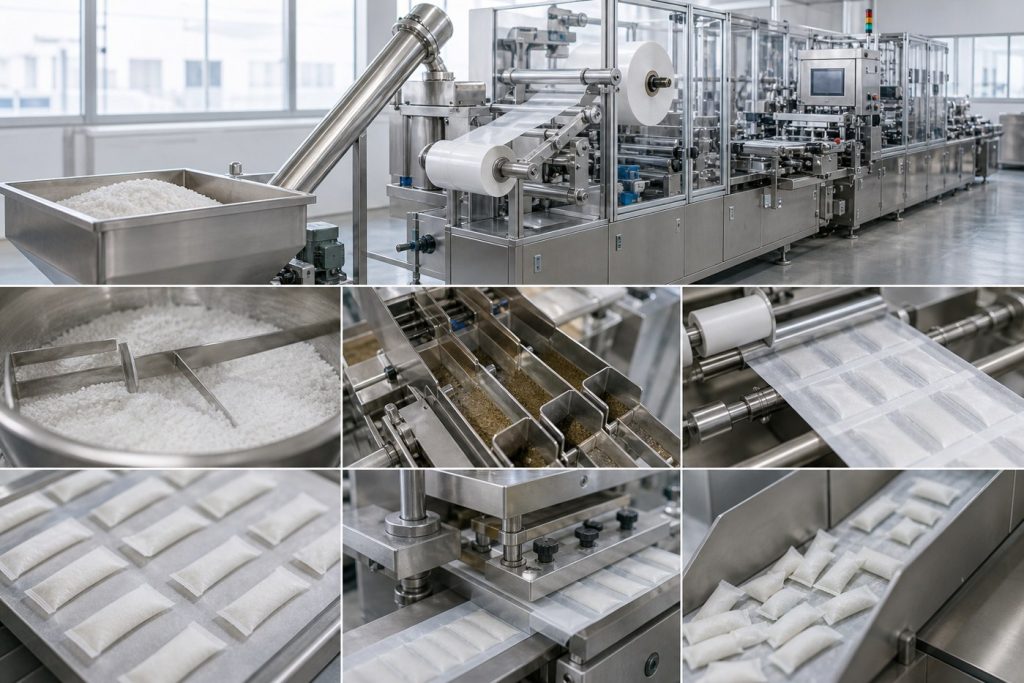
A good pouch begins long before the filling machine starts. Ingredient form, particle size, moisture, bulk density and flavor behavior determine whether a bench formula can become a repeatable commercial batch. This guide follows the practical manufacturing sequence and the decisions an OEM buyer should lock before scale-up.
1. Approve the Raw-Material System
The manufacturer first verifies identity, specification, supplier documents and the amount of every active and carrier. Powders that look similar can flow and blend very differently. Substitutions therefore require review rather than an automatic one-for-one swap.
2. Build a Blend That Can Be Filled Consistently
Actives used at low levels normally need a validated pre-blend or staged addition. Mixing order, time, load and environmental conditions should be documented. The useful endpoint is not simply a visually uniform powder, but a blend that remains uniform while it travels to the filler.
3. Control Filling and Pouch Sealing
- Target net weight and operating tolerance
- Pouch material and dimensions
- Seam width, strength and appearance
- Loose powder and damaged-pouch limits
- In-process weight-check frequency
- Line clearance and reconciliation
4. Condition, Pack and Protect the Product
Freshly made pouches may continue to equilibrate. The can, liner, closure and headspace must be evaluated with the formula because moisture migration affects softness, flavor release and shelf life. Final approval should use the proposed market pack.
5. Release the Batch Against Written Criteria
Release testing can include identity or assay, pouch weight, moisture or water activity, microbiology, sensory checks, seal integrity and packaging inspection. The exact panel depends on formula risk, product category and destination market.
6. Move From Pilot to Commercial Scale
A scale-up plan records the variables most likely to change: mixing energy, hold time, transfer distance, room humidity and line speed. Pilot samples should not be treated as commercial proof until representative equipment and packaging have been assessed.
Frequently Asked Questions
Can one pouch formula run on every machine?
No. Fill range, fabric width, seal design and powder behavior must fit the selected equipment.
What information should a buyer send first?
Target market, actives per pouch, desired pouch size, moisture style, flavors, pack count, claim direction and annual forecast are a useful starting brief.
Planning a functional pouch or ODF project? Share the target market, formula direction, pack format and forecast through our contact page. LinkBioLabs can review stock, modified and fully custom manufacturing routes.
Related manufacturing references
For a complete OEM review, connect this article with the main product and process pages. Buyers usually need category fit, stock-formula options, custom formulation support, process checks, and a direct project discussion before approving samples.
- Custom oral pouch manufacturing
- Stock formulation options
- Private label pouch project planning
- Formulation and R&D support
- Manufacturing process and quality checks
- Technical manufacturing blog
- Discuss a project
Content review note: technical articles are reviewed for functional oral pouch, ODF, packaging, and OEM procurement relevance.