
Primary target long-tail keyword: glycerin vs propylene glycol in semi-moist oral pouch formulas
Humectant choice is often reduced to a simple line: glycerin feels fuller, propylene glycol carries flavor. That is useful as a starting observation, not a production formula. Both ingredients pull and retain moisture, yet they change powder flow, liquid distribution, sweetness, cooling, seam cleanliness and flavor release in different ways.
A semi-moist pouch must stay flexible without becoming wet, sticky or microbiologically difficult to control. The best system depends on the carrier blend, botanical load, nonwoven, target water activity and destination climate. A bench sample that feels good on day two can stain the fabric or lose top notes after three months.
Treat grade and purity as part of the formula
Specify the exact food or applicable compendial grade, supplier and impurity limits. Glycerin and propylene glycol are not interchangeable liquids from any source. Documentation should include identity, assay and relevant contaminant controls.
High-risk excipients need disciplined supplier qualification. A cheaper drum with weak traceability is not a sensible way to save fractions of a cent per pouch. Lock the approved source and require change notification.
Glycerin changes body as well as moisture
Glycerin is viscous and mildly sweet. It can give a fuller, softer mouthfeel and slow liquid migration in a dry carrier. Too much creates tacky mixing, hopper buildup and a heavy sweetness that muddies mint or citrus.
Because it is harder to spray finely when cold, addition temperature and nozzle design matter. Pouring it onto one area produces wet balls that survive mixing and later mark the pouch fabric.
Propylene glycol behaves more like a carrier solvent
Propylene glycol is less viscous and often disperses flavor components more readily. It can support a faster aroma opening and easier spraying. Excess use may produce a thinner, sharper sensory impression and increase migration into the nonwoven or closure liner.
Do not assume every flavor remains stable simply because it dissolves. Some top notes fade faster in a mobile liquid phase, while botanical bitterness can arrive earlier as wetting accelerates.
A blend may be better than either ingredient alone
Many workable formulas use a controlled mixture to balance viscosity, flavor delivery and softness. The ratio should be screened with the actual carrier, active and flavor system rather than copied from another SKU.
Change one variable at a time during screening. If humectant ratio, flavor dose and pouch fabric change together, a good sample cannot be reproduced and a bad one cannot be diagnosed.
Measure water activity and total moisture separately
Total moisture says how much water is present. Water activity indicates how available that water is for reactions and microbial growth. Humectants can change these values differently, so one measurement cannot stand in for the other.
Set product-specific limits supported by stability and microbiological risk assessment. A soft pouch is not proof that the moisture system is controlled.
Watch liquid addition at scale
Laboratory mixing often adds liquid slowly by pipette. Production may use a pump and spray bar over a much deeper bed. Droplet size, feed rate, mixer fill and addition position determine whether the liquid coats evenly or makes local paste.
Define an addition time and post-addition mixing endpoint. Longer mixing is not always corrective; it can warm the blend, drive off volatile flavor and grind fragile particles into dust.
Check fabric wetting and seam cleanliness
After filling, humectant migrates from the carrier toward the nonwoven. Look for translucent spots, oily-looking edges and flavor staining during storage. The problem may be invisible on the first approval day.
Run the intended fabric and line. A more permeable nonwoven may improve release but show surface wetness. Liquid in the seal can weaken bonding even when the center of the pouch feels acceptable.
Use timed sensory, not a first-minute tasting
Record wetting, sweetness, flavor intensity, cooling, bitterness, texture and aftertaste at defined points. Glycerin-rich samples may open slowly and linger; propylene-glycol-rich systems can present aroma and bitter actives earlier.
Test after storage as well as fresh. Low-cost sweetener and flavor combinations often lose balance after a few months, leaving the humectant sweetness or botanical finish more exposed.
Design for the destination climate
Humectants respond to ambient relative humidity. A formula packed in a humid room and shipped through tropical heat may equilibrate differently from one stored in a cool dry market. Package barrier and closure quality remain essential.
Use real-time and accelerated studies in the final can. Include opening and reclosing simulation if consumers are expected to use the can over several days.
Lock a commercial specification
- Humectant grades and suppliers
- Blend ratio
- Liquid addition rate
- Mixer load
- Total moisture
- Water activity
- Fabric appearance
- Seal result
- Timed sensory limits
- Package configuration
Approve the range, not only one successful laboratory point. Production needs room for normal raw-material and environmental variation without turning a soft pouch into a leaking one.
Questions Buyers Usually Ask
Is glycerin always better for a softer oral pouch?
No. It can add softness and body, but excessive glycerin causes tack, slow flavor opening, poor flow and fabric staining.
Can propylene glycol replace glycerin one-for-one?
Usually not without redevelopment. The viscosity, flavor-solvent behavior, sweetness, migration and processing response differ.
Share the carrier system, active load, target softness and shipping market if your semi-moist pouch is becoming sticky, dry or uneven. LinkBioLabs can screen humectant ratios with the intended fabric and package before scale-up.
Recommended Blog Images
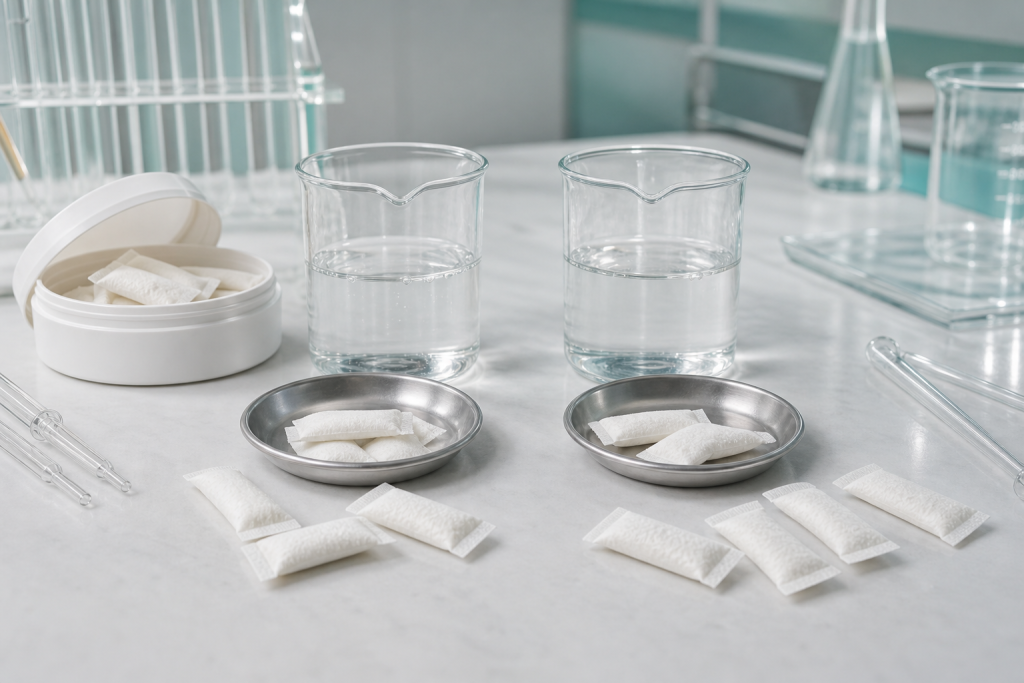
- Side-by-side formulation-lab photograph with clear humectant samples and realistic slim pouches.
- Technical comparison graphic covering viscosity, flavor release, mixing, fabric wetting and storage.
Related manufacturing references
For a complete OEM review, connect this article with the main product and process pages. Buyers usually need category fit, stock-formula options, custom formulation support, process checks, and a direct project discussion before approving samples.
- Custom oral pouch manufacturing
- Stock formulation options
- Private label pouch project planning
- Formulation and R&D support
- Manufacturing process and quality checks
- Technical manufacturing blog
- Discuss a project
Content review note: technical articles are reviewed for functional oral pouch, ODF, packaging, and OEM procurement relevance.