
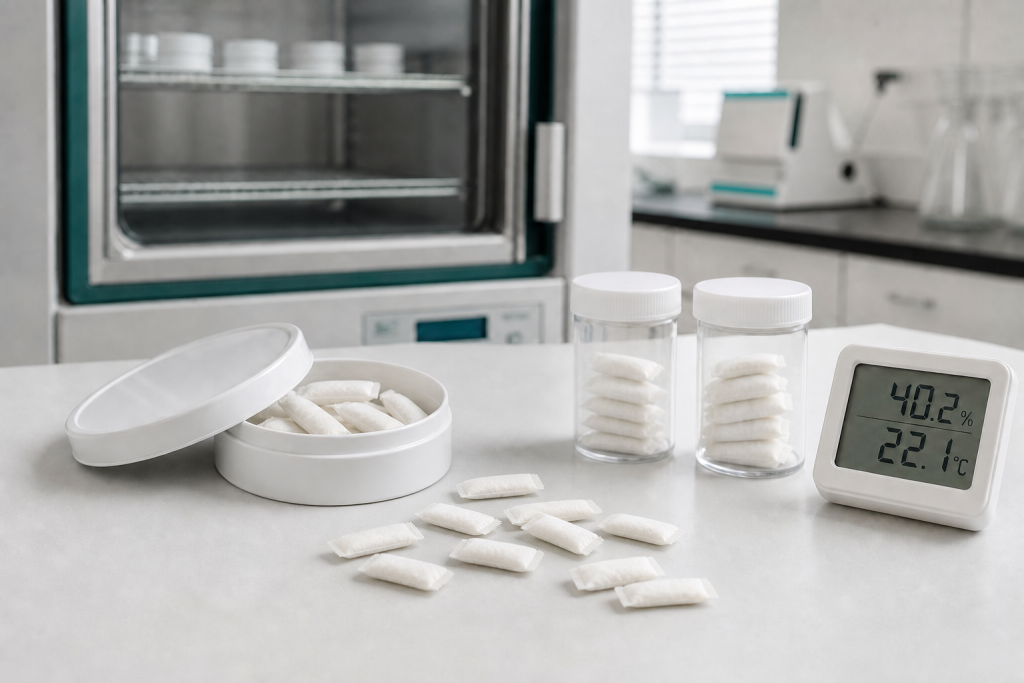
A fresh oral pouch sample can be convincing on the day it leaves the laboratory. The harder question is whether the same pouch will still have the expected taste, softness, appearance and ingredient content after months in a warehouse, a shipping container and a customer’s pocket. That is the job of shelf life testing.
For caffeine, guarana, nootropic, nutritional and oral care pouches, stability is not a single pass-or-fail test. It is a planned comparison of product characteristics over time in the final package. Brands that discuss this work before approving artwork usually make better packaging decisions and avoid promising an expiry period that the product has not earned.
What Can Change Inside a Functional Pouch?
An oral pouch is a small system with several moving parts. Water can migrate between the filling, pouch material and air in the can. Flavors can fade or change character. Hygroscopic ingredients may pull in moisture, while some vitamins and botanical materials can be sensitive to heat, oxygen or light. The pouch seam and can closure also have to keep performing.
Published physical characterization work on oral pouches shows why moisture, dimensions, pouch mass and release behavior deserve measurement rather than guesswork. A recent Scientific Reports study evaluated properties including moisture content and pouch construction. The products in that study are not substitutes for testing a brand’s own formula, but the methods illustrate how much useful information sits behind a simple-looking pouch.
Start With a Written Stability Specification
Before samples enter a chamber or storage room, decide what will be checked and what counts as acceptable. A vague goal such as “still good after 18 months” cannot guide a laboratory. The specification should connect the formula, pouch material, can, label and intended storage condition.
- Appearance, odor, color and visible leakage or staining
- Pouch weight, moisture and physical condition
- Seam integrity, loose powder and pouch breakage
- Flavor, sweetness, cooling and mouthfeel at fixed time points
- Assay of selected active or marker ingredients where appropriate
- Microbiological limits and water activity where relevant
- Can closure, liner and label condition in the final retail pack
Test the Finished Package, Not Only the Bulk Blend
A formula stored in a laboratory jar does not answer how it will behave in the commercial can. The number of pouches, headspace, liner, closure torque and barrier properties all affect the environment around the product. Stability samples should therefore use production-representative pouches and the packaging configuration that will carry the shelf life statement.
This point is easy to miss when custom cans or liners arrive late. If the package changes after a study begins, the brand and manufacturer should assess whether bridging data are reasonable or whether the new configuration needs its own work. A cheaper liner is not cheaper if it shortens flavor life or allows moisture drift.
Real-Time and Accelerated Studies Answer Different Questions
Real-time storage
Real-time samples are stored under the intended long-term conditions and observed across the proposed shelf life. They provide the most direct evidence, but a new brand cannot wait a year or two before making every launch decision.
Accelerated storage
Higher temperature and humidity can reveal weak packaging, flavor change or ingredient instability sooner. Accelerated results are useful for screening and early risk decisions, but they do not automatically convert into an exact number of months. The study design and interpretation should match the product and destination market.
The ICH Q1A(R2) stability guideline was written for drug substances and products, not as a ready-made rulebook for functional pouches. Even so, its disciplined approach to batches, storage conditions, test frequency and container-closure systems is a useful model when a manufacturer builds a product-specific plan.
Use More Than One Batch When the Decision Matters
One hand-made sample can reveal obvious problems, but it may not represent normal production variation. Commercial shelf life confidence grows when the formula, pouch conversion and filling process are represented by suitable pilot or production batches. Record ingredient lots, manufacturing dates, settings and packaging components so an unexpected result can be investigated.
Sensory Testing Needs a Routine
Flavor is often the first quality a customer notices and the least useful result when recorded as “fine” or “bad.” Use retained controls, coded samples and fixed evaluation times. Note the opening aroma, first-minute intensity, midpoint bitterness or dryness, cooling level, finish and pouch softness separately. The same trained reviewers should be used where practical.
A pouch can remain microbiologically acceptable and still fail commercially because the mint disappears, the botanical note becomes harsh or the material dries into a hard pad. Sensory acceptance belongs in the stability plan alongside laboratory values.
Questions to Put in the Manufacturer Brief
- Which shelf life is proposed, and what evidence supports it?
- Will testing use the final pouch material, can, liner and closure?
- Which real-time and accelerated conditions will be used?
- Which active ingredients or markers will be assayed?
- How many batches and time points are included?
- Who reviews out-of-specification or unfavorable trend results?
- Will the brand receive a protocol, interim results and final report?
A Better Way to Plan Launch Timing
Shelf life work can begin while packaging and commercial planning continue, provided the tested configuration is controlled. Set early checkpoints for obvious failures, keep real-time samples running after launch, and avoid printing a long expiry period solely because a similar product uses one. A defensible date comes from the actual formula and package.
LinkBioLabs develops and manufactures functional oral pouches across energy, nootropic, oral care, nutritional and stress-relief formats. Our project teams can align prototype evaluation, packaging selection and a product-appropriate testing plan before scale-up. Send the target market, formula direction, pack format and desired shelf life through our contact page for an initial review.
Related manufacturing references
For a complete OEM review, connect this article with the main product and process pages. Buyers usually need category fit, stock-formula options, custom formulation support, process checks, and a direct project discussion before approving samples.
- Custom oral pouch manufacturing
- Stock formulation options
- Private label pouch project planning
- Formulation and R&D support
- Manufacturing process and quality checks
- Technical manufacturing blog
- Discuss a project
Content review note: technical articles are reviewed for functional oral pouch, ODF, packaging, and OEM procurement relevance.