
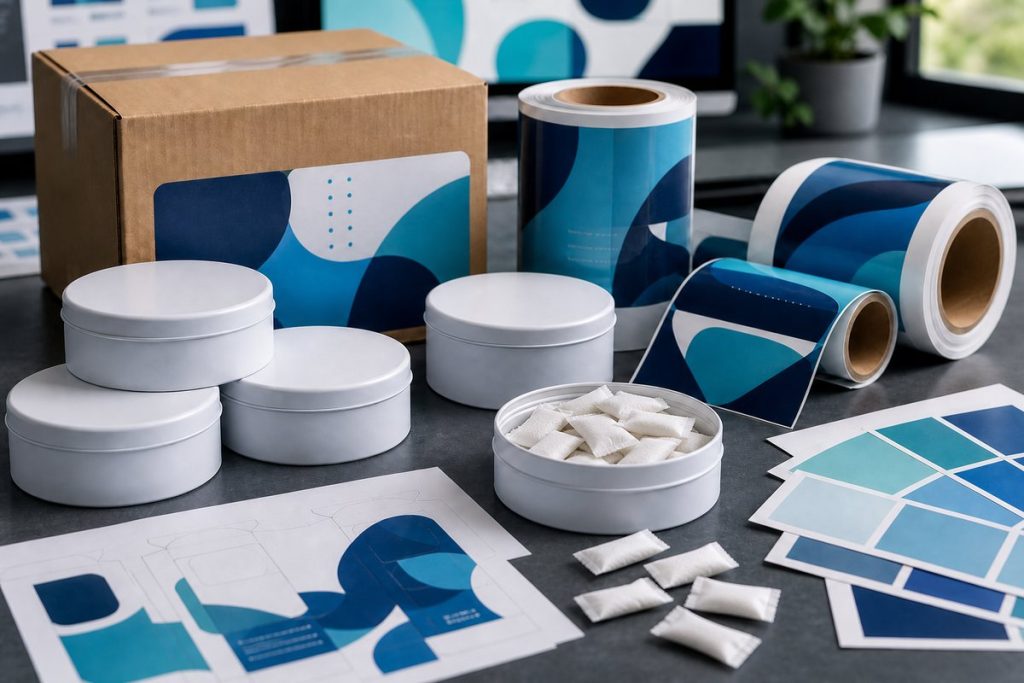
Custom oral pouch packaging has two jobs. It must protect a moisture-sensitive product through storage and transport, and it must communicate a brand clearly on a small curved surface. A beautiful render proves neither. The packaging has to close properly, run on the filling line, survive handling and reproduce consistently in print.
The safest approach is to develop packaging alongside the formula. Pouch count, moisture, can headspace, label material and shipping environment affect each other. Waiting until the formula is finished to source an unusual can can add weeks to the launch or force a last-minute redesign.
Choose the Decoration Route Before Final Artwork
Labeled standard cans
Pressure-sensitive labels offer flexibility for early runs and regional artwork versions. They can provide strong color and finishing options without committing to a large quantity of preprinted cans. Buyers should inspect the label seam, edge lift, scuff resistance and alignment around the lid and base.
Direct-printed or in-mold decorated cans
Printed cans can create a more integrated finish, but usually involve longer lead times, higher minimums and stricter file preparation. Color changes may require new proofs or tooling. Confirm whether the lid and base are decorated separately and whether print tolerances affect fine text.
Sleeves and secondary cartons
Shrink sleeves can provide broad graphic coverage but need careful distortion compensation and seam planning. Folding cartons add space for multilingual information or premium presentation, while also adding another component to procure, inspect and pack.
Start From the Manufacturer’s Dieline
Do not build final artwork from a can diameter found online. Request the current production dieline and its revision date. It should show trim, bleed, safe zones, overlap or seam areas and any region where text may be distorted or hidden. Keep a version number in the filename so an old template cannot return during a later reorder.
Use vector artwork for logos and line work, package linked images correctly and convert or embed fonts according to the printer’s instructions. Very small reversed text, thin rules and subtle gradients can fail on a curved package even when they look clean on a large monitor.
Give Every SKU a Controlled Identity
Flavor color is useful, but it should not be the only difference between products. Put the flavor and strength in a consistent location and use readable text contrast. If several markets require different warnings or languages, create a simple artwork matrix listing SKU, formula, flavor, strength, country, language, barcode and file version.
Barcodes should be assigned by the brand owner through the appropriate GS1 member organization or another accepted route for the sales channel. GS1 explains that a GTIN identifies a trade item; the graphic barcode is the carrier used to encode it. Buyers should confirm retailer requirements and test the printed code at actual size rather than relying on the design-screen preview. See GS1 guidance on GTINs.
Approve Physical Proofs, Not Only PDFs
- Check color under normal retail lighting and against the approved brand reference.
- Read all small text on the curved can without enlarging it.
- Scan every barcode from the printed proof or production sample.
- Open and close the lid repeatedly and inspect tamper-evident features where used.
- Test label adhesion after temperature and humidity exposure appropriate to distribution.
- Confirm the correct pouch count and that headspace does not crush or deform the product.
- Pack finished cans into the shipping carton and perform a practical transit review.
Separate Regulatory Copy From Marketing Copy
The front panel has limited space, but shrinking mandatory text is not a solution. Establish an information hierarchy early and have the responsible market specialist review the final formula-based copy before print approval. Ingredient names, amounts, warnings and claims must follow the actual product and destination-market classification.
Advertising review should include the package as a whole. FTC guidance notes that health-product advertising includes statements and depictions on packaging as well as digital marketing. Images, product names and testimonials can imply claims that are not written as a sentence.
What to Ask a Packaging-Capable Manufacturer
Ask which can sizes and materials are line-tested, what decoration methods are available, who owns print tooling, how color is approved, what packaging tolerances apply and how unused components are stored or reconciled. Confirm lead times for both the first order and a reorder. The shortest pouch-production lead time does not help if a custom lid takes twice as long.
LinkBioLabs coordinates pouch development with packaging and design support, canning, labeling and export-carton planning. Brands can send a preferred can reference, SKU list, target market and approximate quantities through our project contact page for a packaging feasibility review.
Related manufacturing references
For a complete OEM review, connect this article with the main product and process pages. Buyers usually need category fit, stock-formula options, custom formulation support, process checks, and a direct project discussion before approving samples.
- Custom oral pouch manufacturing
- Stock formulation options
- Private label pouch project planning
- Formulation and R&D support
- Manufacturing process and quality checks
- Technical manufacturing blog
- Discuss a project
Content review note: technical articles are reviewed for functional oral pouch, ODF, packaging, and OEM procurement relevance.