
Primary target long-tail keyword: caffeine anhydrous vs guarana extract for oral pouch manufacturing
The raw-material decision behind an energy pouch is not simply synthetic versus natural. Caffeine anhydrous gives a compact, predictable dose. Guarana extract brings a botanical story, but it also adds carrier, color, tannin, variable particle behavior and a larger mass for the same caffeine target.
A buyer should compare the two routes against pouch size, sensory target, label position and production controls. Choosing from the ingredient name alone is how a clean prototype becomes a bitter, uneven commercial batch.
Start with caffeine delivered, not extract weight
Calculate milligrams of caffeine from every source. A standardized guarana extract at 22 percent caffeine requires roughly 4.5 times the raw-material mass of caffeine anhydrous for the same nominal caffeine contribution. That extra mass competes with carrier, flavor and sweetener inside a small pouch.
Use the supplier assay range, not only the target printed on a sales sheet. A broad standardization range changes the amount weighed or creates dose variation if purchasing assumes every lot is identical. The formula and batch record need a defined adjustment rule.
Particle size controls whether the dose stays mixed
Anhydrous caffeine is often much finer and denser than cellulose or other pouch carriers. Guarana may be fine, fluffy or agglomerated depending on the extraction carrier and milling step. Either material can segregate when its particle profile differs sharply from the base.
Request particle-size information and run a geometric pre-blend before the main mix. Sample the beginning, middle and end of filling. One composite mixer sample cannot show whether vibration in the hopper moved the active toward the bottom.
Taste behaves differently over twenty minutes
Caffeine anhydrous produces a direct, persistent bitterness. Guarana adds bitterness plus astringency and earthy notes. Mint can cover the opening but often exposes a dry botanical finish later. More sweetener may make the contrast worse.
Use a timed sensory panel at one, five, ten and twenty minutes. Score bitterness, astringency, cooling, sweetness and residue separately. A sample that wins a quick office tasting can still fail during the full intended use time.
Color and fabric staining are commercial limits
Purified caffeine is easier to keep visually neutral. Guarana extract can range from tan to dark brown and may wick through the nonwoven after humid storage. The pouch can remain chemically acceptable while consumers interpret the stain as leakage or spoilage.
Condition the finished pouch in the actual can and inspect both sides under consistent light. Lock a reasonable incoming color range and require technical review before the extract supplier changes its carrier or concentration method.
Flow and fill weight need a line trial
A laboratory blend may pour well from a beaker yet bridge in a production hopper. Fine caffeine can create dust and electrostatic adhesion. Some botanical extracts absorb room moisture, form small clumps and coat feeder surfaces during a long hold.
Run the intended formula, pouch size and speed. Record individual fill weights through the run, dust at the seal area, hopper residue and cleaning frequency. Hand-filled samples are not evidence that a formula is ready for mass production.
Claims must follow the finished formula
A guarana ingredient does not automatically support broad natural-energy or performance claims. The market, finished-product category and actual caffeine disclosure determine what language is appropriate. Purified caffeine also needs clear serving information and relevant cautions.
Make the website, can, carton and specification agree on caffeine per pouch and per serving. Do not let marketing count guarana extract weight as caffeine or imply faster absorption without product-specific evidence.
Stability can change the original choice
Guarana carriers and residual minerals can affect moisture uptake, flavor and staining. Caffeine itself is relatively stable, but the masking system may fade during hot transport. The product fails commercially when bitterness becomes dominant even if assay remains within limits.
Test active assay, moisture or water activity where relevant, color, clumping, seam condition and timed flavor. Use the final can and liner. A high-barrier package cannot correct an unstable flavor-extract combination.
Choose a route that production can repeat
Use caffeine anhydrous when compact dose, neutral color and tighter assay control matter most. Use standardized guarana when the botanical story justifies extra mass and sensory work. A blended route can balance label position with manufacturing practicality.
The final decision should be written into the material specification: manufacturer, grade, assay range, carrier, particle expectations, color and change-notification requirements. Otherwise the next purchase order may produce a different pouch under the same ingredient name.
Price the usable dose, not the kilogram
Guarana can cost less or more per kilogram while still producing the higher cost per finished pouch. Convert supplier price into cost per delivered milligram of caffeine, then add the carrier, flavor and testing needed for that grade. Include the yield impact if a bulky extract increases pouch size or slows filling.
Procurement should also price assay adjustment and rejected material. A low quotation loses value when each lot needs a different addition rate or creates extra sensory rounds. Compare repeatable commercial cost, not the price of the first sample bag.
Questions Buyers Usually Ask
Is guarana caffeine stronger than caffeine anhydrous?
Strength depends on caffeine delivered, not the source name. Guarana normally contains only a percentage of caffeine and therefore requires more raw-material mass.
Can both sources be used in one pouch?
Yes, if total caffeine, taste, particle behavior, claims and content uniformity are validated in the finished formula.
For a source comparison, send the target caffeine per pouch, desired botanical position, pouch size and destination market. LinkBioLabs can screen both routes before the ingredient and packaging specifications are locked.
Recommended Blog Images
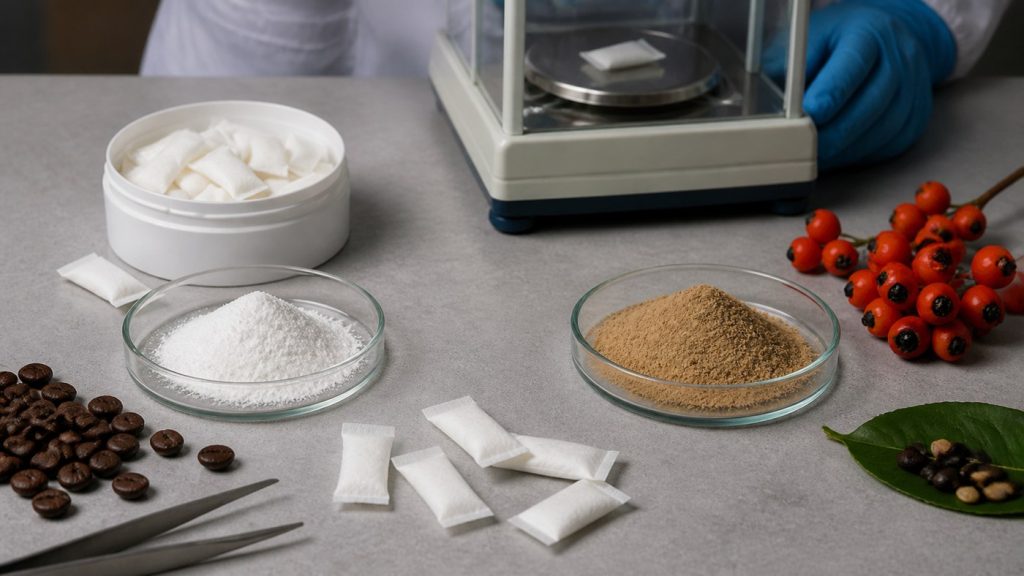
- Lab comparison of caffeine anhydrous and standardized guarana extract beside realistic finished pouches.
- Decision graphic comparing dose mass, taste, color, flow, claims and stability.
Related manufacturing references
For a complete OEM review, connect this article with the main product and process pages. Buyers usually need category fit, stock-formula options, custom formulation support, process checks, and a direct project discussion before approving samples.
- Custom oral pouch manufacturing
- Stock formulation options
- Private label pouch project planning
- Formulation and R&D support
- Manufacturing process and quality checks
- Technical manufacturing blog
- Discuss a project
Content review note: technical articles are reviewed for functional oral pouch, ODF, packaging, and OEM procurement relevance.