
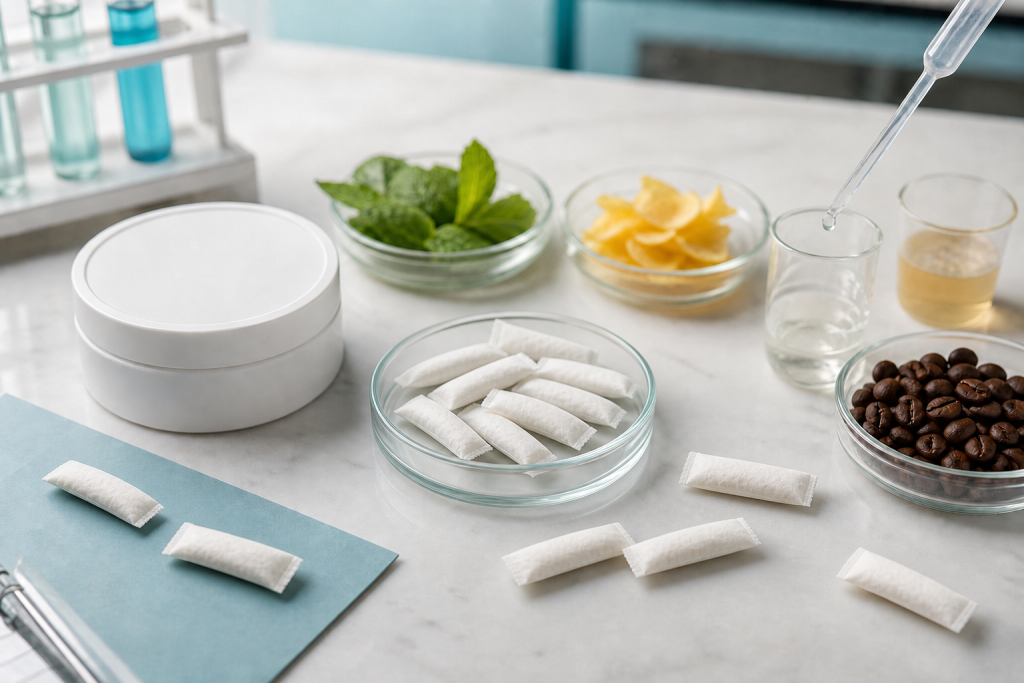
Caffeine is easy to put on a concept sheet and much harder to make pleasant in a pouch. Its bitterness arrives quickly, while the pouch remains in the mouth long enough for weak flavor decisions to become obvious. Adding more mint or sweetener may improve the first minute and still leave an unpleasant middle or finish.
A useful OEM brief therefore does not ask for a flavor that “covers caffeine.” It describes the caffeine source, target amount, pouch moisture and the sensory curve the brand wants a user to experience. Taste masking is a formulation task, not a final splash of flavor.
Lock the Caffeine Input First
Confirm the exact caffeine material used in prototypes and production. Anhydrous caffeine, botanical sources and premixed systems can bring different particle properties, carriers and flavor backgrounds. Ask for identity, assay, supplier documentation and the amount per pouch. A flavor approved with a reduced caffeine sample is not a valid approval for the commercial formula.
Caffeine is recognized as distinctly bitter, but individual perception and the surrounding formula change how strong that bitterness feels. A review on the taste of caffeine describes the complexity behind its sensory response. For product development, that means bench assumptions should be checked with the actual pouch rather than a flavored drink or powder.
Build Masking in Layers
Sweetness
Sweeteners can soften the initial edge, but excess sweetness creates its own lingering aftertaste. Compare blends rather than increasing one sweetener until the bitterness disappears at the opening.
Acidity and flavor character
Citrus, berry, cola, coffee and mint interact with bitterness in different ways. Acidity may brighten fruit but can also sharpen an already aggressive profile. The best flavor is the one that works with the base, not simply the most popular name in a catalog.
Cooling
Cooling can redirect attention and create a clean finish. It should be measured separately from mint flavor because strong cooling may hide irritation during a short tasting and become uncomfortable during normal use.
Evaluate a Timeline, Not One Sip
Use coded pouches and record the opening aroma, first minute, midpoint and finish. Note sweetness, caffeine bitterness, cooling, dryness and any throat sensation separately. A practical test should run for the intended use period and use pouches stored in the proposed can, not loose fresh samples from the bench.
- Opening aroma and flavor recognition
- Time until caffeine bitterness becomes noticeable
- Balance of sweetness, acidity and cooling
- Mouthfeel and moisture at the midpoint
- Aftertaste after the pouch is removed
- Consistency across pouches and sample ages
Keep the Masking System Production-Ready
Flavor oils, powders and low-dose modifiers must distribute consistently in the blend. Ask how the manufacturer controls addition order, mixing time and batch uniformity. The formula record should identify each flavor component or approved compound, target amount and permitted supplier. Otherwise a successful sample can become impossible to reproduce.
Advanced pharmaceutical taste-masking techniques include coating, complexation and encapsulation, but a method suitable for one dosage form is not automatically appropriate for a food-positioned pouch. The 2025 RSC review of bitter taste strategies is useful background; ingredient status, release behavior, cost and destination-market rules still need product-specific review.
Questions for a Caffeine Pouch Manufacturer
- Will the final caffeine grade and amount be used in every approval sample?
- How are sweetness, flavor and cooling adjusted independently?
- What pouch moisture and weight are used for sensory approval?
- How are low-dose flavor components distributed during scale-up?
- Which sensory checkpoints are recorded on retained samples?
- What changes require a new sample and written brand approval?
LinkBioLabs develops custom caffeine pouches through formula planning, sample rounds, flavor adjustment, production and packaging. Send the target market, caffeine direction, preferred flavor, pouch count and expected volume through our contact page to begin a technical review.
Related manufacturing references
For a complete OEM review, connect this article with the main product and process pages. Buyers usually need category fit, stock-formula options, custom formulation support, process checks, and a direct project discussion before approving samples.
- Custom oral pouch manufacturing
- Stock formulation options
- Private label pouch project planning
- Formulation and R&D support
- Manufacturing process and quality checks
- Technical manufacturing blog
- Discuss a project
Content review note: technical articles are reviewed for functional oral pouch, ODF, packaging, and OEM procurement relevance.