
Primary target long-tail keyword: caffeine pouch shelf life during hot-climate shipping
A pouch that looks stable in an air-conditioned sample room can arrive in Dubai, Singapore or southern Florida with a hard filling, faded flavor and brown marks around the seam. Heat accelerates reactions. Humidity moves through weak packaging and changes the way carriers, sweeteners and pouch fabric behave.
The usual response is to blame the can. Packaging matters, but raw-material specifications often determine whether a formula has enough stability margin for a difficult shipping route. A generic food-grade certificate is not enough. Each critical material needs limits that relate to the finished pouch.
Carrier moisture and particle behavior come first
The carrier makes up much of the filling mass. Its initial moisture, water-binding behavior, particle size and bulk density affect flow at manufacture and texture after storage. Two cellulose or fiber grades with the same ingredient name may hold water differently. One remains loose; the other forms a dense plug after several weeks at elevated humidity.
Set an incoming moisture limit and a particle-size range. Record bulk density and flow if the dosing system is sensitive. Do not approve a cheaper carrier only from a certificate of analysis. Run it in the finished blend, then expose packaged samples to the expected hot-climate profile.
A coarse carrier mixed with very fine caffeine also raises segregation risk. The pre-blend can pass, yet vibration in the hopper separates the low-dose active. Samples from the end of the run then differ from the first units. Material standards and process controls have to be written together.
Botanical extracts need more than an assay
Guarana, tea and other herbal extracts can bring residual solvents, carriers, minerals and hygroscopic solids. Standardization tells the buyer how much marker compound is present. It does not describe how the extract will taste, absorb moisture or stain the nonwoven.
Specify botanical identity, plant part, extract ratio or marker range, carrier, residual solvent information, particle size and relevant contaminant limits. Request lot-to-lot color and sensory expectations. A darker replacement lot may meet assay while producing visible brown migration during high-humidity storage.
Botanical extracts also separate when their density differs sharply from the base. Most small factories check a mixer sample and stop there. A stronger plan samples the beginning, middle and end of filling and keeps retained cans from each point.
Sweeteners can fail without looking spoiled
Xylitol, erythritol and high-intensity sweeteners respond differently to moisture and heat. Low-grade xylitol may contribute to hardening or crystal changes after three months. Some sweetener systems lose balance: the opening sweetness falls while bitterness becomes more obvious.
Specify assay, water content, particle size and supplier grade. For compound sweetener blends, disclose carriers. Replacing one maltodextrin-based premix with another can change both water activity and flavor release even if sweetness is similar in a fresh sample.
Flavor specifications should cover carriers and oxidation
Flavor is often the first attribute to fail in hot shipping. Citrus top notes disappear. Mint becomes sharp. Coffee flavors acquire a stale edge. Semi-moist pouches are especially vulnerable because flavor molecules can migrate into the liner, lid or headspace.
Approve the exact flavor grade and carrier system. Request storage conditions, shelf life and any antioxidant or solvent information relevant to the formula. Measure flavor addition by controlled weight, not by operator judgment. Keep the mixed blend covered and place a time limit on open holding before filling.
Stability panels should score opening aroma, first-minute character, midpoint and finish. “Pass” or “fail” hides gradual degradation that may become commercially unacceptable before the chemical specification fails.
Nonwoven fabric and seals must tolerate the formula
A thin, soft fabric can stretch at high-speed production, shed fiber lint or weaken after long contact with humectants. Lint collects on guides and optical sensors. It may also enter seams, creating narrow leakage paths that admit humid air.
Control basis weight, thickness, tensile behavior, sealing window, air permeability and shedding. Test the fabric with the real filling. Fine extract dust and flavor oil change sealing performance. Fresh hand-sealed samples are not representative of a full-speed run.
After conditioning, inspect seam strength, staining, surface softness and powder leakage. A seam that looks closed may peel easily after eight weeks because liquid flavor migrated into the heat-seal layer.
Incoming limits need a change-control rule
A specification has little value if purchasing can substitute an “equivalent” material without technical review. Lock manufacturer and grade for carriers, extracts, flavors, sweeteners and fabric. Require notification before source, process or carrier changes.
When a change is unavoidable, repeat the tests connected to that material. A new extract may need assay, blend-uniformity, sensory and staining work. A new fabric requires machine and seal trials. Do not wait for a full stability failure to discover the substitution.
Simulate the real route, not a convenient chamber condition
Use final cans, liners, labels, cartons and shipping cases. Combine accelerated storage with humidity cycling and transport handling. A constant chamber cannot reproduce a container that heats during the day and cools at night.
- Track pouch weight and appearance
- Moisture content and water activity where relevant
- Active assay and uniformity
- Flavor and mouthfeel
- Seam integrity and loose powder
- Can closure and liner condition
- Microbiological quality
Map failures by batch position and carton location. If only isolated cans fail, investigate closure or seal variation before reformulating the entire product.
Questions Buyers Usually Ask
Can high-barrier packaging solve a weak raw-material specification?
No. It reduces environmental exposure, but it cannot stop internal flavor reactions, hygroscopic clumping or ingredient migration already built into the formula.
Which raw material should be checked first?
Start with the carrier, botanical actives, sweetener system, flavor carrier and nonwoven fabric. These normally have the largest effect on hot-climate texture and sensory stability.
When requesting a hot-market pouch quotation, include the destination, shipping method and expected warehouse conditions. LinkBioLabs can then review raw-material grades and package barriers against a realistic route rather than a generic room-temperature shelf-life target.
Recommended Blog Images
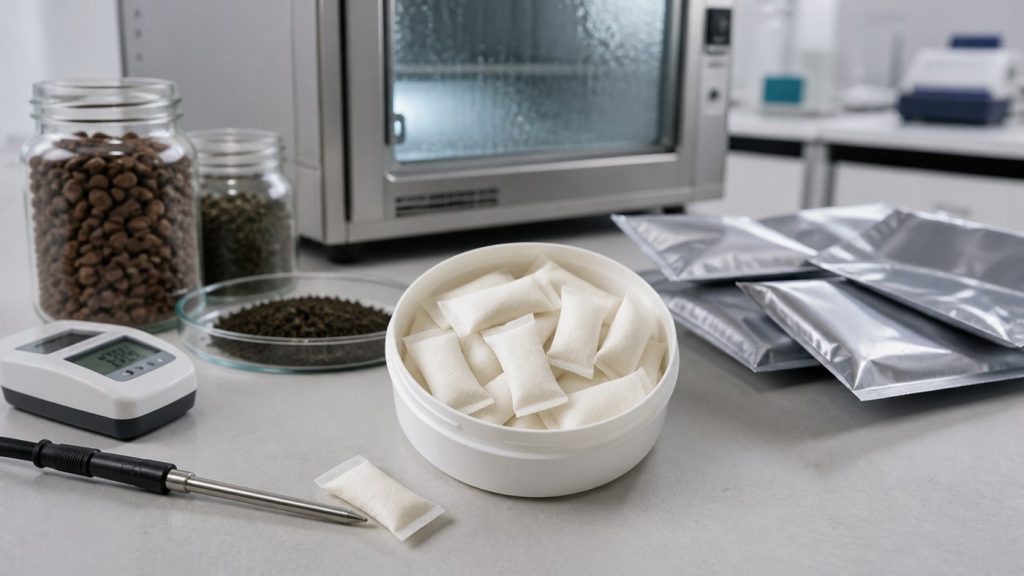
- Factory stability photograph of finished pouches, raw-material jars and a temperature-humidity chamber.
- Shipping-risk comparison graphic showing heat, humidity, flavor migration, pouch staining and seam leakage.
Related manufacturing references
For a complete OEM review, connect this article with the main product and process pages. Buyers usually need category fit, stock-formula options, custom formulation support, process checks, and a direct project discussion before approving samples.
- Custom oral pouch manufacturing
- Stock formulation options
- Private label pouch project planning
- Formulation and R&D support
- Manufacturing process and quality checks
- Technical manufacturing blog
- Discuss a project
Content review note: technical articles are reviewed for functional oral pouch, ODF, packaging, and OEM procurement relevance.