
Primary target long-tail keyword: caffeine particle size and dust control for oral pouch manufacturing
Very fine caffeine is easy to disperse in a laboratory beaker and difficult to control on a pouch line. It clings to bags, separates from coarse carrier, coats sensors and enters the seal. A coarser grade may flow better but release and bitterness can change.
Particle specification is therefore a formulation and production decision. Buyers should evaluate dose uniformity, dust, sensory performance and equipment behavior together rather than approving a caffeine grade from assay and price alone.
Describe more than the average particle size
Request a sieve distribution or suitable particle data, not one nominal number. A small fine tail can drive most dust and electrostatic adhesion even when the median looks acceptable.
Record bulk density, flow and moisture with the exact supplier grade. Milling or agglomeration changes these properties without changing the chemical name.
Match caffeine to the carrier
Dense fine caffeine moves differently from cellulose, gum or granular sweetener. During vibration the blend can separate after it passed a mixer sample. Matching particle ranges or using a compatible premix reduces the driving force.
Do not mill everything to the same fine powder. Excess fines increase dust, poor flow and surface adhesion. The target is compatible behavior, not identical appearance.
Build a controlled low-dose premix
Add the active geometrically into a defined carrier portion before the main blend. Screen lumps and document addition order, mixer load and time. Visual whiteness is not evidence of uniformity.
Sample the premix and finished pouches. Beginning, middle and end results reveal segregation during transfer and filling that the mixer result cannot show.
Control static and room conditions
Dry air and fine powder increase electrostatic adhesion to scoops, bags, mixer walls and hopper windows. High humidity creates clumps and intermittent feeding. Set a practical environmental range and ground suitable equipment.
Inspect residue after discharge and include it in reconciliation. Active left on a wall is both a dose and worker-exposure issue.
Capture dust near the source
Local extraction should control airborne powder without pulling excessive active from the process. Review charging, transfer and feeder locations. General room ventilation alone may spread contamination before capture.
Filters and vacuum tools need defined cleaning and product-change rules. A dust collector can become a cross-contamination source if its status is unclear.
Keep powder out of the seal
Fine caffeine and carrier on the nonwoven prevent full heat bonding. The seam can look closed, then leak loose powder after transport. Inspect longitudinal and end seals separately.
Trend rejects around startup, hopper refills and speed changes. Raising jaw temperature will not correct a constant curtain of dust and may scorch the fabric.
Link fill weight with active results
Measure individual pouch weight and caffeine content. Low dose can result from a light fill, a nonuniform blend or active lost as dust. Without both datasets the investigation guesses at the cause.
Review beginning-to-end trends rather than only averages. A passing mean can conceal early high units and late low units.
Check release and taste after grade changes
Agglomerated caffeine may wet differently from micronized material. Particle change can alter the first minutes of bitterness and laboratory release even if content uniformity improves.
Use timed sensory and a focused release comparison where appropriate. Do not solve dust by creating a slow, gritty or weak consumer experience.
Lock the grade after validation
- Manufacturer and grade
- Particle distribution
- Bulk density
- Moisture
- Premix method
- Room range
- Dust controls
- Seal inspection
- Change notification
A supplier equivalent requires technical review. Repeat the tests connected to particle behavior before the alternate grade enters commercial production.
Verify the incoming grade before release
Supplier particle data may describe a typical batch rather than the lot delivered. Set an incoming check appropriate to risk, including appearance, moisture, sieve behavior and bulk density. Compare unusual dusting with a retained approved lot before releasing it to production.
Sampling from the top of one bag is weak evidence. Fine material can settle during transport. Use a defined bag and container sampling plan, especially when a shipment contains several manufacturing lots.
Investigate dust without blaming the operator
Map where deposits appear: charging point, mixer vent, container rim, hopper window, dosing screw, forming shoulder or seal jaw. The location indicates whether the main driver is transfer, static, poor capture, feeder vibration or excess fines.
Record room humidity, batch hold and line speed with the observation. Cleaning more often may hide the symptom while active loss and content drift continue.
Include worker and cross-product controls
Risk assessment should define protective equipment, containment, cleaning and waste handling for concentrated caffeine. Dust found outside the product zone should trigger investigation, not be accepted as normal white powder.
Check the next product after changeover when lines are shared. Residue in filters, vacuum hoses or hidden ledges can transfer caffeine into a nominally caffeine-free pouch.
Questions Buyers Usually Ask
Is micronized caffeine always better for oral pouches?
No. It can improve dispersion but also increase dust, static, segregation and seal contamination.
Can a granulated caffeine grade change flavor release?
Yes. Wetting and dissolution behavior may change, so sensory and release performance should be rechecked.
Send the dose, caffeine grade, carrier profile and current line issues for a particle review. LinkBioLabs can compare uniformity and dust controls before the commercial raw-material specification is locked.
Recommended Blog Images
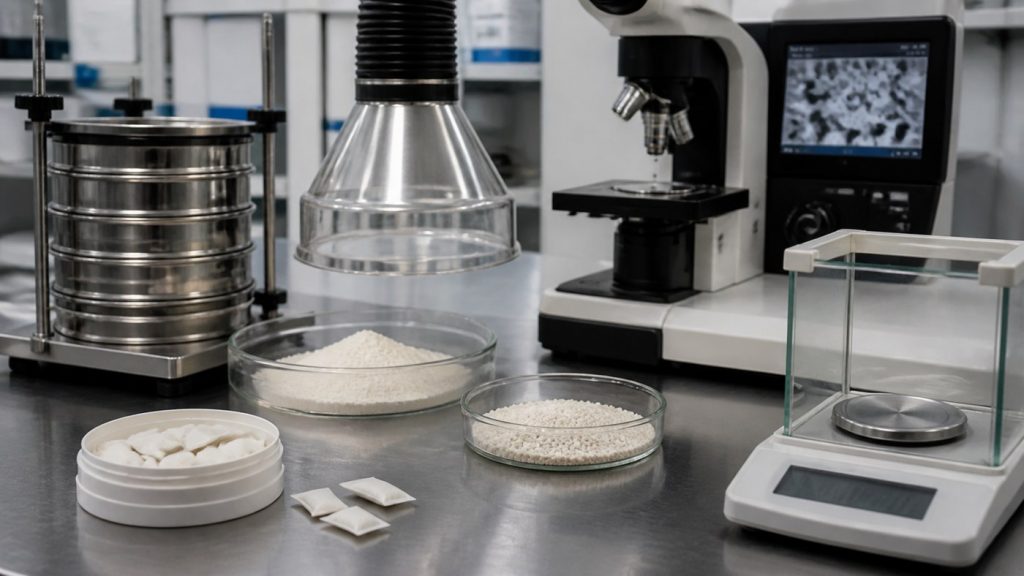
- Factory QA photograph with sieve stack, extraction hood, caffeine grades and realistic pouches.
- Particle-to-process diagram covering premix, transfer, dust, filling and seals.
Related manufacturing references
For a complete OEM review, connect this article with the main product and process pages. Buyers usually need category fit, stock-formula options, custom formulation support, process checks, and a direct project discussion before approving samples.
- Custom oral pouch manufacturing
- Stock formulation options
- Private label pouch project planning
- Formulation and R&D support
- Manufacturing process and quality checks
- Technical manufacturing blog
- Discuss a project
Content review note: technical articles are reviewed for functional oral pouch, ODF, packaging, and OEM procurement relevance.