
Primary target long-tail keyword: beverage brand oral pouch launch plan
A beverage formula cannot be poured into an oral pouch and called a line extension. The serving volume disappears, acids become sharper, caffeine bitterness sits against the gum and familiar top notes fade inside a closed can. The brand may remain recognizable, but the formulation has to be rebuilt.
A workable beverage brand oral pouch launch plan starts with the use occasion and ends with a landed-cost check. Packaging artwork belongs near the end, not at the beginning.
Define the pouch job before choosing ingredients
Decide whether the pouch replaces one beverage serving, provides a smaller top-up or introduces a caffeine-free wellness occasion. Commuting, gaming, travel and work breaks have different dose and use-time expectations.
Write the target user, serving direction and maximum daily use on one page. This prevents the commercial team from describing the same pouch as both a mild all-day format and a high-energy shot.
Translate the beverage dose honestly
List caffeine from purified caffeine, coffee, tea and guarana separately. Convert extract standardization into the actual raw-material weight required per pouch. A 22 percent guarana extract occupies far more space than an equivalent dose of purified caffeine and brings color, tannin and bitterness.
Do not carry every beverage ingredient into the pouch. Electrolytes, amino acids and fibers used per bottle may exceed a comfortable pouch fill. Keep ingredients that support the new use occasion; remove decorative label carryovers.
Rebuild the flavor instead of copying it
Beverage flavor is diluted across hundreds of milliliters. In a pouch, the first saliva contact exposes sweetener, acid and botanical solids in a small area. A citrus system that tastes clean in water can feel sour and metallic beside caffeine.
Select two or three brand cues: perhaps roast aroma, a citrus top note and a cooling finish. Run a timed panel at one, five, ten and twenty minutes. We have seen founders approve a strong first minute, then discover a dry guarana aftertaste that remains long after the mint disappears.
Choose dry or semi-moist early
Dry blends usually feed more easily and give a wider microbiological margin, but release can feel slow or dusty. Semi-moist blends feel softer and bloom faster. They also create more risk around clumping, water activity, flavor migration and aged seal strength.
Make matched prototypes with the same active and pouch dimensions. Comparing unrelated competitor samples does not tell the factory which format works for this formula.
Test the real nonwoven and fill system
Fine caffeine and flavor powders can pass through an open fabric pore structure. Soft nonwoven grades may shed lint at slit edges or stretch on the forming shoulder. Hand-filled samples hide both problems.
The pilot should use the intended fabric, fill weight and line speed. Review powder leakage, seam contamination, pouch weight distribution, content uniformity and aged seam strength. Most small OEMs do not perform continuous inline thickness checks, so the sampling plan must cover the start, middle and end of the run.
Keep claims within the evidence
A beverage brand often arrives with performance language written for advertising. Do not assume rapid flavor release proves faster caffeine absorption. Avoid medical, stress-treatment or cognitive-disease claims for herbal and nootropic versions.
Review caffeine warnings, serving limits, ingredient naming and target-market supplement rules before printed cans are ordered. Website copy, specification, carton and label must use the same dose.
Build packaging around the formula
The can, liner and closure form one moisture system. Semi-moist pouches may dry out or send volatile mint into the liner. Dry pouches can absorb humid air after repeated opening. A decorative paper label does not correct a weak closure.
Use production-equivalent cans in stability work. Include hot shipping or humidity cycling when stock may travel by sea or sit in an unconditioned warehouse. Flavor failure often appears before caffeine assay failure.
Budget the pilot without hiding losses
Separate formulation rounds, pilot setup, unused ingredient minimums, nonwoven rolls, testing, cans, labels, cartons and freight. The machine consumes material during threading and adjustment. Not every filled pouch becomes saleable stock.
Ask for first-order and repeat-order costs. Low MOQ custom printing may cost more than the formula. A stock can with a good label can be the sensible launch route if it avoids thousands of obsolete packages.
Set a written release gate
- Active assay and content uniformity
- Individual pouch and fill weight
- Water activity where relevant
- Powder leakage and fabric lint
- Seam integrity
- Timed sensory profile
- Microbiological quality
- Package and transport stability
Agree limits before the pilot. A team that has already paid for photography is tempted to approve weak flavor or high weight variation. A written gate makes the decision less emotional.
Know when to revise the concept
Proceed when the dose fits the pouch, flavor remains acceptable through the intended use time, production runs consistently and landed cost fits the retail plan. Revise one blocking variable at a time.
Stop if the concept only works with an oversized pouch, unsupported claim or unrealistically low factory price. A smaller, clearer product usually protects the beverage brand better than forcing the entire drink label into a new format.
Questions Buyers Usually Ask
Can a beverage flavor be used directly in an oral pouch?
It can be a starting reference, but carrier, acid level, oil content and direct oral exposure require pouch-specific reformulation and stability testing.
Can coffee or guarana provide all of the caffeine?
Sometimes. The extract assay, required mass, bitterness, color, powder flow and content uniformity must fit the target pouch size.
A useful first brief includes the beverage ingredient list, caffeine target per pouch, destination market, use occasion, preferred flavor and expected first order. LinkBioLabs can review feasibility before custom cans or large ingredient quantities are purchased.
Recommended Blog Images
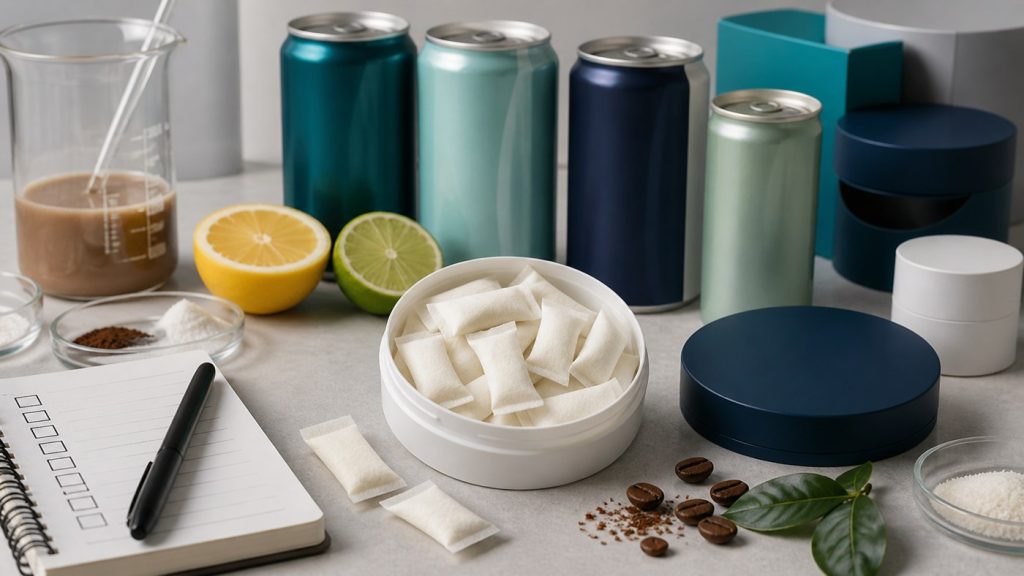
- Product-development photograph with realistic slim oral pouches, unbranded beverage cans, coffee or citrus cues and pilot samples.
- Launch checklist graphic covering dose, flavor, format, fabric, claims, packaging, testing, MOQ and landed cost.
Related manufacturing references
For a complete OEM review, connect this article with the main product and process pages. Buyers usually need category fit, stock-formula options, custom formulation support, process checks, and a direct project discussion before approving samples.
- Custom oral pouch manufacturing
- Stock formulation options
- Private label pouch project planning
- Formulation and R&D support
- Manufacturing process and quality checks
- Technical manufacturing blog
- Discuss a project
Content review note: technical articles are reviewed for functional oral pouch, ODF, packaging, and OEM procurement relevance.