
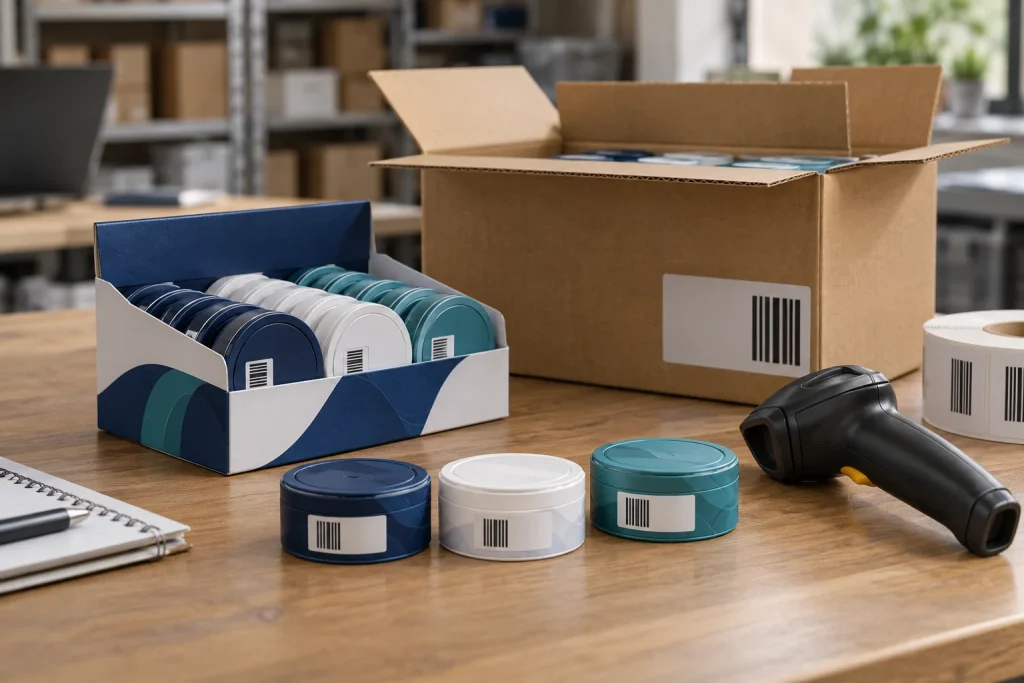
Cover: AI-generated packaging-hierarchy concept. Label graphics are illustrative and are not production-ready barcodes.
A private-label oral pouch launch needs a controlled product record at each sellable packaging level. Map the internal SKU, trade-item identifier, formula revision, declared contents and packaging artwork before labels are printed. A barcode that scans successfully can still point to the wrong flavor, count or case configuration.
Energy, nootropic, oral care, nutritional and stress relief pouches can share a can shape while remaining distinct commercial products. Treating that shared shape as one item creates avoidable ordering errors. This article applies GS1 identification principles to oral pouch brand launches; it does not replace a brand owner’s GS1 allocation process or a retailer’s implementation requirements.
SKU, GTIN, barcode and lot number have different roles
- SKU: the business’s internal stock-keeping identifier. Define a stable naming convention and document how it maps to the product specification.
- GTIN: the Global Trade Item Number used to identify a trade item in the GS1 system.
- Barcode: the machine-readable representation carrying identification data. The graphic and the product record must agree.
- Lot or batch: an identifier for a production grouping used in traceability. It does not replace the trade-item identifier.
The GS1 GTIN Management Standard supports consistent identification decisions across supply chains. For an oral pouch project, that means the brand, manufacturer and distributor need the same definition of the item being ordered, even when their internal inventory codes differ. [1: GS1 GTIN Management Standard, release 1.1]
Create a variant record before creating artwork
A useful record contains the brand, category, flavor, declared active amount where applicable, pouch count, declared net quantity, formula version, can specification, target market, label version and responsible approver. Keep the trading identifier as a controlled field. Do not place guessed or unassigned barcode numbers in production artwork just to complete a visual mockup.
Map the can, retail multipack and shipping case
Describe each level as it will actually be ordered. A single can sold to a consumer, a fixed multipack sold as one retail product and a master case sold to a distributor are different records when they are distinct trade items. Link each higher level to its contents, count and unit of measure. A loose shipping container used only for transport is not automatically the same as an orderable trade item.
- Can record: exact product variant, declared contents, approved artwork and its assigned identifier.
- Multipack record: the included can variants and quantities, whether the assortment is fixed, and its retail declaration.
- Case record: number of sellable units, configuration, dimensions, gross mass and the identifier used by the receiving customer.
- System mapping: customer item code, manufacturer SKU and the correct GTIN for the unit on the order.
Illustrative reconciliation: a delivery of 120 cases containing 24 cans per case represents 2,880 cans. If the distributor’s record mistakenly says 20 cans per case, the same delivery is recorded as 2,400 cans. No physical shortage is required for the systems to disagree. The quantities are a worked example, not a LinkBioLabs pack configuration.
Three packaging changes that need a GTIN decision
1. A change to declared net content
GS1 states that a change to legally required declared net content printed on the pack requires a new GTIN. Net content can be expressed as weight, volume, count or units. For a pouch can whose count is part of that declaration, changing from 20 to 24 pouches is not merely an artwork correction, even if the can remains the same diameter. Review the affected higher packaging levels too. [2: GS1, declared net content]
2. A change to case quantity
GS1’s pack/case rule addresses changes in the number of trade items in a case and the number of cases in a predefined pallet configuration. If the individual can is unchanged but the case changes from 24 cans to 30, the identification review concerns the changed grouping and applicable higher levels; the case-count change alone does not redefine the contents of the individual can. [3: GS1, pack/case quantity]
3. A physical dimension or gross-weight change over 20%
The GS1 dimensional rule uses more than 20% on any physical axis or on gross weight as a trigger for a new GTIN. It is separate from the net-content rule. A smaller dimensional change is therefore not blanket permission to keep a GTIN when another rule applies. GS1 also rejects accumulating small changes to avoid the threshold. [4: GS1, dimensional or gross-weight change]
A brand or formulation change can raise a separate identification question. Record the reason for each decision and consult the complete standard, rather than treating these three examples as an exhaustive checklist.
Approve the product data and the printed symbol together
Before the print file is released
- Have the brand owner or its authorized party confirm the assigned identifier and the item description.
- Reconcile formula revision, flavor, declared quantity and can count against the signed specification.
- Link the can artwork to multipack and case records without copying the can’s identifier into every packaging level.
- Confirm symbol type, size, placement and print requirements with the trading partner and print supplier.
- Separate variable lot or date information from fixed product-identification artwork, and identify who supplies each field.
Before the first shipment
Verify the physical printed barcode using the applicable verification requirements, then check what the receiving system retrieves from that code. A routine scanner read is not a complete print-quality verification. Keep the approved proof, product-data export and a photograph or retained example of the finished label together. Test the record at the correct unit of measure: can, multipack or case.
If an identifier is changed, agree how old and new inventory will be distinguished. Update purchase orders, case labels, distributor records and online listings together. Do not rely on a new label color to communicate a product transition to the receiving warehouse.
Connect SKU decisions to the production order
For the finished oral pouch categories covered by this site, LinkBioLabs’ stated minimum is 3,000 cans per SKU and at least 9,000 cans per total order. This does not impose a minimum of three SKUs: one SKU at 9,000 cans can meet those numerical minimums. Final product and packaging requirements still need confirmation for the order.
Decide which differences create separate production SKUs before dividing quantities across flavors or packaging versions. Then keep the production SKU decision and the GS1 trade-item decision connected in the master record; they are related processes with different purposes. This avoids approving several label variants while allocating insufficient production volume to each.
Start with the oral pouch product categories and can-format catalog. Use the pre-print labeling checklist to align product declarations with artwork before sending the project brief.
Frequently asked questions
Is an internal SKU the same as a GTIN?
No. A SKU is an internal inventory code; a GTIN identifies a trade item in the GS1 system. Keep a documented mapping between them.
Can the same barcode be used on every flavor?
Do not use one trade-item identifier for distinct flavor products that need separate ordering and identification. Apply the GS1 allocation rules and the customer’s data requirements to each variant.
Does every new production batch need a new GTIN?
A batch change alone does not normally create a new trade item. Retain appropriate lot traceability and assess any simultaneous product or packaging changes under the applicable GTIN rules.
Does the 9,000-can minimum mean I must order three SKUs?
No. The stated minimums are 3,000 cans per SKU and 9,000 cans for the total order. One SKU at 9,000 cans satisfies those numerical minimums; the project still requires order confirmation.
Sources and editorial scope
Sources checked on 22 October 2026. The packaging scenarios and quantity reconciliation are original illustrative examples. GS1 requirements, local rules and trading-partner specifications should be checked for the actual launch configuration.
- GS1 GTIN Management Standard, release 1.1, September 2023.
- GS1 rule: declared net content.
- GS1 rule: pack/case quantity.
- GS1 rule: dimensional or gross-weight change.
Related manufacturing references
For a complete OEM review, connect this article with the main product and process pages. Buyers usually need category fit, stock-formula options, custom formulation support, process checks, and a direct project discussion before approving samples.
- Custom oral pouch manufacturing
- Stock formulation options
- Private label pouch project planning
- Formulation and R&D support
- Manufacturing process and quality checks
- Technical manufacturing blog
- Discuss a project
Content review note: technical articles are reviewed for functional oral pouch, ODF, packaging, and OEM procurement relevance.