
Primary target long-tail keyword: powder flowability testing for oral pouch filling
A formula can blend evenly and still run badly on a pouch machine. Fine caffeine coats the hopper wall, a botanical premix bridges over the feeder, or a fluffy carrier changes packing density after ten minutes of vibration. The line then produces alternating heavy and light pouches while the average batch weight still looks reasonable.
Powder flowability testing helps identify this risk before commercial production. It does not produce one universal pass number. Powder behavior is affected by particle size, shape, moisture, electrostatic charge, consolidation and the geometry of the actual feeder. A useful program combines standardized measurements with a representative line trial.
Bulk density determines whether the formula physically fits
Loose bulk density links formula mass to volume. If the blend is too fluffy, the target dose may not fit into the approved slim pouch without overfilling the fabric or slowing the machine. If density varies between lots, the same volumetric feeder setting produces a different weight.
Measure the complete formula, not a calculated average of ingredient densities. Addition order, mixing time and flavor liquid change how particles pack. Record the method, container dimensions, sample handling and time after mixing so repeat batches can be compared.
Tapped density shows sensitivity to consolidation
Powder in a production hopper experiences vibration from motors, refills and the filling mechanism. Tapped density provides a controlled indication of how much the bed may compact. A large difference between loose and tapped density warns that the feeder condition can drift during a run.
USP General Chapter <616> provides harmonized approaches for bulk and tapped density. The numbers become useful only when the OEM keeps the method consistent. Changing cylinder size, sample mass or drop condition can move the result without any material change.
Do not rely on one flow index
Compressibility index and Hausner ratio are convenient screening tools calculated from bulk and tapped density. Angle of repose and flow through an orifice examine different behavior. USP <1174> explicitly treats powder flow as multifaceted; no single simple method characterizes every manufacturing condition.
A blend may form a respectable cone yet stop at a small feeder opening. Another may flow quickly through a funnel but segregate as dense particles move ahead of light carrier. Select tests that reproduce the problem the pouch line actually needs to avoid.
Match the test opening to the feeder risk
Orifice-flow tests should use a documented opening, funnel geometry and starting condition. If the aperture is much larger than the production outlet, every blend appears free flowing. If it is unrealistically small, workable formulas fail during development.
Record intermittent flow, rat-holing and the need to tap the apparatus. Reporting only the time after manually breaking a bridge hides the most important observation. Video is useful when suppliers and production teams need to compare a failure remotely.
Moisture and room conditions can reverse the result
Hygroscopic minerals, acids and plant extracts can absorb enough water during weighing to become cohesive. Very dry powders may develop electrostatic adhesion instead. Test at the intended production temperature and relative humidity, then challenge the upper exposure limit.
Define how long opened ingredients and finished blend may remain in the room. A ten-minute laboratory test on freshly opened material cannot support a four-hour production hold. Retest after the maximum planned hold and after any liquid flavor has equilibrated.
Particle matching matters more than visual fineness
Large differences in particle size and density promote segregation during transfer and vibration. Milling every component to a fine powder is not the answer: excess fines increase dust, static, poor flow and seal contamination. A controlled premix or an appropriately granulated carrier often performs better.
Compare sieve distribution, morphology and density of the active with the main carrier. Inspect beginning, middle and end pouches for both fill weight and active content. Weight uniformity cannot prove that a low-dose caffeine or botanical component stayed evenly distributed.
Liquid flavor addition can create hidden wet zones
Flavor and humectant should be sprayed across a moving bed at a controlled rate. Pouring liquid onto one point creates agglomerates that may pass a bulk sample but intermittently block the feeder. Wet balls can also smear onto nonwoven and weaken seals.
Lock nozzle position, droplet pattern, addition time, mixer load and post-addition mixing. Longer mixing may warm the powder and strip volatile notes. The endpoint should be supported by flow and uniformity results, not simply by adding extra minutes.
Challenge the hopper during the pilot run
A pilot should use the intended feeder, hopper level, pouch dimensions and line speed. Measure output after startup, after hopper refill, during low-level operation and following a planned stop. These transitions expose bridging and consolidation that a short steady run misses.
Do not let operators correct the trial with undocumented stirring. If agitation or vibration is required, its setting and frequency belong in the master record. An unofficial metal rod in the hopper is a contamination risk and makes batch performance dependent on one operator.
Link flow data with pouch results
Trend individual pouch weights, reject frequency, machine stops and seal contamination against the powder results. A passing average can conceal repeating high-low cycles. Lane-specific data may reveal one feeder that is worn or poorly aligned rather than a formula defect.
Lock a raw-material and process window
- Approved ingredient suppliers and grades
- Particle-size distribution and fines limit
- Loose and tapped-density methods
- Selected flow or orifice test
- Blend moisture and water activity where relevant
- Room humidity and maximum exposure
- Liquid addition parameters
- Hopper level and agitation settings
- Beginning-to-end weight and content sampling
- Change-control and retrial triggers
A supplier substitution should not enter production because the assay and ingredient name match. Bulk density, moisture and particle behavior can change while chemical identity remains correct. Repeat the tests connected to feeder performance before approving the alternate grade.
Questions Buyers Usually Ask
Which powder-flow test is best for oral pouch manufacturing?
There is no single best test. Bulk and tapped density, compressibility measures, orifice flow and a representative machine trial answer different questions. The combination should match the feeder and formula risk.
Can poor powder flow be fixed by increasing machine vibration?
Sometimes vibration restores flow, but it can also compact or segregate the blend. The setting must be validated with beginning-to-end weight and active-content data.
Share the target fill weight, pouch dimensions, ingredient grades and current hopper behavior for a scale-up review. LinkBioLabs can compare laboratory flow data with a representative production trial before the commercial formula is locked.
Recommended Blog Images
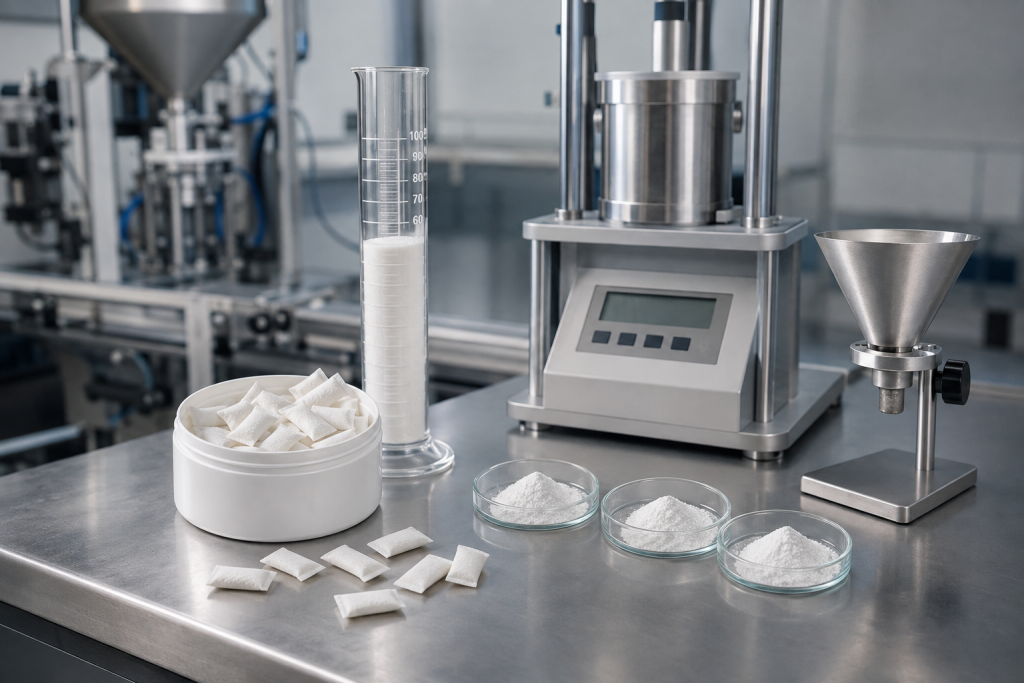
- Factory laboratory photograph with bulk-density cylinder, tapped-density tester, flow funnel and realistic slim pouches.
- Diagnostic graphic connecting particle size, moisture, consolidation, hopper flow and pouch-weight variation.
Related manufacturing references
For a complete OEM review, connect this article with the main product and process pages. Buyers usually need category fit, stock-formula options, custom formulation support, process checks, and a direct project discussion before approving samples.
- Custom oral pouch manufacturing
- Stock formulation options
- Private label pouch project planning
- Formulation and R&D support
- Manufacturing process and quality checks
- Technical manufacturing blog
- Discuss a project
Content review note: technical articles are reviewed for functional oral pouch, ODF, packaging, and OEM procurement relevance.