
Primary target long-tail keyword: how to prevent oral pouches clumping in humid shipping
A shipment can leave the factory with loose, clean pouches and arrive as a soft block inside the can. The first complaint usually calls it “melting.” Most cases are less dramatic: moisture moved through the formula, the nonwoven became tacky, flavor or humectant reached the surface, and weeks of vibration pressed neighboring pouches together.
This is not one defect with one additive fix. Hygroscopic ingredients, water activity, room humidity, equilibration time, can barrier, closure fit and case temperature all contribute. The investigation must separate internal moisture migration from moisture entering through the package.
Start with the ingredients that pull moisture
Screen every active, carrier, sweetener and flavor system for hygroscopic behavior. Mineral salts, botanical powders, certain acids and low-molecular-weight sweeteners may absorb water quickly even when the incoming moisture result passes. Supplier specifications should cover exact grade, moisture method, packaging and storage after opening.
Do not judge risk from the ingredient name alone. Two botanical extracts with the same declared plant can use different carriers and drying processes. One remains free flowing; the other softens within minutes in the weighing room. Record open exposure during pilot work.
Water activity and moisture answer different questions
Total moisture measures how much water is present. Water activity describes how available that water is for reactions and microbial growth. Both are useful, but neither alone predicts every sticking failure. Local wet pockets can exist while a composite result looks normal.
Measure after a defined equilibration period and at controlled temperature. FDA technical material notes that water-activity readings are temperature sensitive. Comparing a warm fresh blend with a conditioned stability sample creates apparent drift that may be analytical rather than real.
Watch liquid addition at production scale
Laboratory samples often receive flavor and humectant slowly from a pipette. Production uses a pump or spray bar over a deeper moving bed. Poor droplet distribution creates small wet agglomerates that survive mixing, fill into several pouches and later stain the fabric.
Lock addition rate, nozzle position, mixer load and post-addition time. Longer mixing is not always safer. It can warm the blend, strip volatile top notes and break particles into fines without fully redistributing a concentrated wet lump.
Allow the blend and pouch to equilibrate
Moisture continues moving after the mixer stops and after the pouch is sealed. Packing immediately can trap a changing product inside the can. Define maximum and minimum bulk hold times, covered-container conditions and the permitted interval between pouch filling and canning.
Inspect pouches at several points, not only at line release. Surface translucency, darker seams, oily spots and changed flexibility are early warning signs. A pouch can feel acceptable at two hours and become tacky after forty-eight hours.
Keep the nonwoven surface drier than the center
The consumer needs saliva to enter the pouch, but flavor liquid should not continuously migrate outward during storage. Fabric permeability, bonding pattern and fiber treatment affect that balance. A softer or faster-wetting fabric is not automatically compatible with a semi-moist formula.
Run the intended nonwoven, fill weight and seam settings. Hand-filled samples use different compression and surface contact. Check wetback, staining, lint and timed flavor release after storage as well as when fresh.
Can count and packing pressure matter
Overfilled cans compress pouches into broad contact areas. Shipping vibration then works tacky surfaces together. Count, pouch dimensions, natural thickness and lid clearance should be part of the packaging specification, not decided by how many units can be forced into the can.
Validate normal high and low pouch-weight conditions. Twenty light pouches and twenty heavy pouches do not create the same stack height. Inspect units from the bottom of the can, where compression and liquid migration may be most visible.
Check moisture barrier as a complete system
The can body, liner and closure jointly control vapor ingress. A good resin cannot compensate for an uneven rim or poorly compressed liner. Measure closure performance after heat, humidity and vibration rather than relying on the component drawings.
A desiccant may help a genuinely moisture-driven failure, but it must be sized against product moisture, headspace and package ingress. It should not be added to rescue uncontrolled liquid distribution. Confirm that the component does not damage flavor or become confused with the oral pouches.
Reproduce the shipping route
Constant high temperature is useful for screening, but export shipments also experience temperature cycling. A warm container cools overnight; relative humidity changes and local condensation can occur. Add appropriate cyclic conditions, vibration and case compression to the package study.
Build a practical clumping score
Define grades before looking at results: freely separated, light contact that separates without damage, multiple pouches adhering, surface tearing, or a consolidated block. Record removal force where useful and photograph samples under consistent lighting.
Also measure water activity, total moisture, can headspace condition, surface appearance, seam integrity and sensory change. A single clumping score cannot show whether the cause is formula migration, package ingress or mechanical compression.
Investigate complaints with matching retains
Compare the returned can with unopened retains from the same batch, packaging lot and production phase. Check shipping history and whether the complaint followed repeated consumer opening. A fresh laboratory remake is not a substitute for the affected lot.
Open cans over a clean tray. Note where the stuck units were located and whether powder, oil or torn fibers appear at the contact point. Bottom-only clumping suggests compression; widespread wet surfaces point more strongly toward moisture or liquid migration.
Release the product against a written control plan
- Approved ingredient grades and moisture limits
- Room temperature and relative-humidity range
- Liquid addition and mixing parameters
- Blend and filled-pouch hold times
- Water activity and total-moisture methods
- Nonwoven grade and seam window
- Can count, liner and closure specification
- Shipping and stability challenge conditions
- Clumping score and corrective-action rule
Questions Buyers Usually Ask
Will a desiccant always stop oral pouches from sticking?
No. It helps only when excess available moisture or package ingress drives the problem. Uneven humectant, flavor migration, excessive can compression or incompatible fabric still require correction.
Should dry pouches be tested for humid shipping?
Yes. Dry formats can contain hygroscopic powders and may absorb moisture after packaging or repeated opening. The risk is often lower, not absent.
Share the formula moisture style, can count, nonwoven grade and destination route if pouches are arriving stuck together. LinkBioLabs can structure a focused comparison before the next commercial batch.
Recommended Blog Images
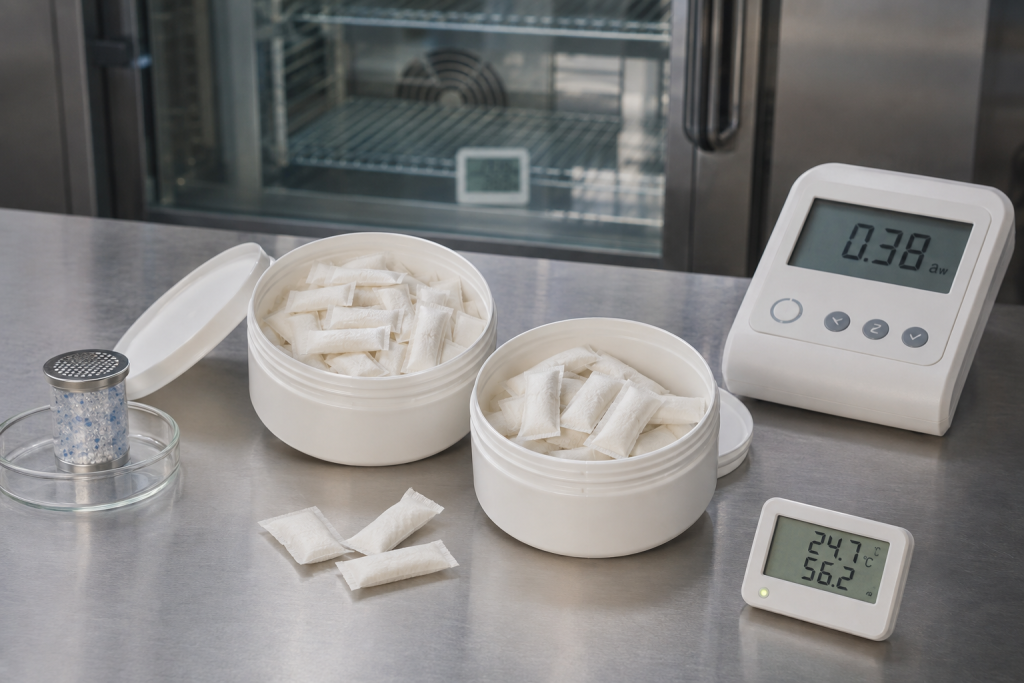
- Packaging-stability laboratory showing separated and lightly clumped slim pouches, humidity chamber and water-activity meter.
- Root-cause diagram connecting hygroscopic ingredients, liquid addition, fabric, can pressure and humid distribution.
Related manufacturing references
For a complete OEM review, connect this article with the main product and process pages. Buyers usually need category fit, stock-formula options, custom formulation support, process checks, and a direct project discussion before approving samples.
- Custom oral pouch manufacturing
- Stock formulation options
- Private label pouch project planning
- Formulation and R&D support
- Manufacturing process and quality checks
- Technical manufacturing blog
- Discuss a project
Content review note: technical articles are reviewed for functional oral pouch, ODF, packaging, and OEM procurement relevance.