
Primary target long-tail keyword: oxygen scavenger vs desiccant for oral pouch cans
Desiccant and oxygen scavenger packets look similar but solve different failures. A desiccant manages water vapor. An oxygen scavenger reacts with oxygen. Using the wrong component can leave vitamin oxidation, flavor loss or pouch caking unchanged.
The selection should follow measured failure mode, can barrier and stability data—not a packaging trend. Some formulas need neither; some need both, provided their activation conditions remain compatible.
Identify the failure first
Track potency, color, aroma, texture, water activity and headspace oxygen in controls. Oxidized citrus is not corrected by drying the can, while a clumping mineral blend is not corrected by removing oxygen.
Size against the complete package
Calculate headspace, oxygen initially trapped between pouches, expected ingress through the can and closure, and consumer opening. For desiccant, consider product moisture, vapor ingress and target internal humidity.
Check activation conditions
Many scavengers need a certain humidity to react. A strong desiccant can slow that reaction. Review supplier performance curves at the actual temperature and humidity rather than combining two sachets by assumption.
Protect against mix-ups
Scavenger and desiccant components require distinct part numbers, incoming checks and line clearance. Similar white sachets are easy to confuse, and the error may not become visible until late stability.
Test sensory contact risks
Confirm the auxiliary component does not release odor, dust or heat that changes the nearby pouches. Keep it physically controlled so consumers do not mistake it for the product.
Validate after opening
A desiccant may continue helping after repeated opening; a scavenger can exhaust. Run an in-use simulation alongside unopened stability and record internal humidity, oxygen and product attributes.
Lock the specification
State supplier, capacity, dimensions, print, placement, storage before use, exposure time on the line and change notification. “Add one absorber” is not a production instruction.
Can one packet control both oxygen and moisture?
Only a validated combination component can claim both functions; performance still depends on the package and formula.
Does active packaging replace a good can barrier?
No. High ingress or closure leakage can exhaust the component before expiry.
Share the observed stability failure, can dimensions and target shelf life for an active-packaging screening plan.
Recommended Blog Images
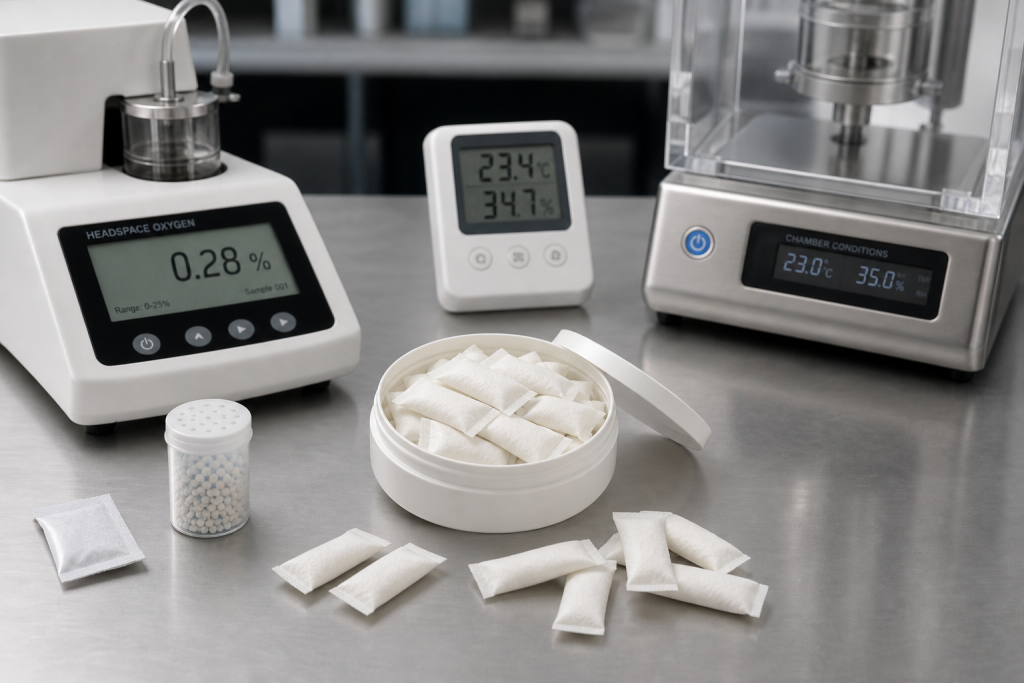
- Packaging laboratory with headspace oxygen and humidity instruments, slim pouches and two auxiliary components.
- Decision graphic comparing moisture, oxygen, capacity, activation and in-use exposure.
Related manufacturing references
For a complete OEM review, connect this article with the main product and process pages. Buyers usually need category fit, stock-formula options, custom formulation support, process checks, and a direct project discussion before approving samples.
- Custom oral pouch manufacturing
- Stock formulation options
- Private label pouch project planning
- Formulation and R&D support
- Manufacturing process and quality checks
- Technical manufacturing blog
- Discuss a project
Content review note: technical articles are reviewed for functional oral pouch, ODF, packaging, and OEM procurement relevance.