
Primary target long-tail keyword: microbiological limits for semi-moist functional oral pouches
A semi-moist pouch can look clean, smell fresh and still be a difficult microbiological product. Water activity, botanical bioburden, room exposure and equipment hygiene all influence the result. A finished-product test alone only reports what happened in the few units sampled.
Brands should ask how the manufacturer built the control system: ingredient limits, water quality, environmental handling, validated cleaning, in-process moisture control and finished-product release. The specification must fit the formula and destination market instead of copying a dry tablet certificate.
Separate total moisture from water activity
Total moisture measures the amount of water. Water activity describes how available that water is for microbial growth and chemical reactions. Humectants, salts and carriers can give two formulas the same moisture percentage but different water activity.
Measure at a controlled temperature after the blend has equilibrated. A reading taken immediately after liquid addition may drift as moisture moves between particles and nonwoven. Set both the sampling time and sample preparation in the method.
Map raw-material bioburden
Tea powders, guarana, spices and other botanical materials usually carry more microbiological variability than refined caffeine, xylitol or mineral salts. A passing supplier COA does not remove the need to understand method, sampling and lot history.
Classify ingredients by risk and set incoming tests accordingly. One high-load botanical can dominate the finished result even when every other component is clean. Treatment options must also protect potency and flavor.
Control water added to the formula
Water used as an ingredient or process aid needs a defined quality standard and monitoring plan. Hoses, holding vessels and spray nozzles can recontaminate acceptable water before it reaches the mixer.
Avoid preparing flavored aqueous premixes far ahead of use. Warm, sweet liquid held for hours is not equivalent to freshly prepared solution. State maximum hold time, covered status and disposition after delay.
Design hygienic liquid addition
Spray liquid across the moving powder bed rather than forming local wet pockets. Wet balls can remain at higher water activity than the composite blend and may escape a pooled sample.
Inspect nozzles after each run. Flavor residue hardens in small passages and is difficult to see. A rinse that looks clear does not prove the internal surface is clean.
Set realistic finished-product tests
Typical programs consider total aerobic count, yeast and mold, and specified organisms based on product and market risk. Exact limits and methods must be agreed with the qualified laboratory and regulatory adviser for the destination.
Document sample count, composite rules and units. “Micro passed” is not an actionable specification. The report should identify the method, result, limit, batch and laboratory.
Use process controls before end testing
FDA dietary-supplement CGMP guidance recognizes controls such as pH, humidity and water activity alongside necessary microbiological testing. Testing cannot repair an uncontrolled process; it can only detect some failures after production.
Trend room conditions, liquid addition, blend hold time and finished water activity. Review slow shifts before they become out-of-specification results.
Challenge the full shelf life
Yeast and mold results at day zero do not prove a twelve- or twenty-four-month product. Store commercial packs and test at justified intervals, including the period after consumers repeatedly open the can.
Accelerated heat can change water migration and preservatives differently from normal storage. Keep real-time samples running and inspect odor, staining, gas, swelling and texture with laboratory results.
Investigate without retesting away the problem
When a result fails, check raw lots, room records, cleaning, water, holds and packaging. Repeating the same composite until one passes destroys useful evidence.
Quarantine the batch, document the investigation and use a scientifically justified resampling plan if appropriate. A release decision should belong to quality, not the sales deadline.
Put the controls in the OEM brief
- Target water activity range
- Raw-material microbiological requirements
- Water specification
- Blend hold limit
- Room condition range
- Finished-product methods
- Sampling plan
- Shelf-life pull points
- Deviation procedure
Confirm these items before pilot production. Adding microbiological expectations after the formula and package are locked often forces expensive changes to moisture, flavor or lead time.
Questions Buyers Usually Ask
Does low water activity mean microbiological testing is unnecessary?
No. Water activity is one control. Ingredient contamination, process hygiene and market requirements still determine the testing program.
Can a preservative replace hygienic manufacturing?
No. A preservative must be compatible and validated, and it does not compensate for contaminated raw materials or poorly cleaned equipment.
Share the formula type, target softness, botanical load and destination market for a microbiological risk review before the pilot specification is approved.
Recommended Blog Images
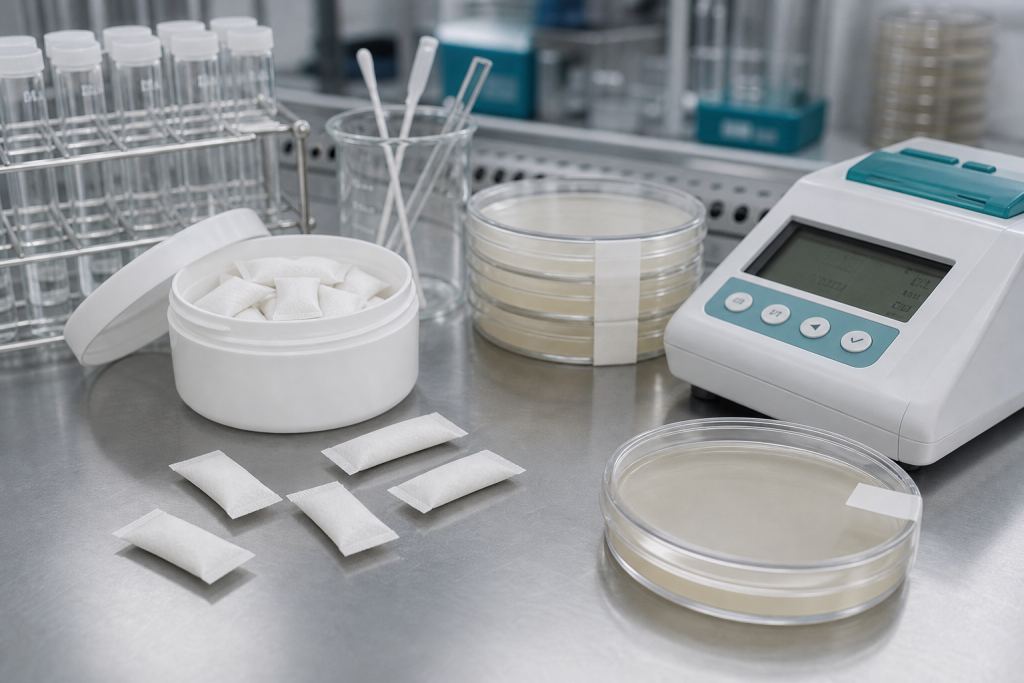
- Clean microbiology laboratory with realistic slim pouches, water-activity meter and covered culture plates.
- Control-map graphic from raw materials and water through blending, packing and shelf-life testing.
Define laboratory handling before samples are sent
Microbiological numbers can be distorted by poor sampling. Use sterile tools, identify individual or composite units, protect samples from heat and send them promptly to the laboratory. Do not open cans in an uncontrolled office and then expect the result to represent the production line. The laboratory should receive the product in a condition that preserves the original batch state.
Review packaging as part of microbial control
A can and liner do not sterilize the pouch. They should prevent uncontrolled moisture gain and protect the product after release. Compare unopened stability samples with an in-use study in which the can is opened and closed on a defined schedule. This reveals whether humid consumer handling pushes water activity, odor or texture beyond the intended range.
Related manufacturing references
For a complete OEM review, connect this article with the main product and process pages. Buyers usually need category fit, stock-formula options, custom formulation support, process checks, and a direct project discussion before approving samples.
- Custom oral pouch manufacturing
- Stock formulation options
- Private label pouch project planning
- Formulation and R&D support
- Manufacturing process and quality checks
- Technical manufacturing blog
- Discuss a project
Content review note: technical articles are reviewed for functional oral pouch, ODF, packaging, and OEM procurement relevance.