
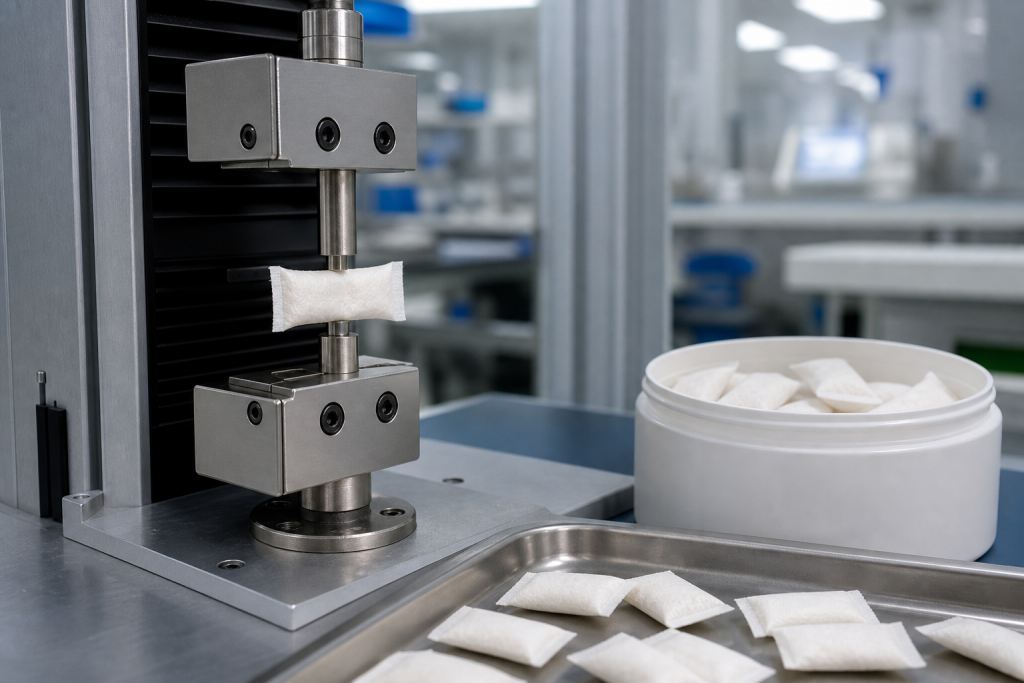
Primary target long-tail keyword: oral pouch seal strength testing for OEM production
A pouch can look properly closed and still fail after it reaches the can. Fine powder sits in the seal, flavor oil softens the nonwoven interface, or a jaw runs slightly cooler after a line stop. The seam holds during visual inspection, then opens when the pouch is compressed in shipping or moved in the mouth.
Seal strength testing gives the factory a measurable production control, but only if the method suits this small porous package. Copying a flexible food-bag burst value into an oral pouch specification is not enough. The specimen, grip position, pull direction, conditioning and failure mode all change the result.
Define which seam is being tested
Form-fill-seal oral pouches normally have more than one critical bonded area. The longitudinal seam and short end seals see different heat, pressure and contamination. Identify them separately in drawings and records.
A single sample cut from the easiest edge can miss the weak location. Inspect where the longitudinal and end seals intersect, because fabric layers, folds and powder accumulation make that junction less forgiving.
Choose a method that answers the factory question
A tensile or peel-style test measures resistance while a sealed strip is pulled apart. A burst or compression approach challenges the whole pouch. ASTM lists methods such as F88 for flexible seal strength and F2054 for restrained burst testing, but applicability and specimen preparation must be established for the product.
For routine production, a simple validated pull method may trend the line better than an elaborate test used once a year. Development can add burst, compression or transport simulation to understand whole-pouch failure.
Condition samples before comparing numbers
Semi-moist formulas continue distributing liquid after filling. A seam tested immediately may behave differently after twenty-four hours. Temperature and humidity also affect nonwoven and adhesive or thermal bonds.
State the time from production to test and the conditioning environment. Do not compare a warm startup pouch with a cooled retained sample and call the difference line drift.
Record failure mode, not only peak force
A high number is not automatically good if the fabric tears beside the seal or the pouch stretches until the grip slips. Note whether failure is adhesive separation, fabric rupture, partial channel opening, grip break or no failure at the set limit.
Photographs of typical modes help operators classify defects consistently. A change from clean seal separation to random fabric tearing may indicate a material-lot difference even while average force still passes.
Powder in the seam is a process defect
Fine caffeine, mineral premix and plant extract can interrupt bonding. Operators sometimes raise temperature to compensate. That can make clean areas brittle while contaminated spots remain weak.
Look upstream at feed timing, dust control, pouch fill level and jaw cleanliness. Trend failures after hopper refill and at higher speed. Seal testing should find the cause, not justify an increasingly harsh heat setting.
Establish a sealing window, not one machine setting
Challenge temperature, pressure, dwell time and line speed around the planned center point. The acceptable region should make sound seams without scorching, shrinking or making the pouch edge unpleasant in the mouth.
Material thickness and basis weight vary by lot. Qualify the intended nonwoven at both ends of its supplier specification rather than relying on one unusually easy roll.
Sample across the production run
Take pouches from startup, stable production, after planned stops, after fabric splice and near the end of the batch. Sample both lanes if the machine has parallel lanes. One composite result hides lane-specific wear or alignment.
Pair test results with pouch weight and visual defects. Overfilled pouches place more stress on the seam and may drag powder into the bond. The filling and sealing processes are connected.
Challenge transport and canning pressure
Pouches are compressed when counted into cans, cases are stacked, and parcels experience vibration and heat. Run a defined handling challenge, then inspect for loose powder, oily marks and opened corners.
Do not use an unrealistic hand squeeze as the whole validation. Document can count, orientation, temperature, vibration or drop condition so repeat orders can be compared.
Build useful acceptance criteria
- Seam location
- Test direction
- Specimen width
- Conditioning time
- Pull rate or load
- Minimum result
- Allowed failure modes
- Sampling map
- Action after failure
Set limits from development and capable pilot data, with a safety margin for commercial variation. A borrowed number without product history may reject good fabric or accept a fragile seam.
Questions Buyers Usually Ask
Can visual inspection replace oral pouch seal strength testing?
No. Visual checks find obvious folds, burns and contamination, but they cannot quantify a bond that looks closed and fails under handling.
Should every finished pouch be burst tested?
No. Testing is destructive. Use a justified sampling plan, routine process controls and investigation rules supported by validation data.
Send the pouch dimensions, fabric grade, fill weight and current seam defect for a test-plan review. LinkBioLabs can map the seal window and sampling points before a full private-label batch is released.
Recommended Blog Images
- Factory QC photograph of a small slim pouch in a compact seal-strength fixture with retained samples.
- Process diagram linking powder control, jaw settings, seal failure mode and transport challenge.
Keep retained samples for failure investigation
Retain sealed pouches from each lane and production phase in the finished can. If loose powder appears after distribution, the factory can repeat strength and visual checks on the actual batch. Without properly identified retains, teams end up testing a new run and arguing about whether transport, fabric or machine setup caused the complaint.
Related manufacturing references
For a complete OEM review, connect this article with the main product and process pages. Buyers usually need category fit, stock-formula options, custom formulation support, process checks, and a direct project discussion before approving samples.
- Custom oral pouch manufacturing
- Stock formulation options
- Private label pouch project planning
- Formulation and R&D support
- Manufacturing process and quality checks
- Technical manufacturing blog
- Discuss a project
Content review note: technical articles are reviewed for functional oral pouch, ODF, packaging, and OEM procurement relevance.