
Primary target long-tail keyword: oral pouch technology transfer from lab formula to OEM production
A bench formula is a recipe. A transferable product is a controlled process. The lab may mix one kilogram, fill pouches by hand and package them immediately. Commercial production uses different shear, transfer distance, hopper residence and seal speed.
Technology transfer converts development knowledge into specifications, batch records, test methods and acceptance limits that another team can repeat without the original formulator standing beside the mixer.
Freeze the product brief first
Define active dose, pouch dimensions, fill target, moisture style, sensory timeline, package count and destination market. If these remain open, the transfer package changes every week.
Separate critical requirements from preferences. The team needs to know what can be adjusted during scale-up and what cannot.
Lock exact material grades
Record manufacturer, grade, carrier, particle expectations and relevant moisture limits for actives, flavors, carriers and nonwoven. Ingredient names are not enough.
Retain development lots. A supplier change during pilot work can be mistaken for a scale effect.
Translate mixing by process behavior
Larger mixers change fill level, shear and discharge. Copying laboratory minutes does not prove equivalent mixing. Define addition order, premix, liquid rate and an endpoint supported by uniformity data.
Include maximum hold and controlled restart instructions. Production delays are part of the process, not exceptions that can be ignored.
Map every transfer step
Powder can segregate between mixer, container, lift, hopper and feeder. Wet blends continue equilibrating and may clump. Draw the route and identify drops, vibration and open exposure.
Minimize unnecessary handling and use covered, identified containers. Hand stirring in the hopper should not be an unofficial fix.
Qualify the fabric at line speed
Hand sealing does not show web tracking, lint, powder retention or commercial sealing window. Run the intended fabric, size, formula and speed.
Inspect startup, stable production and restarts. Flavor oil and fine dust can weaken aged seams after fresh samples look acceptable.
Scale the sampling map
Beginning, middle and end sampling should cover blend containers, line stops and long runs. Test individual weight with active content.
A pooled assay hides time trends. The commercial batch is often longer than the pilot, so evidence must cover the extended exposure.
Transfer sensory knowledge
Define coded reference samples, use time and attributes such as wetting, sweetness, bitterness, cooling, texture and finish. “Same as approved” is not a method.
Store the approved reference under controlled conditions and acknowledge aging. An old sample should not become an unrealistic permanent standard.
Reconcile yield and rejects
Record setup loss, powder residue, underweight units, seam rejects, tests, retains and packaging waste. Yield informs repeat-order cost and identifies weak steps.
Do not hide unexplained active loss inside normal factory waste. Dust and residue need investigation.
Close transfer with a written gate
- Approved formula and materials
- Master batch record
- Equipment and load range
- Hold times
- Fabric and seal window
- Sampling and methods
- Packaging specification
- Deviation plan
- Stability started
A successful transfer ends when the receiving factory can repeat the product and explain its controls, not merely when one pilot batch is filled.
Transfer analytical methods, not only limits
Provide sample preparation, extraction, instrument conditions, calculations and system checks for assay, moisture and other release tests. A limit without a validated or verified method leaves the receiving laboratory to invent the result.
Run method comparison on shared samples when laboratories differ. Agree how outliers, repeats and atypical trends are handled before the pilot produces a disputed number.
Define responsibilities with a transfer matrix
List who owns raw-material approval, master formula, packaging files, methods, pilot deviations, label review, stability and final release. Brands often assume the factory controls claims while the factory assumes copy arrived preapproved.
Add required dates and dependencies. Printed cans should not be released before formula dose and warning text are final. A matrix prevents schedule pressure from reversing the correct sequence.
Plan the first commercial batch as verification
The first full batch is longer than the pilot and may use different lots or more intermediate containers. Add sampling for extended hopper residence, shift change and packaging duration. Trend results by time.
Do not remove extra controls immediately after one pass. Review several lots and close transfer only when the process demonstrates repeatability.
Preserve development knowledge
Record failed trials and reasons, not just the approved formula. The receiving team needs to know that a specific flavor carrier weakened seals or that a fine active segregated after a long hold.
This history prevents future cost-saving substitutions from reopening solved failures. It also makes investigations faster when suppliers change.
Questions Buyers Usually Ask
Can a hand-filled prototype go directly to commercial production?
No. It does not validate feeding, fabric tracking, sealing, yield or beginning-to-end uniformity.
Should laboratory mixing time be copied at scale?
No. Scale changes mixer fill, shear and discharge, so the process must be demonstrated on representative equipment.
Provide the development formula, approved samples, material grades and intended batch size for transfer planning. LinkBioLabs can identify missing scale-up evidence before commercial components are ordered.
Recommended Blog Images
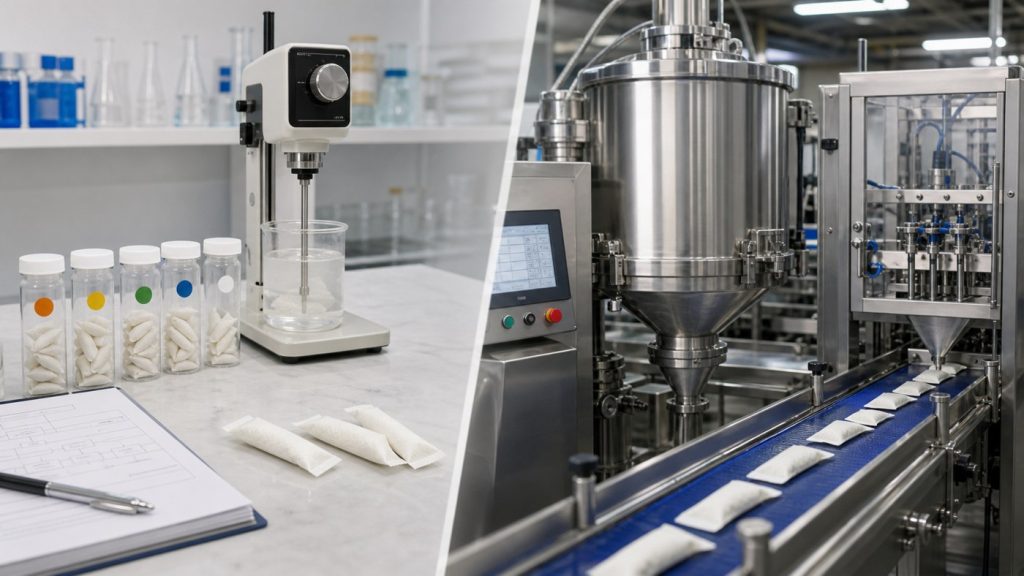
- Split laboratory-to-factory photograph showing prototypes, blender and pouch line.
- Technology-transfer flow covering materials, mixing, transfer, filling, sealing and release.
Freeze the Transfer Version
Before the engineering run, issue one controlled formula and process sheet. Late substitutions cause avoidable confusion: a similar carrier may have different bulk density, while a new flavor can change moisture demand and sealing cleanliness. Record every deviation against that frozen version. Otherwise, the lab sample, pilot batch and commercial batch become three different products and no one can identify which change caused the result.
Related manufacturing references
For a complete OEM review, connect this article with the main product and process pages. Buyers usually need category fit, stock-formula options, custom formulation support, process checks, and a direct project discussion before approving samples.
- Custom oral pouch manufacturing
- Stock formulation options
- Private label pouch project planning
- Formulation and R&D support
- Manufacturing process and quality checks
- Technical manufacturing blog
- Discuss a project
Content review note: technical articles are reviewed for functional oral pouch, ODF, packaging, and OEM procurement relevance.