
Primary target long-tail keyword: oral pouch can closure torque testing for OEM packaging
A lid that feels tight is not necessarily sealed, and the tightest closure is not automatically the best. Too little application torque can allow moisture exchange. Too much can deform the thread, liner or rim and make the can difficult to open.
Torque testing gives packaging teams a repeatable process check. It must be interpreted with liner compression, leakage, consumer opening and aged package data.
Separate application and removal torque
Application torque describes how the closure is put on. Removal torque is measured when it is opened. They are related but not identical because plastic relaxes and liners compress over time.
Record measurement timing. A reading taken immediately after capping cannot be compared with one taken after twenty-four hours without context.
Define the exact component set
Can, lid, liner, thread finish, colorant and supplier affect torque. Visually identical components from another converter may behave differently.
Approve component codes together. Do not validate a lid on one can and assume it applies to every stock package.
Calibrate the tester and fixture
Use a suitable torque meter, stable fixture and defined opening speed. Poor clamping distorts the can or lets the operator add side force.
Check calibration and train operators. Hand feel is useful for screening but cannot replace a documented reading.
Sample across the packaging run
Test beginning, middle and end, plus units after adjustments and component refills. A few laboratory-capped cans do not represent the production capper.
Trend individual readings and range. An acceptable average can hide alternating loose and over-tight closures.
Connect torque to liner compression
Inspect liner position, contact pattern and rim condition. Correct torque with a folded or misaligned liner still produces a weak package.
Foam, foil and other liner structures relax differently. Evaluate the commercial liner after conditioning with the real formula.
Challenge moisture and transport
Track can and pouch weight, texture, aroma and closure after temperature and humidity exposure. Vibration can loosen or damage marginal closures.
Add in-use opening cycles because consumers repeatedly remove and replace the lid. An unopened pass does not prove performance for a large-count can.
Protect consumer usability
High removal force frustrates users and may damage tamper evidence or the can. Low force can feel cheap or allow accidental opening in a bag.
Test with representative users while maintaining child-safety and market requirements where applicable. Do not infer consumer suitability from factory staff alone.
Investigate isolated failures correctly
If a small number of cans gain moisture, map failures by capper time, carton and component lot. Random closure or liner defects can look like formula instability.
Keep retained empty components and finished cans. Without them, teams often reformulate a product that actually had a packaging application problem.
Write a complete closure specification
- Can and lid code
- Liner construction
- Application range
- Removal timing
- Sampling frequency
- Tester and fixture
- Visual liner checks
- Stability conditions
- Change control
A torque number alone is not a seal guarantee. It is one control inside a package-integrity program.
Validate the capper operating range
Challenge low, center and high capper settings with the commercial components. Measure application and removal behavior, liner condition and package integrity. The operating range should tolerate normal component and equipment variation without loose or damaged cans.
Record speed and head position when the capper has multiple stations. One worn head can create a repeating low-torque group hidden by the overall average.
Use leakage methods that fit the package
Torque alone does not prove a hermetic seal. Combine it with weight change, dye or pressure methods where suitable, visual liner checks and stability performance. Select methods that do not create unrealistic stress or false failures for the package design.
When only isolated cans fail, keep their location and component lot. Opening every remaining can destroys the pattern that could identify a capper head or warped rim.
Check tamper evidence as a separate control
A shrink band, induction liner or other tamper feature has its own application parameters. It can appear intact while the screw closure below it is loose. Inspect both systems independently.
Consumer opening should remove the intended feature cleanly without tearing the liner into the product. Run aged samples because adhesive, film and plastic behavior change during hot storage.
Requalify component changes
A new lid color, resin, liner foam or manufacturing site may change friction and relaxation. Require notification and repeat focused torque, opening and barrier checks.
Keep empty-component retains as well as filled cans. They allow dimensional and material comparison after a complaint without opening saleable inventory.
Questions Buyers Usually Ask
Does higher torque always improve moisture barrier?
No. Excess torque can deform components or liners and can make the package difficult to open.
When should removal torque be measured?
At defined times after capping and during stability, because plastic relaxation and liner compression change the result.
Send the can, lid, liner, capper method and target market for a closure review. LinkBioLabs can set a practical torque and integrity study before commercial packaging.
Recommended Blog Images
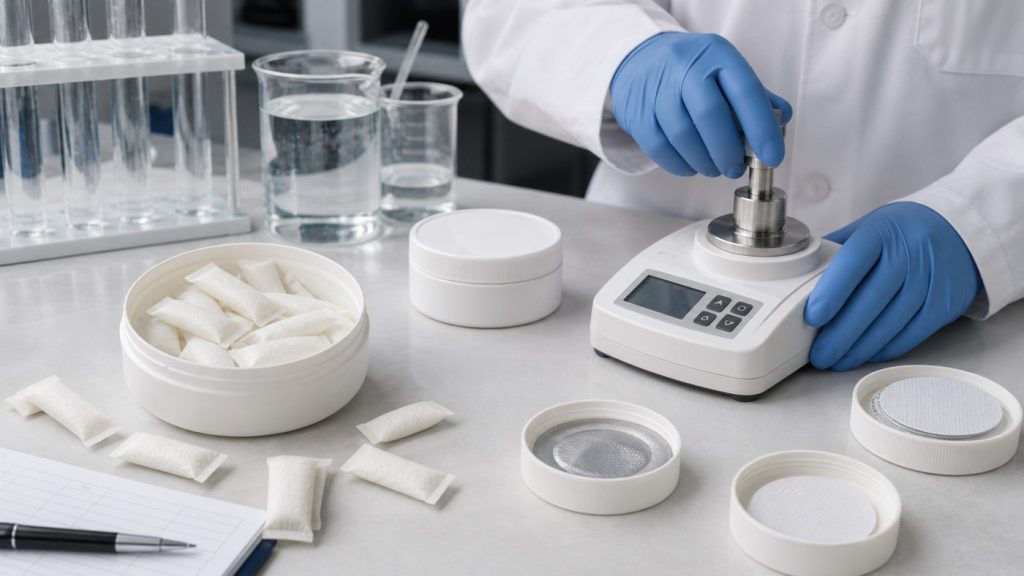
- Packaging lab photograph with torque tester, cans, liners and realistic pouches.
- Closure-control diagram linking torque, liner, leakage, aging and user opening.
Keep Torque Data with the Packaging Record
Closure results should stay with the batch packaging record, including cap lot, liner lot, filling-line speed and test temperature. That detail matters when one shipment opens normally and another feels unusually tight. Without the lot relationship, teams often blame the cap supplier while the real cause is a changed liner thickness or a warm can measured immediately after production.
Related manufacturing references
For a complete OEM review, connect this article with the main product and process pages. Buyers usually need category fit, stock-formula options, custom formulation support, process checks, and a direct project discussion before approving samples.
- Custom oral pouch manufacturing
- Stock formulation options
- Private label pouch project planning
- Formulation and R&D support
- Manufacturing process and quality checks
- Technical manufacturing blog
- Discuss a project
Content review note: technical articles are reviewed for functional oral pouch, ODF, packaging, and OEM procurement relevance.