
Primary target long-tail keyword: how to select pH buffer for functional oral pouch formulation
A buffer can make a pouch taste cleaner, protect an ingredient or keep an acid system from drifting. It can also create a sharp first minute, increase mineral aftertaste, pull moisture from the blend or change the way botanical color moves through the nonwoven.
The correct question is not which buffer is strongest. It is what pH range the finished pouch needs, how much buffering capacity is justified and whether the complete system remains comfortable and stable during the intended use time.
Start with the reason for controlling pH
Write the technical purpose before selecting salts. The project may need to reduce acid bite, support flavor consistency, limit ingredient degradation or control a finished-product specification. These goals do not require the same pH or buffer capacity.
Avoid adding a buffer because a competitor formula appears to contain one. A pouch with mild tea, xylitol and mint may perform well without a strong system, while a citrus botanical formula may need tighter control.
Measure the complete wet environment
Dry-blend pH alone has limited meaning. The pouch becomes a hydrated microenvironment during use. Define a repeatable extraction or wetting method, ratio, temperature and measurement time. Record whether the result is initial pH or an equilibrium value.
Different carriers absorb water at different rates. Two blends with identical ingredient lists can show different first-minute pH because cellulose grade, particle size and moisture changed.
Buffer capacity matters as much as the number
A pH reading shows the current condition. Buffer capacity describes resistance to change when acids or bases enter the system. A high-capacity formula can hold its target but may require enough salts to create chalkiness, irritation or flow problems.
Screen the lowest practical buffer level. Do not chase a precise decimal that has no sensory or stability benefit. Manufacturing tolerances and raw-material variation should be reflected in the acceptable range.
Check every active for compatibility
Vitamin C, mineral salts, tea extracts, caffeine systems and amino acids respond differently to pH. A range that helps one ingredient may accelerate color change or unpleasant taste in another. Review supplier stability information, then confirm in the finished pouch.
Botanical extracts are especially variable. Their carriers and residual minerals can shift the formula even when the marker assay is unchanged. Use production lots, not only a clean laboratory reference.
Expect flavor to change over time
Acid and buffer systems alter sweetness, cooling and bitterness. Citrus may become bright but metallic. Mint can feel harsher at the opening. Mineral buffers sometimes leave a dry finish that appears after the main flavor fades.
Run a timed sensory panel at one, five, ten and twenty minutes where appropriate. A sample approved from the first thirty seconds may become uncomfortable during the real use period.
Control particle size and premixing
Fine buffer salts can segregate from coarse carrier or create local high-pH pockets. Hygroscopic grades may clump during a long hopper hold. Match particle profiles where possible and use a controlled geometric premix for low additions.
Sample beginning, middle and end of filling. A passing mixer sample cannot show whether vibration moved the fine fraction toward the bottom of the hopper.
Watch moisture, flow and the seal area
Some salts change water binding and bulk density. A blend can flow well when fresh and become sticky after liquid flavor addition or humid exposure. Clumps affect fill weight and may smear into the heat-seal zone.
Run the intended formula at production speed. Record hopper residue, weight variation, powder leakage and aged seam strength. Hand-filled samples hide these process effects.
Condition the pouch in its final package
Test pH, flavor, texture, staining and active assay after storage in the actual can and liner. Carbon dioxide exchange, moisture movement and flavor migration can shift the system even when the initial blend was correct.
Include hot or humid conditions for relevant shipping routes. Accelerated results identify weak combinations but should be confirmed with real-time data before assigning a long shelf life.
Set a specification the factory can repeat
- Buffer grade and supplier
- Particle and moisture limits
- Addition order
- Target pH range
- Defined test method
- Blend hold time
- Timed sensory limits
- Active and color stability
- Change notification
Most small OEMs do not measure pouch pH continuously. The specification therefore needs an incoming-material plan, batch sampling and retained units. A new buffer grade or botanical carrier should trigger technical review rather than silent substitution.
When a commercial batch drifts, compare incoming buffer moisture, botanical lot, liquid-flavor addition, room humidity and blend hold time before changing the formula. Retest retained blend and finished pouches separately. This distinguishes a raw-material shift from package aging or an inconsistent laboratory extraction.
Questions Buyers Usually Ask
Does a higher pH make a functional pouch work faster?
Not automatically. Performance depends on the active, formula and evidence; a higher pH can also worsen taste or comfort.
Can pH be measured directly in a dry pouch?
A defined wet extraction or hydration method is normally needed so results are repeatable and comparable between batches.
Send the active system, flavor direction, moisture style and intended use time when reviewing pH control. LinkBioLabs can compare low-level buffer options before the commercial formula is fixed.
Recommended Blog Images
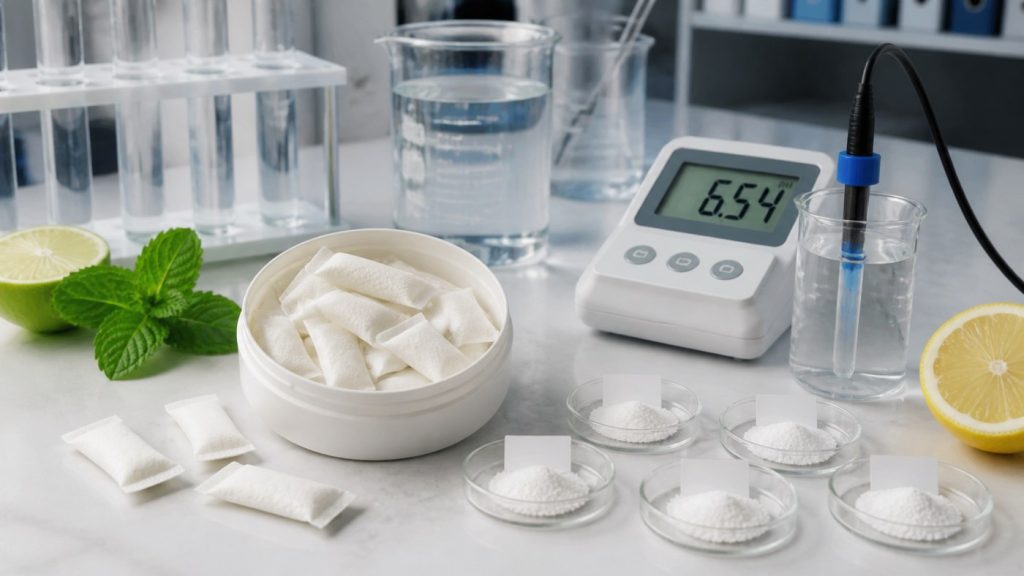
- Formulation lab photograph with pH meter, buffer samples, mint, citrus and realistic slim pouches.
- Decision graphic linking pH, buffer capacity, taste, active stability, moisture and production flow.
Related manufacturing references
For a complete OEM review, connect this article with the main product and process pages. Buyers usually need category fit, stock-formula options, custom formulation support, process checks, and a direct project discussion before approving samples.
- Custom oral pouch manufacturing
- Stock formulation options
- Private label pouch project planning
- Formulation and R&D support
- Manufacturing process and quality checks
- Technical manufacturing blog
- Discuss a project
Content review note: technical articles are reviewed for functional oral pouch, ODF, packaging, and OEM procurement relevance.