
Primary target long-tail keyword: how to select desiccant for dry functional oral pouch packaging
Adding a desiccant can protect a dry pouch from humidity, or it can over-dry the formula, weaken flavor and create a foreign-object complaint. The answer is not to place the largest sachet that fits inside the can.
Desiccant selection starts with the moisture load entering through materials, packaging and consumer opening. It ends with stability data from the final pack configuration.
Decide whether the formula needs one
Measure initial moisture and water activity where relevant, then study change in the closed can. A good closure and controlled filling room may provide enough protection for some dry formulas. Desiccant adds cost, space and handling risk.
Use it when data show moisture uptake threatens flow, texture, flavor or active stability. Do not add one only because tablets commonly use them.
Calculate the real moisture challenge
Consider moisture in pouches, headspace, plastic components, label, liner and air exchanged during filling. Add expected ingress through the closure and consumer opening. Tropical use creates a different load from an unopened room-temperature retain.
Pack count matters. A half-empty can near the end of use exchanges more humid air relative to the remaining product.
Compare desiccant chemistry
Silica gel, molecular sieve and other systems have different capacity and humidity response. The best choice depends on the target relative humidity, temperature and package period. Supplier capacity curves are more useful than a generic gram rating.
Confirm food-contact suitability and component documentation for the destination market. Color-changing indicators may not be appropriate for direct inclusion.
Choose a safe physical format
Sachets can resemble the product if size and color are poorly chosen. Canisters reduce confusion but occupy volume and can rattle. Both must resist tearing, dusting and compression during transport.
Use clear “do not eat” communication where required, while recognizing that printing is not the only control. Distinct shape, secure construction and packaging-line detection reduce risk.
Prevent direct sensory damage
An aggressive desiccant can make the pouch hard or delay flavor release. Volatile mint and citrus may also interact with the desiccant or its wrapper. The active remains acceptable while the consumer experience fades.
Run timed sensory testing after conditioning. Compare no desiccant, candidate sizes and a suitable control rather than assuming lower moisture is always better.
Validate packaging-line handling
Define insertion method, count verification and detection of missing or duplicate units. A desiccant placed under pouches may be missed by vision systems or create inconsistent can counts.
Check whether the can closes properly at maximum fill. Compressed pouches and a tilted canister can interfere with the liner or closure.
Study unopened and in-use packs
Unopened stability measures barrier performance. An in-use study opens cans on a schedule and removes one pouch. Record can and pouch weight, texture, clumping, aroma and closure condition.
A system that performs beautifully unopened can exhaust quickly during daily opening in humid weather. Pack count and serving direction belong in the study.
Do not use desiccant to hide poor controls
It cannot correct wet incoming carrier, uncontrolled room humidity, a leaking closure or a semi-moist formula designed to remain soft. Fix the main source before increasing desiccant.
Trend fill-room conditions and incoming moisture. Otherwise each batch gives the desiccant a different job and shelf-life results become difficult to interpret.
Lock the final configuration
- Desiccant type and supplier
- Unit weight or capacity
- Wrapper or canister construction
- Placement
- Count control
- Can and liner code
- Pack count
- Stability conditions
- Consumer warning
Treat a size, supplier or wrapper change as a packaging change. Repeat relevant moisture, sensory and handling checks before commercial use.
Plan desiccant shelf life before it reaches the line
Desiccant begins adsorbing moisture when its protective bulk package is opened. Define storage, resealing, exposure time and discard rules for the packaging room. A canister left in an open feeder during a humid shift may enter the product with less remaining capacity than the validation unit.
Monitor supplier lot, bulk-pack integrity and indicator controls where suitable. Do not dry or reuse units unless the supplier and approved process specifically support it. Reworked desiccant is difficult to trace and may shed dust.
Check consumer handling and complaint risk
Place the desiccant so it is visible enough to avoid accidental use but does not block pouch removal. Test can inversion and transport vibration. A torn sachet can distribute beads or dust throughout the product even when moisture control was technically effective.
Customer-service instructions should distinguish the desiccant from the functional pouch without making unsupported safety statements. Packaging design, count control and complaint response all belong in the final risk assessment.
Record desiccant presence during finished-can inspection and retain unopened controls from each packaging lot. When a humidity complaint appears, the retained can helps separate a missing unit, exhausted desiccant, closure leak and unusually wet incoming pouch batch.
Questions Buyers Usually Ask
Do all dry oral pouches need desiccant?
No. The decision should follow moisture-ingress, product-sensitivity and in-use data for the final package.
Can too much desiccant damage pouch quality?
Yes. Over-drying may harden the pouch, slow flavor release or change volatile flavor balance.
Provide initial moisture, pack count, can construction, climate and intended use period when evaluating desiccant. LinkBioLabs can compare practical configurations before packaging is purchased.
Recommended Blog Images
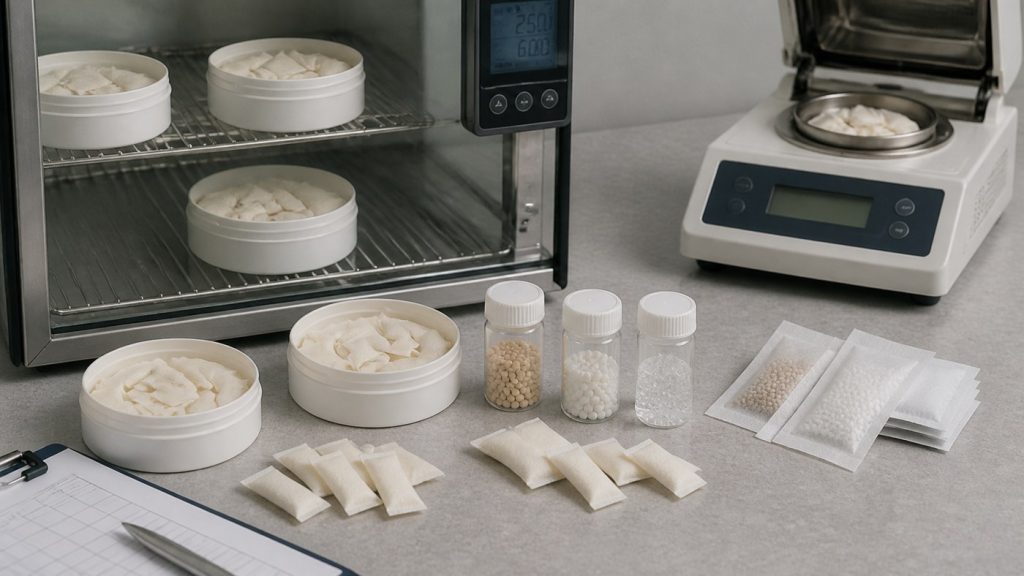
- Candidate desiccant sachets and canisters tested separately with dry pouches and final cans.
- Moisture-load diagram covering filling, package ingress and repeated consumer opening.
Related manufacturing references
For a complete OEM review, connect this article with the main product and process pages. Buyers usually need category fit, stock-formula options, custom formulation support, process checks, and a direct project discussion before approving samples.
- Custom oral pouch manufacturing
- Stock formulation options
- Private label pouch project planning
- Formulation and R&D support
- Manufacturing process and quality checks
- Technical manufacturing blog
- Discuss a project
Content review note: technical articles are reviewed for functional oral pouch, ODF, packaging, and OEM procurement relevance.