
Primary target long-tail keyword: botanical extract contaminant testing for private label oral pouches
A botanical certificate showing marker assay does not prove the material is suitable for an oral pouch. Extracts can carry heavy metals, microbial load, pesticide residues, residual solvents, undeclared carriers or substituted plant material. The small serving format does not remove those risks.
Testing should follow botanical identity, supply chain, extraction process, dose and destination market. Buying every possible panel wastes money; testing only the marker compound leaves predictable gaps.
Confirm identity before discussing strength
Document scientific name, plant part and extract description. Roots, leaves and seeds from the same plant can have different chemistry and regulatory status. Use an identity method appropriate to the processed material; highly extracted powders may no longer support simple visual or DNA confirmation alone.
Keep authenticated supplier documentation and a retained lot. A passing marker assay can still occur in an adulterated or substituted material.
Understand extract ratio and carrier
Extract ratio, marker standardization and carrier percentage describe different things. A 10:1 claim does not tell the buyer how much active marker is present or whether maltodextrin was added. Ask for the complete composition and processing aids relevant to labeling.
Carrier changes affect taste, bulk density, moisture and fill weight. A cheaper lot can meet the marker while occupying more pouch space.
Set heavy-metal limits by use and market
Botanicals accumulate metals differently according to soil and processing. Review lead, cadmium, arsenic and mercury as relevant. Specifications should reflect the finished daily intake and destination requirements, not a generic raw-material number copied from another category.
If a pouch contains several botanicals, calculate combined contribution. Passing ingredients can still create a finished-product concern when their limits are added.
Control microbial risk before blending
Test relevant microbial counts and specified organisms based on material risk. Dry powder is not sterile. A low-water-activity finished pouch cannot be expected to correct contaminated raw material.
Review sampling and treatment history. Heat or irradiation may change color and flavor, so the approved microbial strategy must also be evaluated sensorially.
Review pesticides from the source crop
The useful panel depends on plant, region, agricultural practice and market. A broad screen may be justified for unfamiliar suppliers; targeted testing can follow a well-characterized program later.
Do not rely only on an organic statement. Certification and analytical residue results answer related but different procurement questions.
Check residual extraction solvents
Ethanol, water and other solvents create different residual risks. Obtain the extraction process and set limits for relevant solvents. A supplier changing concentration equipment or solvent system should notify the manufacturer.
Solvent residue can also influence pouch odor and package headspace before reaching a formal safety limit. Include sensory review of incoming lots.
Look for adulterants and undeclared actives
High-value or performance-positioned botanicals carry substitution risk. Use supplier qualification, fingerprinting or targeted adulterant testing where appropriate. Unexpected pharmaceutical-like effects are not a marketing advantage; they are a serious quality event.
Investigate unusual color, odor, assay or consumer response. Do not release a lot because one headline marker passed.
Translate raw-material results into pouch risk
The extract may meet safety limits but still fail manufacturing through bitterness, hygroscopic clumping, fabric staining or segregation. Test the commercial lot in the formula and final can.
Sample beginning, middle and end when density differs from the carrier. Content uniformity is part of botanical control, not a separate machine problem.
Build a supplier-specific specification
- Identity and plant part
- Marker or assay range
- Carrier and extraction process
- Heavy metals
- Microbiological limits
- Relevant pesticides
- Residual solvents
- Particle and moisture controls
- Change notification
Review the specification when the source country, harvest, manufacturer or extraction site changes. Most botanical failures come from assuming the same name means the same material.
Set verification frequency from supplier performance
A new botanical source normally needs more intensive confirmation than a mature supplier with consistent history. Build a schedule for lot release, periodic full panels and triggered testing after source, harvest, process or manufacturing-site changes. Document the rationale instead of using “annual” as an automatic rule.
Trend results rather than filing each certificate separately. A gradual rise in microbial count, moisture or lead can remain within the limit while signaling deterioration in agricultural or processing control. Trending gives procurement time to investigate before a lot fails.
Supplier guarantees do not replace manufacturer responsibility for the finished product. Confirm that laboratory methods, sample identity and report units match the specification. A result copied into a different unit can create a false pass without any analytical error.
Review laboratory uncertainty when results sit close to a specification limit. Repeating a convenient test until one value passes is not a sound release strategy. Use an investigation plan, retained sample and supplier communication to decide whether the lot is representative and suitable.
Questions Buyers Usually Ask
Does a marker assay confirm botanical identity?
Not by itself. Identity needs an appropriate method and supply-chain evidence, especially for processed extracts.
Must every lot receive every contaminant panel?
The plan should be risk-based and compliant with the target market, combining supplier qualification, lot testing and periodic verification.
Send the botanical name, plant part, extract specification, dose and target market for a testing review. LinkBioLabs can align incoming controls with finished-pouch risks before purchasing volume.
Recommended Blog Images
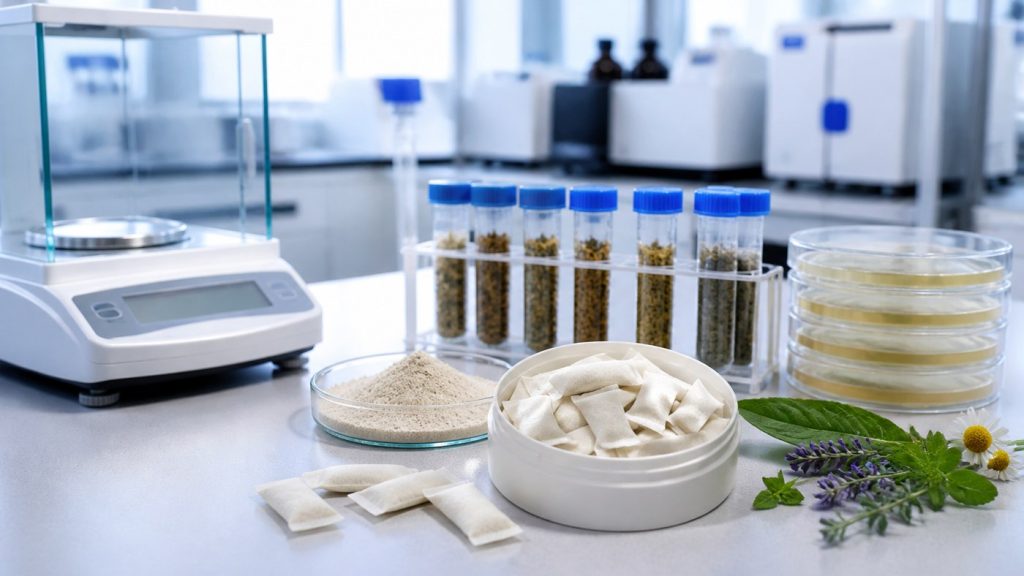
- Analytical lab scene with botanical lots, balance, closed culture plates and realistic pouches.
- Procurement checklist linking identity, metals, microbes, pesticides, solvents and formulation behavior.
Related manufacturing references
For a complete OEM review, connect this article with the main product and process pages. Buyers usually need category fit, stock-formula options, custom formulation support, process checks, and a direct project discussion before approving samples.
- Custom oral pouch manufacturing
- Stock formulation options
- Private label pouch project planning
- Formulation and R&D support
- Manufacturing process and quality checks
- Technical manufacturing blog
- Discuss a project
Content review note: technical articles are reviewed for functional oral pouch, ODF, packaging, and OEM procurement relevance.