
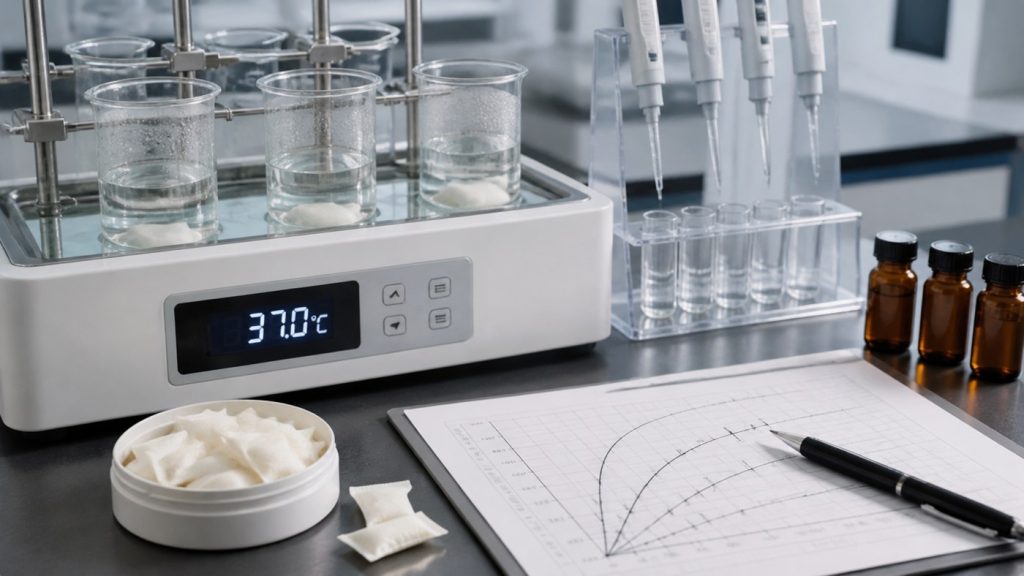
Primary target long-tail keyword: caffeine oral pouch release testing for OEM manufacturing
A pouch can contain the correct caffeine dose and still perform poorly. The active may release too slowly, spike during the first minutes or remain trapped in a dry carrier when the pouch is removed. Assay tells the buyer what is present. It does not describe how the formula behaves during use.
Release testing is a development comparison, not a shortcut to a clinical claim. Used correctly, it helps an OEM choose particle grade, carrier, moisture level and nonwoven fabric before the sensory profile is locked.
Define the question before selecting a method
Decide whether the study compares two caffeine sources, two fabrics, dry versus semi-moist formats or a proposed formulation change. A single curve with no reference does not tell the product team whether the result is good.
Write the target use time and sampling points in advance. A ten-minute energy pouch and a thirty-minute format require different observation windows. Do not stop sampling at five minutes because the first data look convenient.
Control the caffeine starting material
Record caffeine source, assay, particle distribution and supplier grade. Fine anhydrous caffeine, granulated caffeine and standardized guarana do not disperse through the pouch at the same rate. Guarana also contributes carrier and tannins that affect wetting.
If a supplier changes milling or extraction carrier, repeat the relevant comparison. The ingredient name may stay unchanged while the release curve and bitterness move noticeably.
Fabric is part of the delivery system
Nonwoven pore structure controls liquid entry and dissolved-material movement. A soft dense grade may improve comfort but delay wetting. An open grade releases quickly yet allows fine powder to escape into the can.
Test the production fabric after conditioning with the actual formula. Hand-made pouches from laboratory filter material are not representative. Include seam width and finished dimensions because usable surface area changes the result.
Moisture changes the first minutes
Semi-moist pouches normally wet faster and produce an earlier flavor response. Dry blends need saliva entry before caffeine dissolves. Humectants can improve softness but also move flavor into the liner or alter aged seal strength.
Measure total moisture and water activity where relevant. Two formulas with the same water percentage can behave differently because polyols, salts and fibers bind water differently.
Use repeatable laboratory conditions
Control medium volume, temperature, agitation, pouch orientation and sampling replacement. Small changes create large differences when the test contains one small pouch. Document the method well enough for another analyst to repeat it.
Run multiple units, not one attractive curve. Individual fill weight and caffeine content should be known so variation is not mistaken for release behavior.
Pair analytical data with timed sensory work
A fast caffeine curve does not guarantee a good consumer experience. It may arrive with harsh bitterness, cooling overload or powder leakage. Score wetting, flavor, bitterness, astringency and mouthfeel at matching time points.
We have seen buyers prefer the fastest laboratory result, then reject the sample because the first minute felt aggressive. The practical target is controlled performance, not the steepest line.
Do not turn the result into an absorption claim
An in-vitro release test measures movement under laboratory conditions. It does not prove faster absorption, faster energy or superior bioavailability in people. Those claims require a different evidence package.
Use restrained language in technical files and marketing. The curve can support formulation selection and batch comparison without becoming a medical promise.
Build a useful change-control test
Once a formula is approved, a simplified release comparison can help assess new fabric, carrier or caffeine lots. Define reference batches and an acceptable profile range rather than expecting identical points.
Investigate shifts together with assay, fill weight, moisture and sensory data. A slower curve may come from aging or packaging moisture drift, not only the active ingredient.
Set the commercial specification carefully
- Caffeine source and grade
- Finished pouch dimensions
- Fabric grade
- Moisture condition
- Sampling times
- Replicate count
- Assay correction
- Reference profile
- Sensory checkpoints
Most small OEMs do not run release testing on every batch. Buyers should understand whether the method is a development tool, a validation study or a routine release requirement before adding cost to each order.
Read aged release together with flavor loss
Repeat the comparison after selected stability intervals. A dry pouch may absorb moisture and release faster, while a semi-moist pouch may lose water and slow down. Fabric staining or a hardened fill can change the curve even when caffeine assay remains acceptable.
Use the same conditioned cans for analytical and timed sensory review where sample planning allows. If release remains similar but bitterness increases, the likely problem is flavor degradation rather than caffeine movement. That distinction determines whether the team changes carrier, package or masking system.
Keep fresh reference material and document package opening. Comparing a freshly opened retain with a repeatedly opened can creates an in-use question, not a pure shelf-age comparison.
Questions Buyers Usually Ask
Does faster pouch release mean faster caffeine absorption?
No. Laboratory release does not establish human absorption or performance without product-specific clinical evidence.
Should release testing replace content uniformity?
No. Content uniformity measures dose consistency; release testing examines how the formulated pouch behaves under defined conditions.
Provide the caffeine source, target dose, use time, moisture style and fabric when requesting a comparison. LinkBioLabs can design a focused release study before commercial specifications are fixed.
Recommended Blog Images
- Laboratory release vessels, timed sampling and realistic slim caffeine pouches.
- Comparison curve showing controlled, delayed and overly rapid release profiles without marketing claims.
Related manufacturing references
For a complete OEM review, connect this article with the main product and process pages. Buyers usually need category fit, stock-formula options, custom formulation support, process checks, and a direct project discussion before approving samples.
- Custom oral pouch manufacturing
- Stock formulation options
- Private label pouch project planning
- Formulation and R&D support
- Manufacturing process and quality checks
- Technical manufacturing blog
- Discuss a project
Content review note: technical articles are reviewed for functional oral pouch, ODF, packaging, and OEM procurement relevance.