
Primary target long-tail keyword: oral pouch ingredient supplier change control requirements
An ingredient can keep the same common name and still change the finished pouch. A new cellulose grade alters flow. A botanical extract arrives darker and more hygroscopic. A flavor supplier changes its carrier. The certificate looks acceptable, but the seam, taste or stability no longer behaves the same.
Change control turns a purchasing substitution into a documented technical decision. It protects repeatability without forcing every small change through a full development project.
Define what counts as a change
Supplier, manufacturing site, grade, carrier, extraction solvent, particle specification, concentration, packaging and shelf life can all matter. For nonwoven, include fiber construction, basis weight, sealing layer and slit width.
Write the notification requirement into purchasing specifications. If the only control is an ingredient name on the purchase order, procurement may accept an equivalent that formulation has never evaluated.
Risk-rank materials by finished-product impact
High-risk materials include low-dose actives, botanical extracts, flavors, humectants, critical carriers and nonwoven fabric. A change can affect dose, mouthfeel, color, flow, water activity or seal strength.
Lower-risk materials still need identity and compliance review, but testing can be proportionate. The goal is not identical paperwork for every supplier; it is evidence matched to the failure the material could create.
Compare specifications beyond the COA
Certificates report selected tests. They may not show particle distribution, bulk density, flavor carrier, color tolerance or hygroscopic behavior. Ask for technical data, food-contact or market documentation and a statement of manufacturing differences.
For botanicals, compare plant part, extract ratio or marker, solvent, carrier and contaminant controls. Two extracts with the same caffeine or polyphenol assay can taste and flow very differently.
Run a focused bench comparison
Use the current approved lot as a control. Compare appearance, odor, sieve behavior, bulk density, wetting and compatibility with the real formula. For flavor, run coded timed sensory work rather than smelling bottles.
Small trials should use the proposed commercial grade. A supplier sample made for sales may not represent routine production. Record lot number and keep a retained portion.
Test the process failure most likely to move
A new fine active needs blend and content-uniformity work. A carrier grade needs flow and fill-weight study. A flavor carrier needs hold-time, seal and stability checks. New nonwoven requires lint, tracking, powder retention and aged sealing.
Do not repeat every test by habit while missing the relevant one. A full assay panel will not reveal that fabric sheds fibers onto an optical sensor or that citrus oil migrates into the liner.
Use a representative line where needed
Hand-filled pouches cannot approve a material whose main risk appears at speed. Run enough material to observe hopper behavior, dust, machine stops, seal contamination and yield. Sample across time.
If the alternate source is approved only for emergencies, define its qualified batch size and any extra incoming checks. Emergency status should not become permanent silent use.
Review stability and claims impact
A change in extract carrier, flavor solvent or moisture profile can alter shelf life. Start targeted accelerated and real-time comparisons in the final package. Look at flavor, clumping, staining, water activity and seam behavior as well as active assay.
Check whether label declarations, allergen statements, country-of-origin language or botanical claims need revision. Packaging inventory can become unusable even when the formula still performs.
Approve, reject or conditionally qualify
Document the decision, supporting results, effective lot and any restrictions. Conditional approval might require tighter incoming moisture, a shorter hold time or added beginning-to-end sampling for initial batches.
Update formula records, specifications, approved-supplier lists and purchasing codes together. If one system still points to the old grade, warehouse or procurement can undo the technical decision.
Retain evidence for future investigations
Keep supplier documents, comparison samples, trial records and finished-product retains. Record why the change was made, including availability or cost. Months later, a flavor complaint may be the first sign of a subtle difference.
Most small OEMs rely too heavily on staff memory. A concise change file is faster than reconstructing emails after a failure and gives procurement a clear boundary for the next order.
Qualify a second source before the emergency
Waiting for a stockout removes the time needed for technical comparison. For critical actives, flavors, carriers and fabric, identify a potential alternate while the approved source is available as a control. Obtain routine-production samples rather than specially prepared sales material.
A second source does not have to be active on every order. Keep its approval status, retest interval and minimum evidence current. When supply fails, procurement can follow a controlled path instead of asking the line to run an unknown material against a shipping deadline.
Questions Buyers Usually Ask
Does a matching COA prove two ingredients are equivalent?
No. Relevant particle, carrier, sensory, flow and stability characteristics may not appear on the COA.
Does every supplier change require full shelf-life testing?
Not always. Testing should be risk-based, but changes affecting moisture, flavor, actives, fabric or packaging commonly need targeted stability comparison.
For an alternate-source review, provide both specifications, recent COAs, the reason for change and the finished formula. LinkBioLabs can define the smallest defensible comparison before the new lot enters production.
Recommended Blog Images
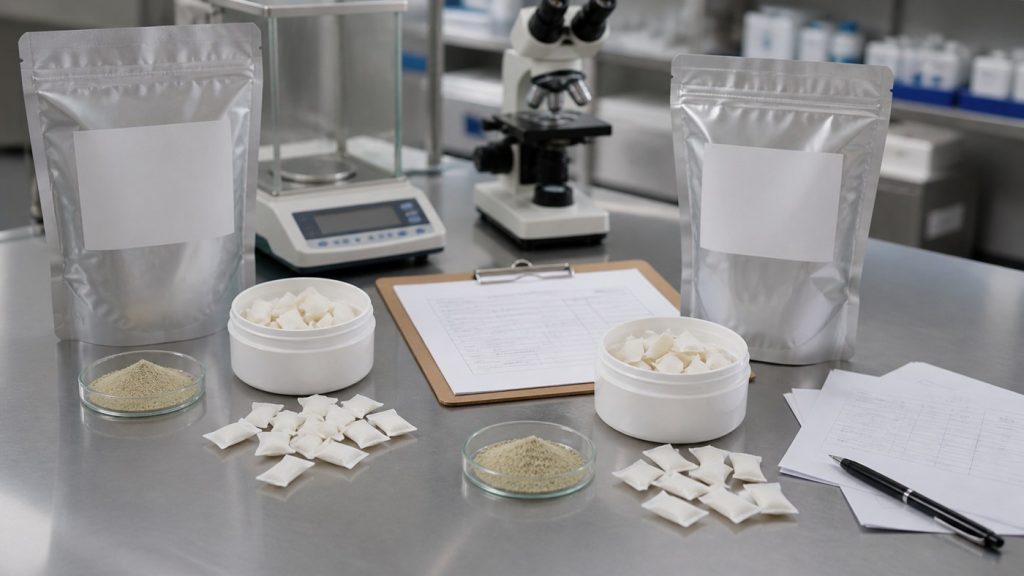
- Side-by-side supplier lots with blank bags, documents, laboratory tools and finished pouches.
- Risk matrix linking material changes to dose, flow, taste, seams, stability and label review.
Related manufacturing references
For a complete OEM review, connect this article with the main product and process pages. Buyers usually need category fit, stock-formula options, custom formulation support, process checks, and a direct project discussion before approving samples.
- Custom oral pouch manufacturing
- Stock formulation options
- Private label pouch project planning
- Formulation and R&D support
- Manufacturing process and quality checks
- Technical manufacturing blog
- Discuss a project
Content review note: technical articles are reviewed for functional oral pouch, ODF, packaging, and OEM procurement relevance.