
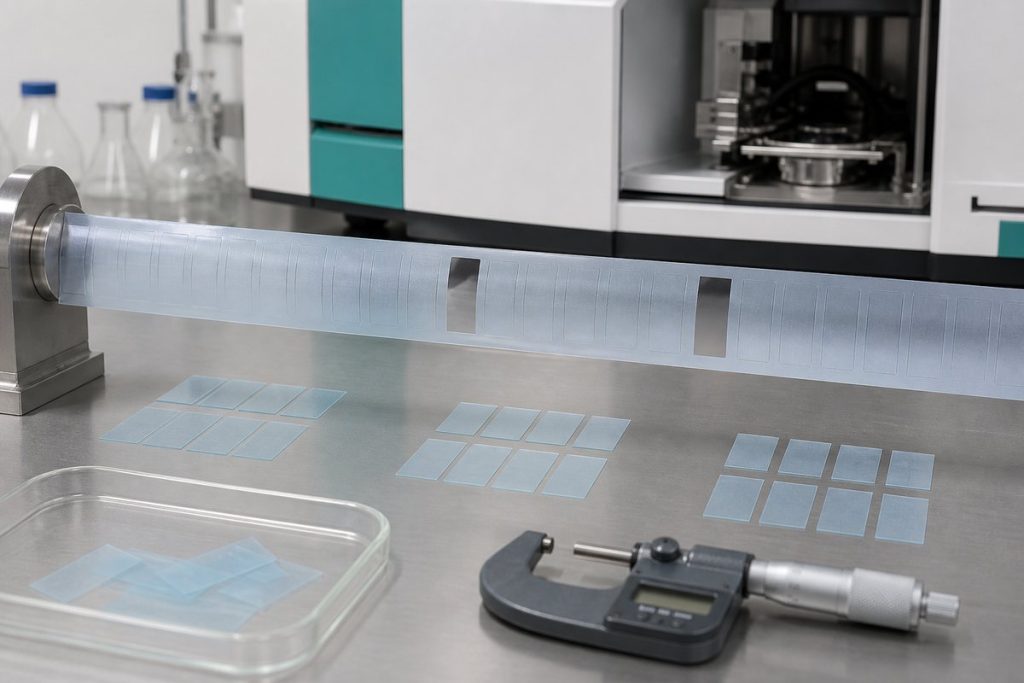
An ODF roll can look uniform while containing meaningful differences from one position to another. Film thickness, ingredient distribution and drying conditions may vary across the web or over the length of a run. For a brand, the practical question is not whether the average assay passes. It is whether individual cut films represent the intended specification consistently.
Content uniformity should therefore be discussed before the pilot batch, not added as a certificate line after production. The formula, mixing process, casting setup, sampling map and analytical method all contribute to the answer.
Begin With the Casting Solution
Uniform finished films start with a stable, homogeneous casting solution or dispersion. Ingredient solubility, particle size, polymer hydration, viscosity, mixing order, temperature, entrained air and hold time can affect distribution. If the active settles, floats, agglomerates or changes during the coating window, downstream sampling will reveal a process problem rather than fix it.
Ask how homogeneity is confirmed before casting and how long the prepared solution may be held. Samples from the top of a vessel alone may miss settling near the bottom. Recirculation or continued mixing must be designed around the formulation rather than used automatically.
Map Samples Across and Along the Web
A single center sample cannot show what happens near both edges, during startup or after an interruption. A useful sampling plan identifies positions across the coating width and points along the production run. It also records which roll section produced each test unit so an unfavorable result can be traced and contained.
- Left, center and right positions across the web
- Startup, steady-state and end-of-run material
- Samples before and after documented adjustments
- Defined roll or reel identifiers
- Cut-unit orientation and dimensions
- Retention of representative finished sachets
Thickness Is a Clue, Not a Substitute for Assay
Thickness or mass per area can reveal coating variation and provides fast process information. It does not prove chemical uniformity when an ingredient is unevenly dispersed. Use dimensional measurements alongside a validated or otherwise appropriate assay method selected for the active system and product category.
Open-access ODF literature lists size, thickness, assay and content uniformity among important quality attributes. The review Orodispersible Films: Current Innovations and Emerging Trends also notes USP <905> as a pharmaceutical reference point. Whether that standard applies to a specific commercial project depends on its regulatory category and market.
Scale-Up Can Change the Pattern
Laboratory films are often cast in small areas, while commercial equipment introduces a wider web, longer drying path and changing material volume in the feed system. Temperature distribution, line speed and coating behavior can create variations that were absent from hand-cast samples.
Research on ODF transfer from laboratory to continuous manufacturing found that processing conditions affected film characteristics, including drug content. This is why a pilot roll needs its own sampling plan rather than relying on laboratory data.
Agree on Method and Acceptance Before Testing
The specification should state the analytical method or reference, sample preparation, number and location of units, calculation, acceptance rule and handling of atypical results. If testing is outsourced, record the laboratory, sample identifiers and chain of custody. A buyer should be able to connect the reported result to a defined section of the batch.
Investigate Trends, Not Only Failures
Results can remain within a broad limit while drifting from left to right or from the beginning to the end of a roll. Trend review may reveal settling, drying imbalance or feed changes before a batch fails. The manufacturer should define who reviews the pattern and what material is placed on hold during an investigation.
Questions for the ODF Manufacturer
- How is casting-solution homogeneity maintained and documented?
- Which web locations and production times are sampled?
- Are thickness and assay results evaluated together?
- Which method and acceptance criteria apply to this product?
- How are startup, shutdown and adjusted material segregated?
- What happens when a result is atypical or out of specification?
- Which results appear on the batch COA?
LinkBioLabs supports ODF formulation and manufacturing development from casting trials through cutting, sachet packaging and scale-up. Share the active system, target film dimensions, regulatory route, batch size and testing expectations through our contact page to define a project-specific quality plan.
Related manufacturing references
For a complete OEM review, connect this article with the main product and process pages. Buyers usually need category fit, stock-formula options, custom formulation support, process checks, and a direct project discussion before approving samples.
- Custom oral pouch manufacturing
- Stock formulation options
- Private label pouch project planning
- Formulation and R&D support
- Manufacturing process and quality checks
- Technical manufacturing blog
- Discuss a project
Content review note: technical articles are reviewed for functional oral pouch, ODF, packaging, and OEM procurement relevance.