
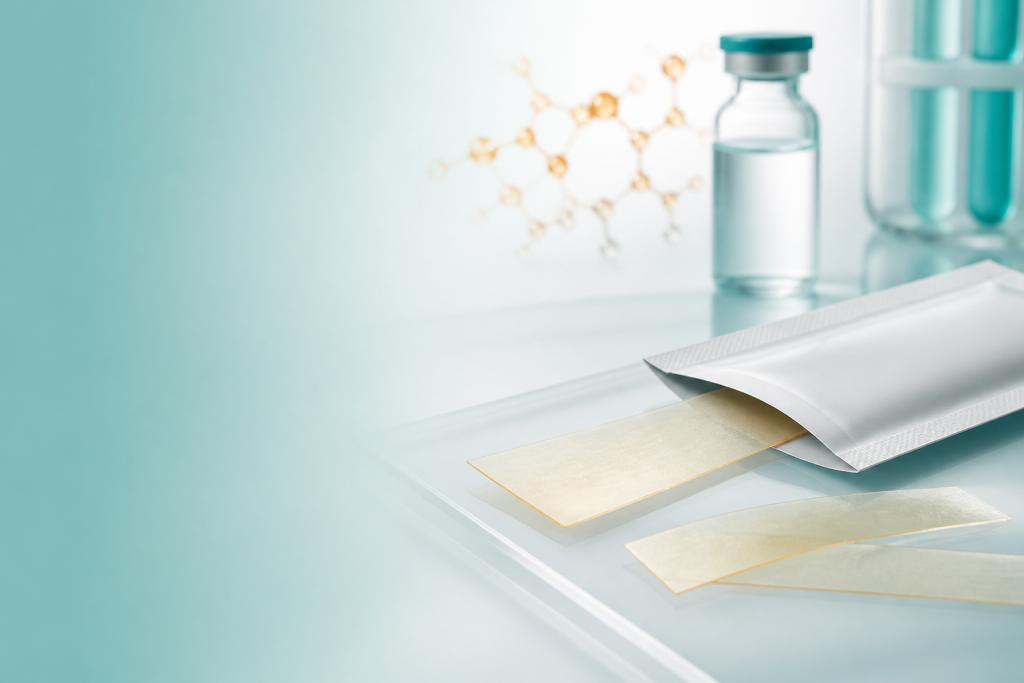
How to Specify a Caffeine ODF Manufacturing Project
A useful caffeine orodispersible film request describes the target market, active specification, film format, sensory direction, packaging and evidence needs before prototype work starts.
1. Start with the destination market
Country and sales channel determine the regulatory questions that should be answered first. Define whether the product is intended as a food supplement, functional product or another category, then review permitted caffeine levels, labeling language and age or warning requirements.
2. Write a measurable film brief
Specify target active amount per film, film dimensions, acceptable weight and thickness ranges, appearance, flavor direction and packaging format. Avoid using terms such as “fast” or “strong” without a measurable test or agreed sensory scale.
Core request-for-quote fields
- Destination country and intended product category.
- Target caffeine specification per individual film.
- Preferred film length, width, thickness and color.
- Flavor, sweetness and cooling direction.
- Individual sachet and carton requirements.
- Forecast volume, launch timing and required documents.
3. Account for caffeine taste and film mechanics
Caffeine can challenge taste masking and active loading. Increasing solids may change viscosity, casting behavior, drying, flexibility and dispersion. Prototype rounds should assess the complete system rather than optimizing flavor or film strength in isolation.
4. Define finished-unit controls
A commercial specification may include appearance, average weight, weight variation, thickness, active-content uniformity, moisture or water activity, mechanical handling and a justified dispersion method. The final set depends on the formula, market and quality plan.
5. Select packaging with stability in mind
Thin films can be sensitive to humidity and handling. Evaluate sachet barrier, seal integrity, carton configuration and distribution climate together. Stability work should use the final commercial packaging, not only bulk film samples.
6. Ask for a scale-up plan
Bench prototypes do not automatically predict commercial casting and cutting. Agree how critical process parameters, in-process checks, yields and deviations will be handled during pilot and production transfer.
Questions to send LinkBioLabs
- Which caffeine forms are compatible with the proposed matrix?
- What active loading is feasible without compromising film handling?
- Which finished-product methods will be used?
- What sachet barrier is proposed for the destination climate?
- What information is needed before sample pricing?
Related manufacturing references
For a complete OEM review, connect this article with the main product and process pages. Buyers usually need category fit, stock-formula options, custom formulation support, process checks, and a direct project discussion before approving samples.
- Custom oral pouch manufacturing
- Stock formulation options
- Private label pouch project planning
- Formulation and R&D support
- Manufacturing process and quality checks
- Technical manufacturing blog
- Discuss a project
Content review note: technical articles are reviewed for functional oral pouch, ODF, packaging, and OEM procurement relevance.